Robotics simulation assets
Create object assets and articulated structures intended for physics-based environments such as Isaac Sim.
Independent tool overview
Seed3D is ByteDance's 3D-generation model family for creating high-fidelity assets, materials, articulated objects, and simulation-oriented scenes.
Visit the official Seed 3D site ↗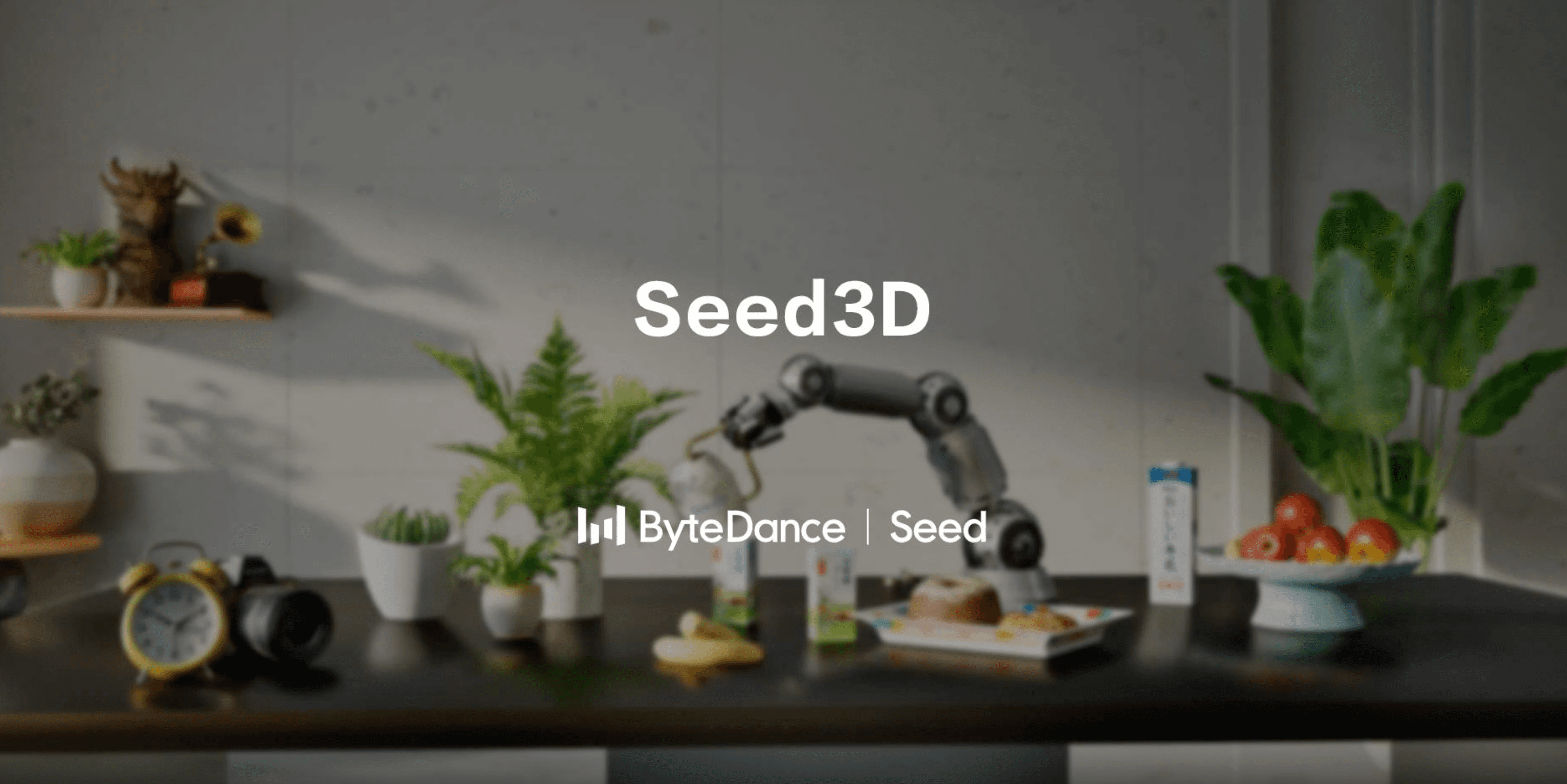
Overview
Seed3D began as an image-to-3D research system for turning a single reference image into a textured asset designed for physics engines and embodied-AI simulation. It generates geometry and physically based rendering materials rather than only a viewable 3D approximation.
Seed3D 2.0 is the current generation. ByteDance rebuilt the geometry pipeline around coarse and fine stages, unified PBR-material generation, and added part-level decomposition, articulation, and scene composition. These additions make the model more relevant to robotics, game production, industrial visualization, and world-simulation research.
The technical reports are public, but Seed3D is not presented as a downloadable open-weight model. ByteDance provides access to Doubao-Seed3D-2.0 through the Volcano Engine Ark experience center and API.
Use cases
The strongest fit depends on the job you need the product to complete, not the size of its feature list.
Create object assets and articulated structures intended for physics-based environments such as Isaac Sim.
Generate textured objects, separable functional parts, and scene components that artists can refine for real-time use.
Reconstruct reference objects where geometric detail and consistent PBR material behavior matter.
Scale the creation of varied objects and environments for training and evaluating agents in world simulators.
Capabilities
Seed3D 2.0 separates overall structure generation from high-frequency detail recovery to better preserve sharp edges, thin walls, and complex topology.
A single material model produces multi-view albedo and metallic-roughness information for more physically consistent appearance under changing light.
The system can segment an object into functional pieces and complete the geometry of individual parts for editing or interaction.
It can infer kinematic components, joint types, axes, and motion ranges, then produce structured output such as URDF for compatible simulators.
Seed3D can reason about layouts from text or visual inputs, generate objects, and assemble them into coherent multi-object environments.
Doubao-Seed3D-2.0 is available through Volcano Engine Ark for interactive evaluation and programmatic generation.
Process
Step 1
Use a clean image or supported set of visual references with a clearly visible object, consistent lighting, and minimal occlusion.
Step 2
Select Doubao-Seed3D-2.0 in Volcano Engine's 3D-generation experience or submit a task through the Seed3D API.
Step 3
Check silhouettes, thin structures, hidden surfaces, UVs, PBR maps, scale, and whether the generated material behaves correctly under new lighting.
Step 4
Use the part and joint capabilities when the object needs independent pieces, motion, or URDF-based simulation.
Step 5
Import the result into the target DCC tool, game engine, or simulator and test collisions, mass, joints, performance, and visual fidelity before production use.
Cost
Seed3D 2.0 is available through Volcano Engine Ark's experience center and API. ByteDance does not publish a simple consumer subscription or a clearly listed English per-generation price on the Seed3D product page, so cost depends on the active Volcano Engine account and usage terms.
Free to read
The Seed3D 1.0 and 2.0 technical reports and project information are publicly available.
Account-dependent
Evaluate Doubao-Seed3D-2.0 through the Volcano Ark visual-model experience center.
Usage-based
Create 3D-generation tasks programmatically through Volcano Engine.
Pricing checked . Check current pricing at the source ↗
Assessment
Compare
The right alternative depends on the specific output, workflow, controls and budget your project requires.
Design
A creator-friendly image and text-to-3D platform with a more conventional web product and downloadable asset workflow.
Explore Rodin →Design
A commercial 3D generator suited to fast asset creation through web and API interfaces.
Explore Tripo AI →Design
Tencent's professional 3D model family is worth comparing for geometry, topology, and production-oriented game assets.
Explore Hunyuan 3D Smart Topology (PolyGen) →Questions
Seed3D is ByteDance Seed's model family for generating high-fidelity 3D assets and simulation-oriented content. It creates geometry and PBR materials and has expanded into parts, articulation, and scene composition.
Version 2.0 adds a two-stage geometry pipeline, a unified PBR-material model, better fine-detail reconstruction, part-level generation, articulated objects, and multi-object scene creation.
Yes. ByteDance says Doubao-Seed3D-2.0 is available in the Volcano Engine Ark experience center and through its Seed3D API.
The research papers and project information are public, but ByteDance does not list official downloadable model weights for Seed3D 2.0. Access is provided through Volcano Engine.
That is the system's intended use, and it includes PBR materials, parts, articulation, and URDF-compatible output. Teams should still validate geometry, collisions, mass, joints, scale, and engine compatibility before using an asset in a simulation.
ByteDance does not publish a simple consumer price on the Seed3D page. Interactive and API access run through Volcano Engine, so users should confirm current trial allowances and usage-based charges in their account.
Bottom line
Seed3D 2.0 stands out for treating 3D generation as a simulation and production problem rather than only a visual novelty. Its PBR, part, articulation, and scene capabilities are promising for robotics and interactive content, but it is best evaluated as a hosted technical platform: access, regional support, cost, and downstream asset cleanup all need to be tested against the intended pipeline.
Visit Seed 3D website ↗
ElevenLabs UI - A collection of open Source agent and audio components for AI audio & voice agents
.jpeg)
Nano Banana Pro - Google's image generation model with unprecedented control, improved text rendering and enhanced world knowledge.

Reve - Free, high-quality AI image generator

Stitch - Google's experimental tool for turning ideas into UI designs for mobile and web applications

Get access to all our AI courses, hundreds of real-world AI use cases, live expert-led workshops, an exclusive network of AI early adopters, and more.
Get unlimited access to all of our current & upcoming industry-specific AI courses for the duration of your subscription.
To keep up with the rapid pace of AI, our team publishes AI implementation guides daily. Our library contains 300+ practical use cases to automate real-world work.
Join weekly, live, interactive sessions with industry leaders who are at the forefront of AI for hands-on implementation guidance and exclusive insights.
Network with an exclusive community of AI-first professionals who are working smarter with AI. Learn how early adopters are using AI in their work and businesses.