Text-heavy visual drafts
Designers creating posters, infographics, covers, menus, or social graphics where readable Chinese or English text and layout matter.
Independent tool overview
ERNIE-Image is Baidu's 8B open-weight text-to-image model for instruction-heavy visuals, multilingual text rendering, posters, comics, and structured layouts. The Apache 2.0 weights can run locally on a 24GB GPU; choose the 50-step base model for fidelity or the distilled 8-step Turbo checkpoint for speed.
Visit the official Ernie Image site ↗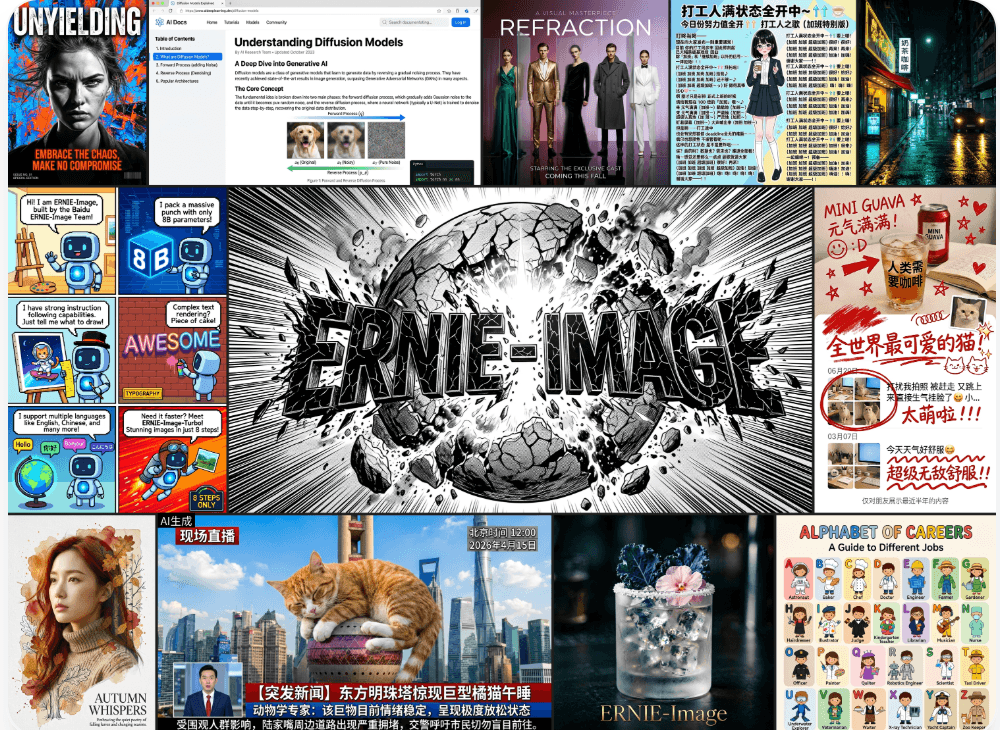
Overview
ERNIE-Image uses an 8-billion-parameter single-stream Diffusion Transformer inside a latent-diffusion pipeline. A lightweight Prompt Enhancer can expand short prompts into more structured descriptions before generation, helping with relationships, composition, text, and style—but it may also introduce details the user did not request, so compare it on and off for strict brand work.
Baidu publishes two checkpoints. The base SFT model normally runs for 50 inference steps and prioritizes general quality and instruction fidelity. ERNIE-Image-Turbo uses distribution-matching distillation and reinforcement learning to generate in eight steps with better speed and strong aesthetics, at some benchmark tradeoff depending on the task.
The model card emphasizes Chinese and English text rendering, complex object relationships, posters, infographics, comics, storyboards, and multi-panel compositions. Baidu reports leading open-weight results on GenEval, OneIG-EN, OneIG-ZH, and LongTextBench, but those are first-party evaluations; production teams should test spelling, layout, brand consistency, anatomy, diversity, and prompt adherence on their own assets.
The Hugging Face checkpoints are labeled Apache 2.0, which generally permits commercial use under the license, while Baidu's showcase page says its displayed examples are for demonstration and non-commercial personal derivative creation. That restriction applies to reusing the showcased examples, not a blanket replacement for the model-card license. Teams still need legal review for trademarks, likenesses, copyrighted prompts or references, training-data concerns, and the rights status of each output.
Use cases
The strongest fit depends on the job you need the product to complete, not the size of its feature list.
Designers creating posters, infographics, covers, menus, or social graphics where readable Chinese or English text and layout matter.
Creators testing comics, storyboards, multi-panel narratives, and scenes with multiple objects and explicit spatial relationships.
Technical teams that want open weights, local inference, adapters or fine-tuning, and control over deployment instead of a closed image API.
Capabilities
Designed for dense, long-form, and layout-sensitive text in Chinese, English, and additional languages.
Handles multi-object descriptions, spatial relationships, and knowledge-rich prompts better than many smaller open-weight baselines in Baidu's tests.
Targets posters, UI-like visuals, comics, storyboards, and multi-panel arrangements where organization matters.
Expands terse prompts into detailed structured instructions and can be enabled or disabled at inference time.
Lets teams trade the base model's 50-step instruction fidelity for Turbo's faster eight-step generation.
Official examples cover Hugging Face Diffusers and SGLang, with safetensors weights and common preset resolutions.
Process
Step 1
Start with Turbo for interactive drafts and base for final-quality comparisons; evaluate both on the same seed and prompt set.
Step 2
Pin model and library versions, verify checkpoint provenance, budget VRAM and storage, and do not expose a local generation server without authentication.
Step 3
Specify subject, relationships, exact visible text, layout, style, lighting, and exclusions; test with and without Prompt Enhancer.
Step 4
Zoom in on spelling, faces, hands, logos, small objects, panel order, cultural context, and accidental resemblance before publication.
Step 5
Save prompts, seeds, checkpoint versions, edits, approvals, and source assets; run moderation and legal review appropriate to the use case.
Cost
Baidu provides the ERNIE-Image and ERNIE-Image-Turbo weights for download under Apache 2.0 with no model license fee listed. Running them is not cost-free: local GPU hardware, electricity, storage, engineering, moderation, and any hosted inference provider are separate. The official model card exposes third-party deployment options whose usage prices can change, so compare cost per accepted image rather than raw generation count.
Free weights; infrastructure extra
Apache 2.0 ERNIE-Image checkpoint for higher-fidelity 50-step generation.
Free weights; infrastructure extra
Distilled ERNIE-Image-Turbo checkpoint for eight-step generation.
Provider-specific
Third-party demos and inference providers can run the checkpoints without local GPU ownership.
Pricing checked . Check current pricing at the source ↗
Assessment
Compare
The right alternative depends on the specific output, workflow, controls and budget your project requires.
Design
Consider Qwen Image 2.0 for another Chinese-developed visual model with generation and editing workflows and strong text rendering.
Explore Qwen Image 2.0 →Content Creator
Consider FLUX 3 when a newer Black Forest Labs model and hosted early-access workflow are preferable to self-hosting ERNIE-Image.
Explore FLUX 3 →Design
Consider PromeAI when designers want a packaged web product with specialized architecture and creative workflows instead of managing model infrastructure.
Explore PromeAI →Questions
The official model weights are downloadable under Apache 2.0 without a listed license fee. You still pay for local or hosted compute, storage, engineering, and operational safeguards.
The official Hugging Face model cards label the weights Apache 2.0, which permits commercial use subject to the license. This does not clear rights in prompts, reference assets, trademarks, people, or outputs; obtain legal review for material commercial use.
The base SFT checkpoint typically uses 50 inference steps and prioritizes general quality and instruction fidelity. Turbo is distilled and optimized to generate in eight steps, trading some task-dependent fidelity for much faster output.
Baidu says the model can run on consumer hardware with 24GB of VRAM. Actual memory depends on resolution, batch size, precision, attention implementation, offloading, and the software stack.
Text rendering is one of its stated and benchmarked strengths, especially for Chinese and English. Always proofread every character and move final copy into a conventional design tool when exact typography is mandatory.
Do not assume so. Baidu says the displayed examples demonstrate capabilities and do not imply commercial use or endorsement; create your own outputs and respect the stated example restrictions and third-party rights.
Bottom line
ERNIE-Image is a compelling open-weight option for teams that care about multilingual typography, structured composition, and local control. The base/Turbo split is practical, and the 24GB target lowers the deployment barrier. It is not a turnkey creative suite, however: organizations must supply infrastructure, evaluation, moderation, provenance, and rights review. Test both checkpoints and Prompt Enhancer settings on real brand layouts before choosing it for production.
Visit Ernie Image website ↗
HeyGen CLI - Agent-first tool for generating and shipping videos from the terminal

Happy Horse - Alibaba's new SOTA AI video model

Avatar V - HeyGen's new AI avatar model that generates studio-quality, hyperrealistic videos from a 15-second clip

Echo-2 - SpAItial's SOTA text-to-3D world model with real-time browser rendering

Get access to all our AI courses, hundreds of real-world AI use cases, live expert-led workshops, an exclusive network of AI early adopters, and more.
Get unlimited access to all of our current & upcoming industry-specific AI courses for the duration of your subscription.
To keep up with the rapid pace of AI, our team publishes AI implementation guides daily. Our library contains 300+ practical use cases to automate real-world work.
Join weekly, live, interactive sessions with industry leaders who are at the forefront of AI for hands-on implementation guidance and exclusive insights.
Network with an exclusive community of AI-first professionals who are working smarter with AI. Learn how early adopters are using AI in their work and businesses.