Difficult web research
Investigate questions where one search query is unlikely to find enough evidence.
Independent tool overview
Deep Max is Exa's highest-compute agentic search system, designed to answer difficult web questions through a frontier model, many parallel Exa searches and compact source retrieval.
Visit the official Deep Max site ↗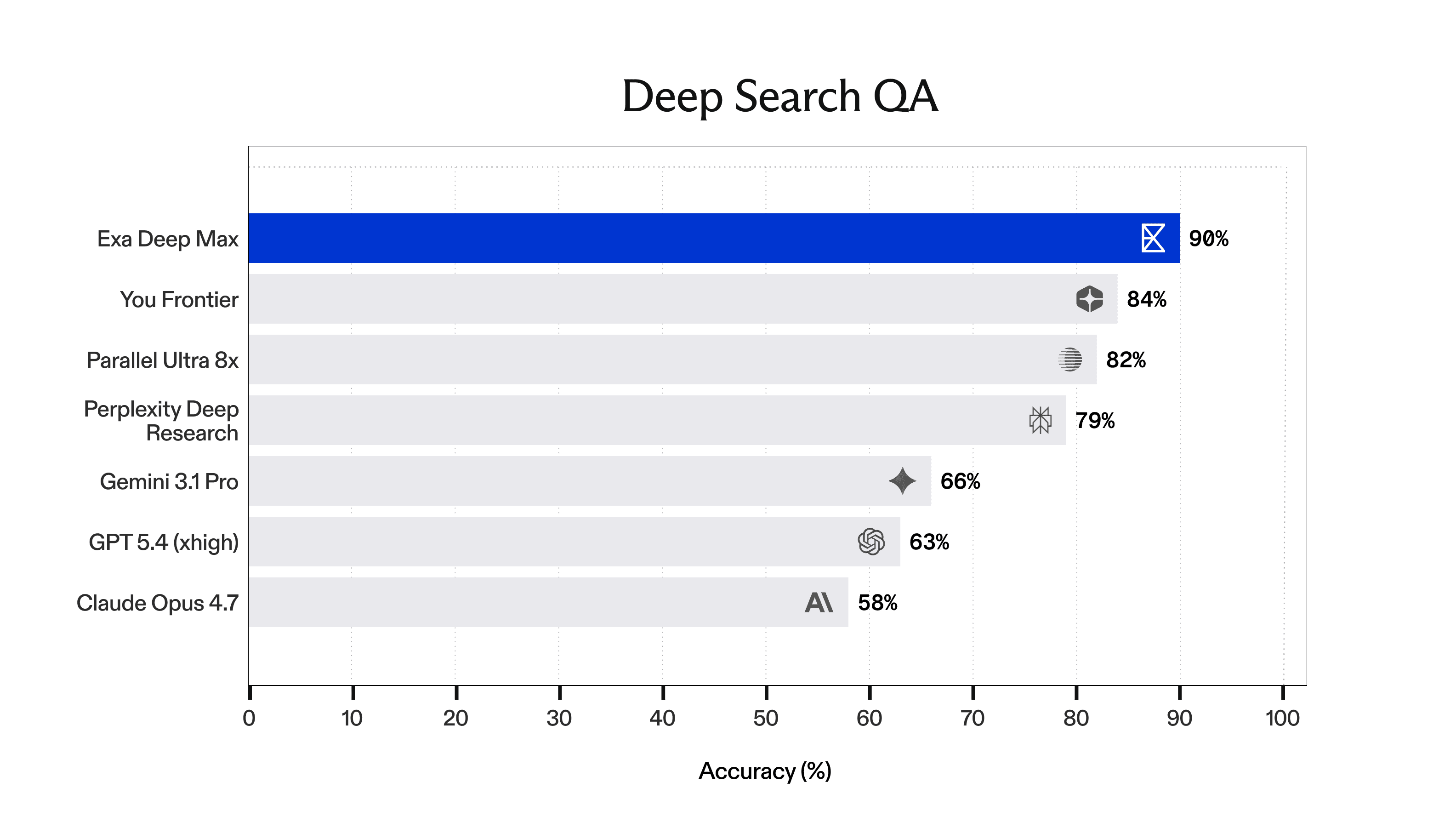
Overview
Exa introduced Deep Max as its highest-quality search endpoint for research questions that need broad retrieval and synthesis. Its architecture fans out dozens of search calls, reads token-efficient excerpts and full pages, then combines the evidence into an answer.
Deep Max is still best understood as a high-end Exa capability, not a documented self-serve API type. Exa's current public Search API exposes deep-lite, deep and deep-reasoning; the Deep Max announcement and product page direct customers to sales for specific access.
Exa reports strong results on Deep Search QA, FRAMES and HLE-Search, but those are vendor-run benchmark results. Buyers should test the exact questions, source types, freshness requirements and output schema their application will use.
Use cases
The strongest fit depends on the job you need the product to complete, not the size of its feature list.
Investigate questions where one search query is unlikely to find enough evidence.
Find companies, people, papers or events and return fields grounded in web sources.
Use a deeper search tier when coverage matters more than sub-second response time.
Capabilities
Runs many Exa searches across different angles of a complex question.
Uses a high-capability model to aggregate evidence and produce a unified result.
Exa Highlights focuses context on relevant passages while full page retrieval supports final grounding.
Parallel tool calls use Exa's own search and content stack instead of an external legacy search layer.
Current Exa deep search modes can return schema-matched JSON for downstream applications.
Public deep-lite, deep and deep-reasoning modes let developers choose less compute when Deep Max is unnecessary.
Process
Step 1
Start with deep or deep-reasoning and measure accuracy, latency and cost on representative tasks.
Step 2
Document which questions remain incomplete and what source or reasoning failures justify a higher tier.
Step 3
Ask Exa about availability, pricing, limits, data controls and the exact integration surface.
Step 4
Inspect citations, test freshness, score required fields and retain a human review path for consequential research.
Cost
Exa does not publish a standalone Deep Max rate and asks interested customers to contact sales. The current self-serve Search API charges $12 per 1,000 deep-lite or deep requests and $15 per 1,000 deep-reasoning requests for up to ten results.
Contact sales
Exa's highest-compute agentic search capability.
$12 per 1,000 requests
Lightweight synthesized search through the public Search API.
$12 per 1,000 requests
Multi-step public search mode with reasoning and structured outputs.
$15 per 1,000 requests
Public search mode with more reasoning for harder tasks.
Pricing checked . Check current pricing at the source ↗
Assessment
Compare
The right alternative depends on the specific output, workflow, controls and budget your project requires.
Agents
Choose Exa Agent for a documented asynchronous API with fixed effort tiers, citations and structured outputs.
Explore Exa Agent →Agents
Choose Parallel Search for another web-search API designed for agent workflows.
Explore Parallel Search →Consumer
Choose Gemini Deep Research Agent for Google's long-running research API and model ecosystem.
Explore Gemini Deep Research Agent →Questions
Deep Max is Exa's highest-compute agentic search system, using a frontier model and dozens of parallel Exa search calls to answer difficult web research questions.
Exa's current public Search API lists deep-lite, deep and deep-reasoning, not deep-max. Contact Exa to confirm Deep Max access and its exact integration surface.
Exa has not published a standalone Deep Max rate. Its public deep and deep-reasoning modes currently cost $12 and $15 per 1,000 requests respectively.
Exa says typical launch queries completed in tens of seconds and reported benchmark medians between roughly 11 and 64 seconds depending on the test. Real latency depends on the task and service terms.
No. Deep Max is presented as Exa's highest-compute search capability. Exa Agent is a documented asynchronous research API with run lifecycle, effort controls, input data and structured outputs.
Bottom line
Deep Max is an interesting quality-first search system, but most developers should benchmark Exa's documented deep and deep-reasoning modes first. Consider sales-assisted Deep Max only when measured research gaps justify its undisclosed access and pricing.
Visit Deep Max website ↗
HY-World 2.0 - Tencent's open-source world model that turns text, images, or video into interactive 3D scenes

Custom Voices - xAI's new tool to clone your voice from short clips for use within Grok's applications
Gemini 3.1 Flash TTS - Google's new speech model with inline tags for voice direction across 70+ languages

Realtime TTS-2 - Inworld AI's new voice model that hears conversation audio to match user tone and emotion

Get access to all our AI courses, hundreds of real-world AI use cases, live expert-led workshops, an exclusive network of AI early adopters, and more.
Get unlimited access to all of our current & upcoming industry-specific AI courses for the duration of your subscription.
To keep up with the rapid pace of AI, our team publishes AI implementation guides daily. Our library contains 300+ practical use cases to automate real-world work.
Join weekly, live, interactive sessions with industry leaders who are at the forefront of AI for hands-on implementation guidance and exclusive insights.
Network with an exclusive community of AI-first professionals who are working smarter with AI. Learn how early adopters are using AI in their work and businesses.