Long-running agent orchestration
Handle the smaller set of difficult planning and synthesis calls inside a multi-model agent system.
Independent tool overview
NVIDIA Nemotron 3 Ultra is a frontier-scale, open-weight text model with 550 billion total parameters, 55 billion active parameters, and up to a one-million-token context window for demanding agentic reasoning.
Visit the official NVIDIA Nemotron 3 Ultra site ↗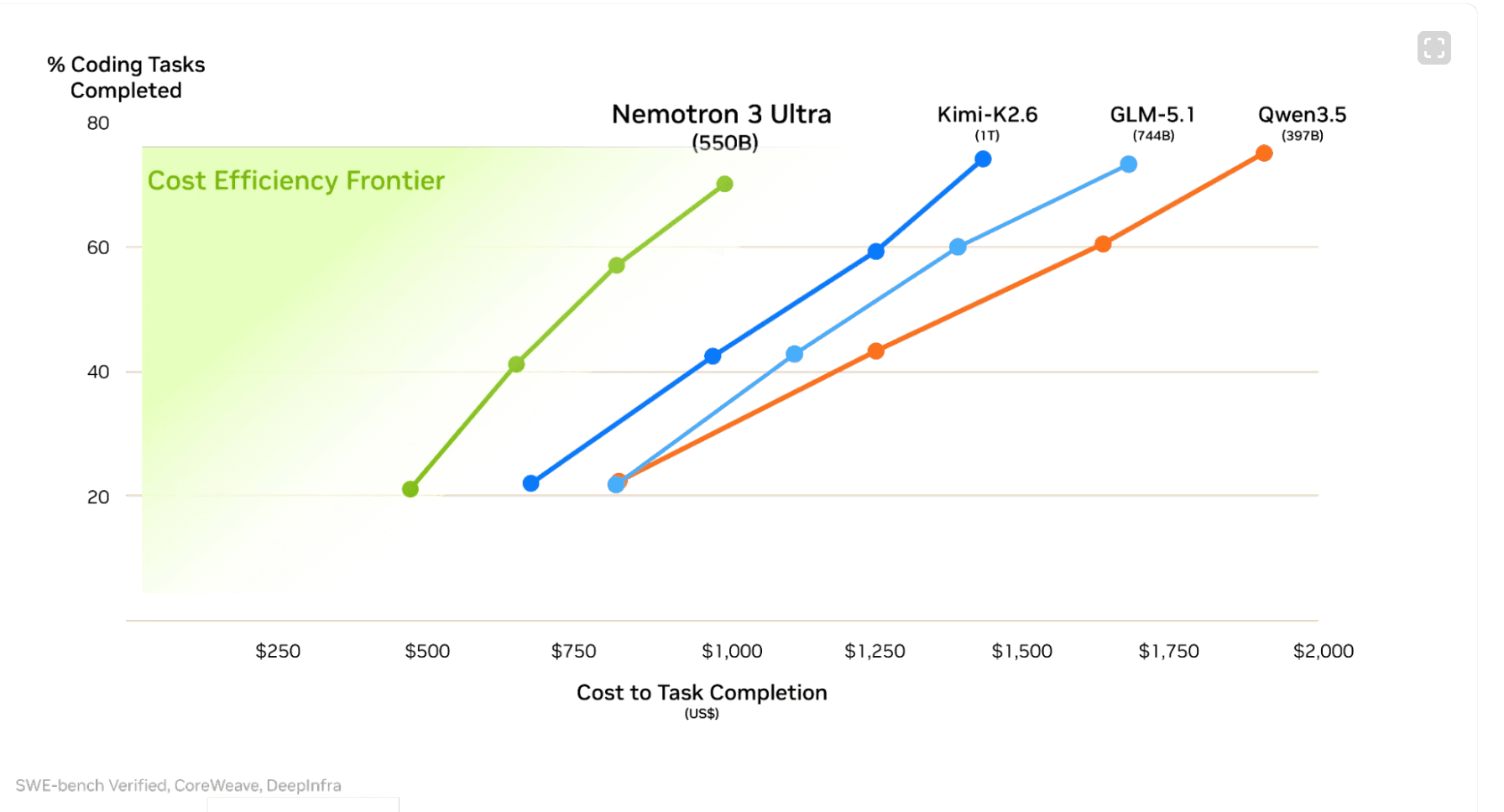
Overview
Nemotron 3 Ultra is NVIDIA's largest Nemotron 3 reasoning model, aimed at orchestration, long-horizon agents, coding, tool use, high-stakes RAG, and analysis across very large document or code collections. It is an infrastructure component for developers, not a finished consumer chatbot.
Its hybrid architecture combines Mamba-2, attention, a latent mixture of experts, and multi-token prediction. Only 55 billion of its 550 billion parameters are active for a token, but the complete checkpoint is still enormous: even the smaller NVFP4 release requires a serious multi-GPU deployment.
Developers can try the model through NVIDIA's free API endpoint, download BF16 or NVFP4 weights, or deploy through NVIDIA and open inference tooling. The weights support commercial and non-commercial use under OpenMDW 1.1, but operating cost, safety controls, evaluation, and production reliability remain the deployer's responsibility.
Use cases
The strongest fit depends on the job you need the product to complete, not the size of its feature list.
Handle the smaller set of difficult planning and synthesis calls inside a multi-model agent system.
Reason across large document sets, repositories, transcripts, or retrieved evidence with up to a 1M-token window.
Power terminal, repository, debugging, and software-maintenance agents that need multi-step reasoning and tool use.
Act as a reasoning layer over retrieved evidence when the deployment includes rigorous citation and validation controls.
Fine-tune an open-weight frontier model with LoRA, supervised fine-tuning, or reinforcement-learning recipes.
Capabilities
Combines Mamba-2, mixture-of-experts, and selected attention layers with more efficient latent expert routing.
Predicts multiple future tokens to improve throughput for long outputs and multi-turn agent workflows.
Supports prompts and outputs within a combined context of up to 1M tokens when the serving stack and memory budget allow it.
The chat template can enable or disable thinking, letting developers reserve deeper reasoning for harder calls.
Choose the higher-precision release or the smaller, faster NVFP4 checkpoint based on accuracy, memory, and hardware needs.
NVIDIA lists English, French, Spanish, Italian, German, Japanese, Hindi, Korean, Brazilian Portuguese, and Chinese.
Official recipes cover vLLM, SGLang, TensorRT-LLM, Dynamo, DGX systems, and OpenAI-compatible serving.
NVIDIA publishes LoRA, full supervised fine-tuning, and reinforcement-learning paths through NeMo libraries.
Cookbooks connect Ultra to tools such as OpenCode, OpenHands, Hermes Agent, Kilo Code, and Pi.
Process
Step 1
Build a representative evaluation set and test NVIDIA's API before committing to a multi-GPU deployment.
Step 2
Compare BF16 with NVFP4 on your own tasks; quantization can change performance by benchmark and workload.
Step 3
Use an officially documented vLLM, SGLang, TensorRT-LLM, Dynamo, or NIM route that matches the hardware.
Step 4
Do not default every request to maximum context and open-ended thinking; enforce limits based on task value.
Step 5
Connect tools, memory, retrieval, permissions, timeouts, and a sandbox around the model rather than exposing raw actions.
Step 6
Measure task completion, citation fidelity, tool errors, latency, throughput, GPU utilization, and cost on production-like traces.
Step 7
Require deterministic validation or human approval for code execution, external messages, financial operations, and other high-impact steps.
Cost
NVIDIA publishes the model weights under OpenMDW 1.1 and currently labels the build.nvidia.com model endpoint free for evaluation. That does not make production inference free: self-hosting requires large GPU systems, while managed deployment, support, and production NIM licensing depend on the provider and infrastructure agreement.
Free endpoint
Try the model and API through build.nvidia.com under NVIDIA's trial terms and service limits.
No model download fee
Download BF16 or NVFP4 weights under OpenMDW 1.1.
Infrastructure cost
The smaller official checkpoint lowers memory and throughput cost but remains frontier-scale.
Infrastructure cost
Higher-precision deployment with materially greater memory requirements.
Provider-specific
Run the model through a cloud inference provider or enterprise NVIDIA deployment.
Pricing checked . Check current pricing at the source ↗
Assessment
Compare
The right alternative depends on the specific output, workflow, controls and budget your project requires.
Consumer
A smaller 120B/12B-active Nemotron with the same 1M context direction and a substantially easier deployment footprint.
Explore Nemotron 3 Super →Consumer
Better for high-volume routine agent execution where speed and efficiency matter more than Ultra-class reasoning.
Explore Nemotron 3.5 Lightning →Coding
A smaller open-weight reasoning and coding model with much more accessible self-hosting requirements.
Explore GLM-4.7 →Consumer
A competing flagship reasoning model for teams comparing managed frontier intelligence rather than NVIDIA-centered deployment.
Explore Qwen3-Max-Thinking →Questions
It is NVIDIA's frontier-scale open-weight text model for complex reasoning, coding, tool use, long-context analysis, RAG, and long-running agents.
The model has 550 billion total parameters and activates about 55 billion parameters per token through its mixture-of-experts architecture.
NVIDIA calls it an open model and releases weights, datasets, recipes, and supporting materials under OpenMDW 1.1. It is safest to describe it as open-weight and review the actual license rather than assuming every artifact uses a standard software open-source license.
It can be self-hosted, but not on an ordinary PC. NVIDIA lists at least four B200-class GPUs or eight H100s for the NVFP4 checkpoint, with higher requirements for BF16.
The official model cards list up to one million tokens. Real usable context depends on serving configuration, KV-cache memory, latency targets, and whether the model accurately uses the relevant evidence.
The weights have no download price, and NVIDIA currently provides a free trial endpoint. Production use still incurs GPU, hosting, storage, networking, engineering, support, or managed-provider costs.
BF16 is the larger higher-precision checkpoint. NVFP4 is quantized for a smaller footprint and higher throughput; its accuracy remains close on NVIDIA's published tests but varies above or below BF16 by benchmark.
GenRM is a separate Nemotron 3 Ultra–based generative reward model for judging model responses. It is not the default conversational and agentic checkpoint.
Usually no. NVIDIA positions Ultra for the difficult minority of orchestration and reasoning calls. Smaller Nemotron models can handle routine tool calls and high-volume execution more economically.
Bottom line
Nemotron 3 Ultra is compelling for teams that need open-weight frontier reasoning, huge context, and control over deployment. Its model economics only make sense when difficult agent tasks justify a multi-GPU system; most workloads should route routine steps to smaller models.
Visit NVIDIA Nemotron 3 Ultra website ↗
MiniMax M3 - Open-weight model with 1M context and computer use

Claude Fable - Anthropic's new frontier Mythos-class model with top performance across benchmarks

Claude Opus 4.8 - Anthropic's new top model with improvements to reliability, coding, and agentic flows.

Freddy - Plug your wearables, CGMs, power meters, and gym apps straight into any AI agent that speaks MCP

Get access to all our AI courses, hundreds of real-world AI use cases, live expert-led workshops, an exclusive network of AI early adopters, and more.
Get unlimited access to all of our current & upcoming industry-specific AI courses for the duration of your subscription.
To keep up with the rapid pace of AI, our team publishes AI implementation guides daily. Our library contains 300+ practical use cases to automate real-world work.
Join weekly, live, interactive sessions with industry leaders who are at the forefront of AI for hands-on implementation guidance and exclusive insights.
Network with an exclusive community of AI-first professionals who are working smarter with AI. Learn how early adopters are using AI in their work and businesses.