Existing production systems
Maintain a tested GPT-5.4 integration while evaluating a newer model against real quality and cost targets.
Independent tool overview
GPT-5.4 is a supported previous-generation OpenAI reasoning model for coding, professional documents and tool-using agents, with a 1.05-million-token API context window, 128,000-token maximum output and native computer use.
Visit the official GPT 5.4 site ↗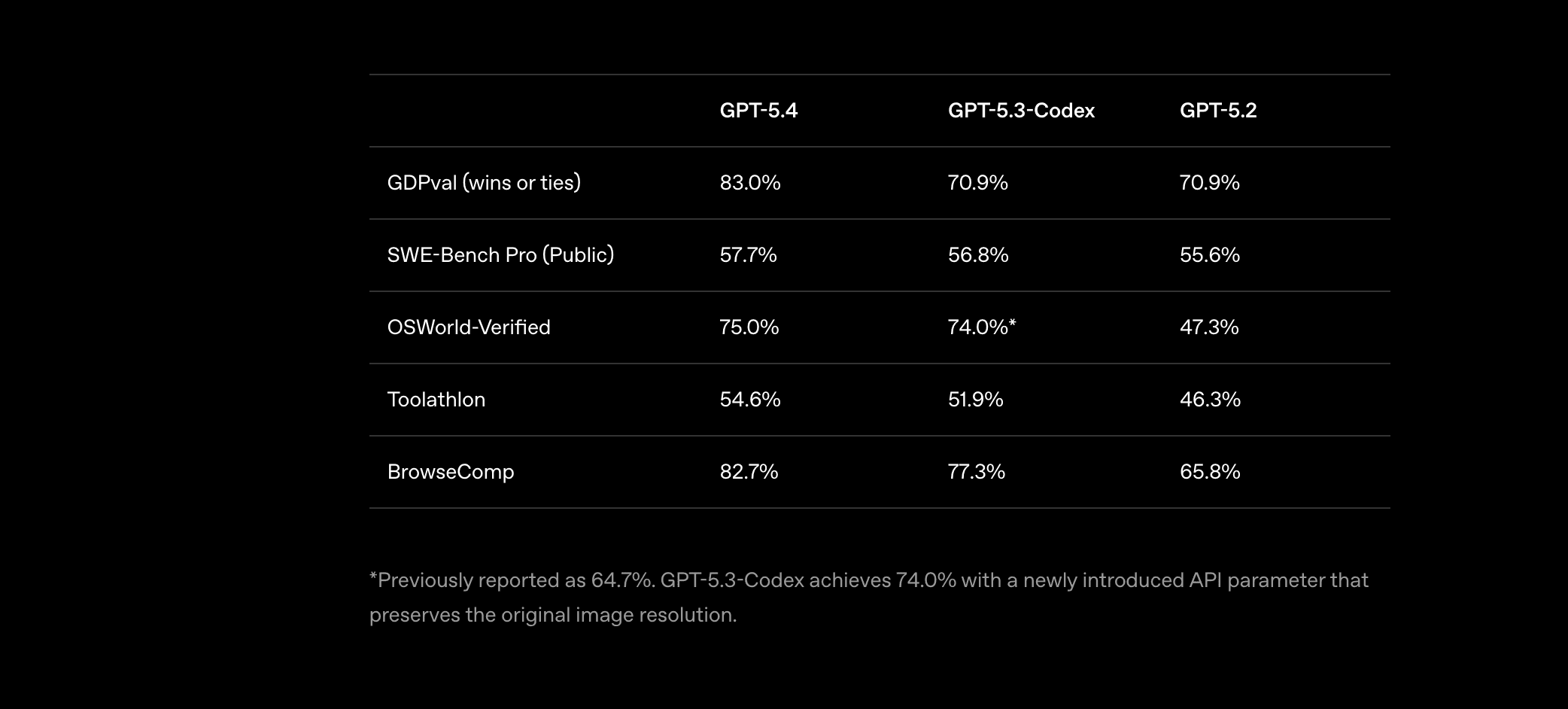
Overview
OpenAI launched GPT-5.4 in March 2026 across ChatGPT, the API and Codex. It combined general reasoning with coding capabilities from GPT-5.3-Codex and added native computer control, stronger tool search and improved work on spreadsheets, presentations and documents.
The API model remains listed as gpt-5.4, with a dated gpt-5.4-2026-03-05 snapshot for teams that need behavior stability. It accepts text and image inputs, returns text, and supports structured outputs, web and file search, code execution, hosted shell, MCP, skills and computer use.
GPT-5.4 is no longer OpenAI's recommended starting point for new systems; the current guidance points developers to the GPT-5.6 family. Existing applications should compare migration quality, latency and total token cost on representative tasks rather than switching solely on benchmark claims.
Use cases
The strongest fit depends on the job you need the product to complete, not the size of its feature list.
Maintain a tested GPT-5.4 integration while evaluating a newer model against real quality and cost targets.
Analyze large document sets or codebases when the 1.05M context window is worth its special pricing.
Build screenshot, mouse, keyboard and browser workflows with native computer-use support and explicit confirmation policies.
Capabilities
The API supports none, low, medium, high and xhigh reasoning effort to balance latency, cost and task quality.
GPT-5.4 can issue mouse and keyboard actions from screenshots or generate code for browser automation libraries.
The API supports up to 1.05M tokens of context and 128K output tokens, with a surcharge above the standard long-context threshold.
The launch emphasized spreadsheets, presentations, documents, legal analysis and other multi-step professional deliverables.
Responses API tools include web search, file search, image generation, code interpreter, hosted shell, apply patch, skills, MCP and tool search.
The original detail level supports full-fidelity perception up to 10.24M total pixels or a 6,000-pixel maximum dimension, whichever limit is reached first.
Teams can select the March 5, 2026 snapshot instead of relying on an alias when reproducibility matters.
Process
Step 1
Use GPT-5.4 when an existing production evaluation supports it; start new projects with current OpenAI model guidance.
Step 2
Set effort intentionally and measure task success, latency and token use instead of defaulting to xhigh.
Step 3
Give agents the minimum required tools, isolate computer-use environments and require confirmation for consequential actions.
Step 4
Retrieve only relevant material where possible because inputs above 272K tokens change pricing for the entire request.
Step 5
Compare GPT-5.4 with GPT-5.6 at the same reasoning effort and one level lower, using a pinned task set and real total cost.
Cost
Standard GPT-5.4 costs $2.50 per million input tokens, $0.25 cached input and $15 output. GPT-5.4 Pro costs $30 input and $180 output. Long inputs above 272K tokens trigger higher rates for the full request.
$2.50 input / $15 output per 1M tokens
General reasoning, coding, agent and professional-work model.
$30 input / $180 output per 1M tokens
Higher-compute version for difficult quality-first tasks.
Above 272K input tokens
Special pricing applies to the full request once input crosses the threshold.
Pricing checked . Check current pricing at the source ↗
Assessment
Compare
The right alternative depends on the specific output, workflow, controls and budget your project requires.
Business Operations
Choose current ChatGPT when you want OpenAI to route everyday work through its newest supported consumer models.
Explore ChatGPT →Consumer
Compare GPT-5.5 when maintaining an intermediate OpenAI migration path, though new API work should also test GPT-5.6.
Explore GPT 5.5 →Consumer
Choose Gemini 3.5 Flash when lower-latency, lower-cost multimodal throughput matters more than staying within OpenAI's stack.
Explore Gemini 3.5 Flash →Questions
Yes. OpenAI's current API catalog still lists gpt-5.4 and the pinned gpt-5.4-2026-03-05 snapshot. It is a supported previous-generation model rather than the recommended starting point for new builds.
Standard pricing is $2.50 per million input tokens, $0.25 cached input and $15 output. Regional, Priority and long-context adjustments can increase the effective rate.
The API model page lists a 1,050,000-token context window and a 128,000-token maximum output.
Yes. It supports native computer use through screenshot-based mouse and keyboard actions as well as code-driven browser automation. Developers still need permission boundaries and human confirmation for consequential actions.
For GPT-5.4 and GPT-5.4 Pro, OpenAI charges 2x the input rate and 1.5x the output rate for the full request when input exceeds 272K tokens under standard, Batch or Flex processing.
For new work, OpenAI recommends the GPT-5.6 family. For an existing application, preserve GPT-5.4 as the baseline, test GPT-5.6 at the same reasoning effort and one level lower, and compare quality, latency and total cost on representative tasks.
Bottom line
GPT-5.4 remains useful where it is already evaluated, especially for long-context and computer-use systems. New deployments should treat it as a migration baseline and validate GPT-5.6 before committing to an older model generation.
Visit GPT 5.4 website ↗
Gemini 3.1 Flash-Lite - Google's fastest, cheapest Gemini 3 model for high-volume dev workloads
Copilot Cowork - Microsoft's Anthropic-powered AI for running multi-step tasks across M365 apps

GPT-5.3 Instant - OAI's ChatGPT default model update with fewer refusals and less hallucinations

Nemotron 3 Super - NVIDIA's open 120B reasoning model with 1M token context for agentic workflows

Get access to all our AI courses, hundreds of real-world AI use cases, live expert-led workshops, an exclusive network of AI early adopters, and more.
Get unlimited access to all of our current & upcoming industry-specific AI courses for the duration of your subscription.
To keep up with the rapid pace of AI, our team publishes AI implementation guides daily. Our library contains 300+ practical use cases to automate real-world work.
Join weekly, live, interactive sessions with industry leaders who are at the forefront of AI for hands-on implementation guidance and exclusive insights.
Network with an exclusive community of AI-first professionals who are working smarter with AI. Learn how early adopters are using AI in their work and businesses.