Enterprise AI programs
Deploy agents with central permissions, auditability, spend controls, model options, and organizational policies.
Independent tool overview
Writer is an enterprise agent platform for building, running, and governing AI workflows grounded in company knowledge, systems, brand rules, and approval requirements.
Visit the official Writer site ↗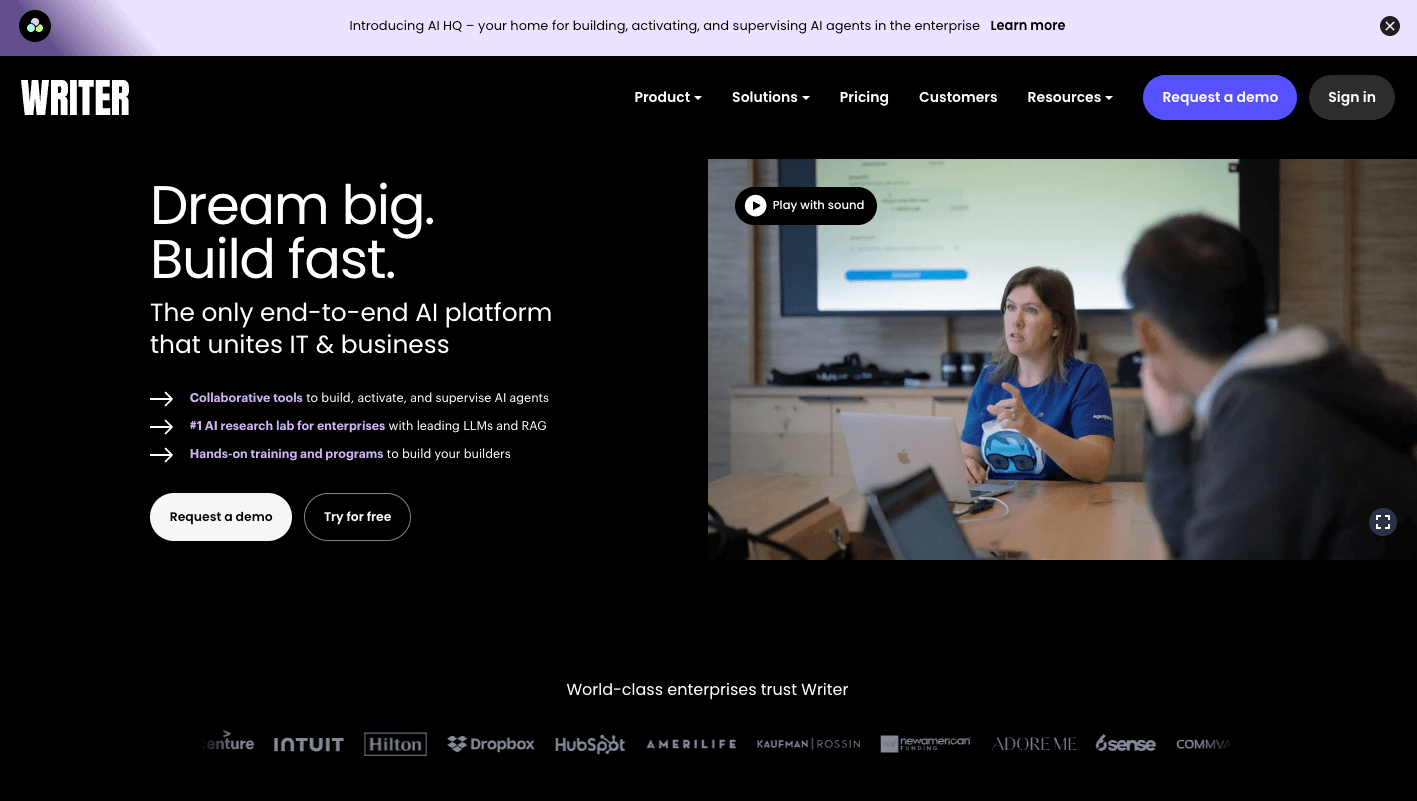
Overview
Writer is no longer best described as an AI writing assistant. Its current platform centers on Writer Agent, which can plan and execute multi-step work, create documents, presentations, dashboards, files, or actions in connected systems, and turn successful processes into reusable Playbooks and scheduled routines.
Company context comes from Writer Knowledge Graphs and connectors, while personality profiles, style rules, guardrails, permissions, and approvals shape what an agent may do. AI Studio gives technical and business administrators a shared control plane for building agents, monitoring activity and spend, auditing actions, and governing deployment.
Palmyra X6 is Writer’s current default model, but Enterprise administrators can enable other providers and bring models through platforms such as AWS Bedrock, Microsoft Azure, and NVIDIA NIM. That flexibility makes Writer a platform decision rather than a simple copywriting subscription: the value depends on integration quality, governance maturity, repeatable workflows, and measured business outcomes.
Use cases
The strongest fit depends on the job you need the product to complete, not the size of its feature list.
Deploy agents with central permissions, auditability, spend controls, model options, and organizational policies.
Automate repeatable research, campaign, outreach, content, and reporting workflows while applying brand and product context.
Connect agents to approved company sources so outputs can use current internal facts instead of prompt-only context.
Use connectors, browser automation, code execution, and actions to move work beyond chat into existing business systems.
Evaluate Enterprise controls including SSO, SCIM, RBAC, audit logs, guardrails, data residency, and available compliance documentation.
Capabilities
A plain-language interface that decomposes a goal, gathers company context, selects tools, executes steps, and returns a finished deliverable or action.
Save successful workflows for repeat use, share them with teams, chain steps, trigger them from events, or run them on a schedule.
Ground agents in organizational documents, data, and approved sources through graph-based retrieval and connectors.
Apply company voice, style guides, terminology, and departmental profiles consistently across generated material.
Supports code execution, web search, browser automation and takeover, file and presentation generation, image analysis and generation, and data analysis.
Starter advertises access to more than 100 prebuilt agents, while Enterprise adds administrative curation and broader deployment controls.
Build agents, skills, and workflows while giving administrators visibility into usage, actions, costs, policies, and deployment.
Enterprise adds granular permissions, approval patterns, audit logs, agent observability, knowledge access controls, and integration with third-party guardrails.
Uses Palmyra X6 by default and can support approved third-party or customer-selected models in Enterprise.
Writer advertises encryption, SSO and SCIM, granular RBAC, customer-managed keys, data residency, self-hosting, and compliance reports or agreements on eligible plans.
Process
Step 1
Start with a repetitive, bounded workflow that has clear inputs, reviewers, acceptable error rates, and an outcome worth tracking.
Step 2
Build the relevant Knowledge Graph and connectors with least-privilege access to company data and systems.
Step 3
Configure brand rules, personality, guardrails, roles, approvals, cost boundaries, and prohibited actions before automation.
Step 4
Describe the desired outcome in plain language and review the plan, sources, tool use, and produced deliverable.
Step 5
Evaluate missing data, stale sources, prompt injection, access boundaries, hallucinations, model changes, and failed downstream actions.
Step 6
Turn the validated process into a repeatable workflow with the right trigger, schedule, ownership, and review checkpoints.
Step 7
Use adoption, spend, output quality, action logs, and business metrics to decide whether to scale, revise, or disable it.
Cost
Writer publishes two platform plans but does not show a dollar amount for either. Starter uses monthly or annual per-seat pricing with fixed credit limits and includes a 14-day trial. Enterprise is custom-priced and combines seats with a pooled credit balance; additional credits, solution packs, and services can add cost.
14 days free
A no-card trial for evaluating Writer Agent and a limited team setup.
Price not publicly listed
Per-seat monthly or annual plan with fixed credit limits for one small team.
Contact sales
Custom deployment for organizations that need scale, model flexibility, integrations, and governance.
Pricing checked . Check current pricing at the source ↗
Assessment
Compare
The right alternative depends on the specific output, workflow, controls and budget your project requires.
Business Operations
Choose this when Microsoft 365 integration and familiar productivity surfaces matter more than a separate agent platform.
Explore Microsoft Copilot →Content Creator
Compare Jasper for a marketing-centered content and brand workflow with less emphasis on enterprise-wide agent governance.
Explore Jasper →Business Operations
Use ChatGPT for a broader general-purpose assistant and simpler individual or team adoption.
Explore ChatGPT →Project Management
Compare Claude for strong long-context reasoning and writing without committing first to Writer’s full workflow platform.
Explore Claude →Questions
Writer is an enterprise platform for agentic work. It combines Writer Agent, Playbooks, a Knowledge Graph, connectors, models, and governance to execute repeatable workflows across company systems.
Writing and brand consistency remain important capabilities, but the current product is much broader. It can research, analyze data, generate files and presentations, browse, execute code, and take actions through connected systems.
Writer does not publish current dollar amounts for Starter or Enterprise. Starter is per seat with monthly or annual billing and fixed credits; Enterprise uses custom pricing and a pooled credit model.
Yes. Starter has a 14-day trial for up to five users and does not require a credit card.
Writer Agent is the platform’s primary interface. It plans and executes multi-step work using company context, tools, and rules, then produces a deliverable or completed action.
Playbooks are reusable agent workflows. Teams can save a successful process, share it, add triggers or schedules, and run it consistently.
Palmyra X6 is the current default model. Enterprise administrators can also enable approved outside models or bring models through supported infrastructure providers.
Writer says it does not train its models on customer prompts, completions, or documents and advertises zero retention by default. Buyers should confirm the exact storage and retention terms for their selected integrations and contract.
Writer says Enterprise platform credits expire at the end of the contract term. Lite-user credits reset monthly and do not roll over.
Starter can work for one team of up to five users testing a small number of workflows. Teams that only need writing help may find a simpler assistant more economical.
Bottom line
Writer is most compelling when an organization needs to move from scattered AI chats to governed, repeatable workflows grounded in company systems. Starter is useful for proving one or two tightly scoped processes; Enterprise should be evaluated like platform infrastructure, with a security review, a real cost model, and pilot metrics for quality, time saved, and downstream errors. It is overkill for basic copy assistance but a serious option for teams ready to own agent operations.
Visit Writer website ↗
Build AI voice agents effortlessly for businesses.

Guidde: Creates ai-powered step-by-step video documentation from your screen recordings and voice prompts.

Automate data processes with AI and efficiency.

Fireflies AI: Records, transcribes, and analyzes meetings with automated summaries and searchable notes.

Get access to all our AI courses, hundreds of real-world AI use cases, live expert-led workshops, an exclusive network of AI early adopters, and more.
Get unlimited access to all of our current & upcoming industry-specific AI courses for the duration of your subscription.
To keep up with the rapid pace of AI, our team publishes AI implementation guides daily. Our library contains 300+ practical use cases to automate real-world work.
Join weekly, live, interactive sessions with industry leaders who are at the forefront of AI for hands-on implementation guidance and exclusive insights.
Network with an exclusive community of AI-first professionals who are working smarter with AI. Learn how early adopters are using AI in their work and businesses.