Private-market diligence
Screening deals, analyzing data rooms, reviewing LPAs and DDQs, and generating investment committee material with source context.
Independent tool overview
V7 Go is an enterprise AI platform for complex, document-heavy workflows in private markets, insurance, and real estate. It combines document extraction, workflow agents, persistent organizational context, integrations, review controls, and document generation in a custom-priced deployment.
Visit the official V7 Go site ↗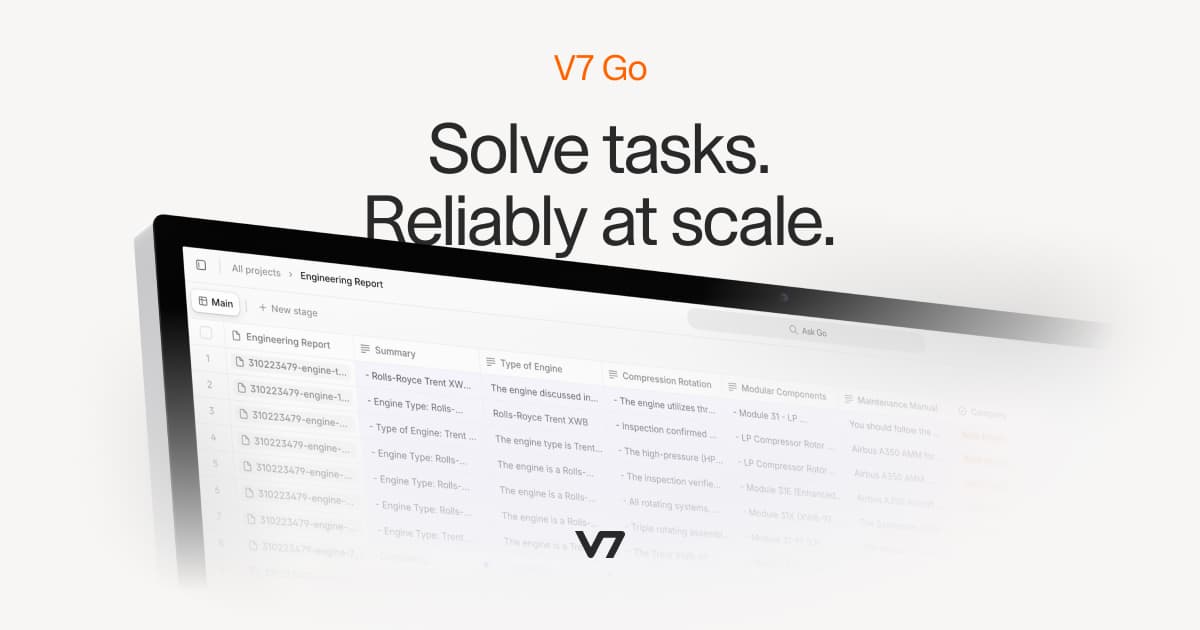
Overview
V7 Go is built for teams whose work starts with data rooms, investment documents, submissions, policies, claims, leases, portfolio reports, and other complex files. It turns that material into structured tables, analyses, generated documents, and repeatable workflows rather than stopping at a chat response.
The platform's Context Graph connects source documents, reports, memos, emails, entities, relationships, and evidence so agents can reuse organizational context across deals and reporting cycles. Workflow agents can then extract, reason, route exceptions for human review, and create outputs such as investment memos, summary decks, or CRM records.
V7 Go is a sales-led enterprise product. Pricing is assembled from platform access, users, and document-processing volume, and V7 does not publish a standard monthly rate. It is separate from V7 Darwin, the company's image and video data-labeling platform.
Use cases
The strongest fit depends on the job you need the product to complete, not the size of its feature list.
Screening deals, analyzing data rooms, reviewing LPAs and DDQs, and generating investment committee material with source context.
Automating submission ingestion, underwriting triage, policy review, claims processing, and exception routing.
Extracting lease and acquisition data, supporting underwriting, and standardizing portfolio reporting.
Teams that need an incoming file to trigger extraction, analysis, review, and a finished document or system update.
Capabilities
Connects documents, emails, entities, relationships, and source evidence into reusable institutional context for teams and agents.
Breaks complex tasks into controlled reasoning and action steps, with conditional logic and routes for human review.
Recognizes printed and handwritten text as well as charts, diagrams, logos, tables, and layout in complex files.
Turns extracted and analyzed information into rule-driven tables that teams can review, transform, and use downstream.
Creates one-off or recurring outputs such as reports, memos, slides, and PDFs from approved workflow results.
Connects workflow inputs and outputs to common data rooms, storage, CRM, collaboration, and enterprise systems; V7 also publishes MCP connectivity.
Supports multiple foundation models and allows organizations to connect their own provider API keys when required.
V7 advertises fine-grained access, audit logs, encryption, testing, and a policy of not training models on customer data.
Process
Step 1
Start with one document-heavy workflow that has clear inputs, expected outputs, reviewers, and measurable manual effort.
Step 2
Bring in files, data rooms, email, systems, and historical evidence needed to interpret each document correctly.
Step 3
Configure required fields, calculations, comparisons, decision rules, citations, and model or tool steps.
Step 4
Route low-confidence, high-sensitivity, or policy-dependent results to qualified people before downstream action.
Step 5
Create the table, memo, deck, report, or system record and send it through connected business tools.
Step 6
Track exceptions, corrected fields, processing time, and downstream errors to refine the workflow against real documents.
Cost
V7 Go uses custom annual pricing. V7 says the package combines a base platform fee, user access, and volume-based document processing; no standard monthly or per-page rate is published.
Contact sales
An annual enterprise package tailored to the workflow, team, and document volume.
Pricing checked . Check current pricing at the source ↗
Assessment
Compare
The right alternative depends on the specific output, workflow, controls and budget your project requires.
Business Operations
Mistral OCR 4.1 is a model and API option for layout-aware document extraction when a team wants to build its own workflow layer.
Explore Mistral OCR 4.1 →Data Analysis
Unriddle is a lighter research and document-analysis option for individuals and small teams that do not need an enterprise process platform.
Explore Unriddle →Students
ChatPDF is a simpler choice for conversational questions and summaries over individual PDFs rather than recurring institutional workflows.
Explore ChatPDF →Questions
V7 Go is an enterprise AI platform for automating complex document workflows across private markets, insurance, and real-estate investment. It combines extraction, agents, organizational context, review controls, integrations, and generated outputs.
V7 does not publish a fixed rate. Its pricing page describes a custom annual package made up of platform access, users, and document-processing volume.
V7 says Go can recognize printed and handwritten text along with charts, diagrams, logos, and other document elements. Buyers should test their own layouts and quality thresholds in a pilot.
Yes. V7 describes one-off and recurring pipelines that can process a new source file and generate standardized reports, decks, or other documents, with review steps where needed.
No. V7 Go automates document-intensive business workflows. V7 Darwin is a separate product for annotating images, videos, and medical imaging data used to train models.
Bottom line
V7 Go is strongest when an organization has a repeatable, high-value document process with enough volume and risk to justify a governed enterprise rollout. Its combination of context, extraction, agents, review, integrations, and finished outputs is broader than a PDF chatbot. The tradeoff is a custom sales process and meaningful implementation work, so teams should insist on a representative pilot and agreed quality metrics.
Visit V7 Go website ↗
Get access to all our AI courses, hundreds of real-world AI use cases, live expert-led workshops, an exclusive network of AI early adopters, and more.
Get unlimited access to all of our current & upcoming industry-specific AI courses for the duration of your subscription.
To keep up with the rapid pace of AI, our team publishes AI implementation guides daily. Our library contains 300+ practical use cases to automate real-world work.
Join weekly, live, interactive sessions with industry leaders who are at the forefront of AI for hands-on implementation guidance and exclusive insights.
Network with an exclusive community of AI-first professionals who are working smarter with AI. Learn how early adopters are using AI in their work and businesses.


