Enterprise CX quality teams
Expand review coverage and prioritize high-risk interactions across a large support operation.
Independent tool overview
Solidroad is an enterprise customer-experience quality platform that scores human and AI support interactions, turns performance gaps into practice simulations, and tracks coaching progress.
Visit the official Solidroad site ↗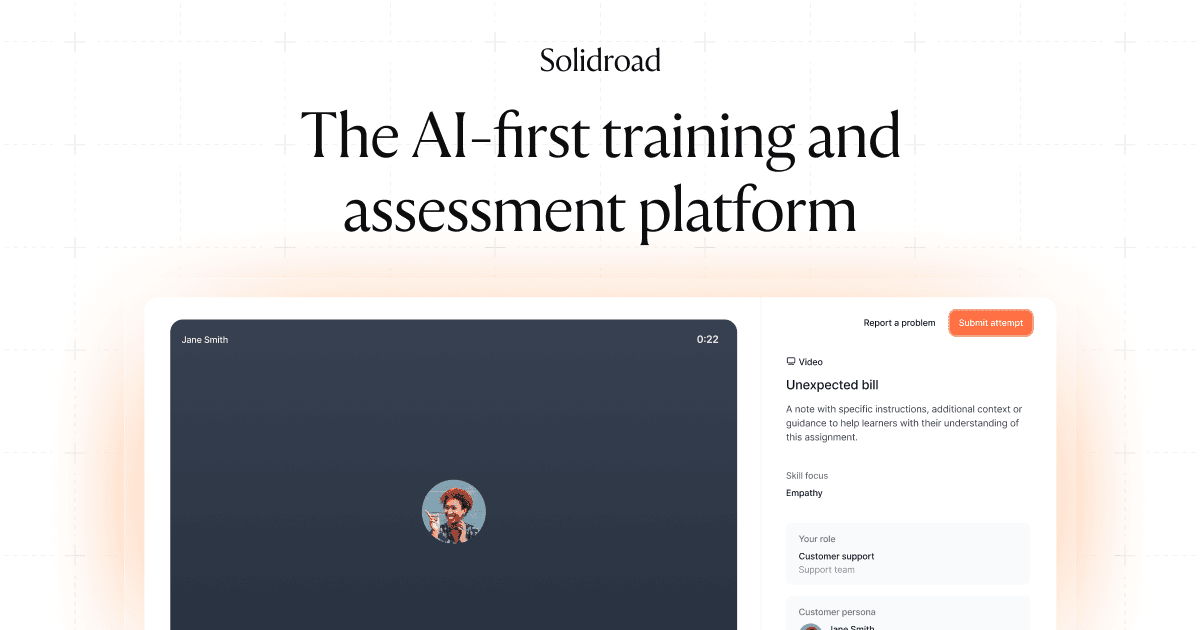
Overview
Solidroad connects quality assurance with training for customer-support operations. It evaluates real interactions against a company's own scorecards, flags risky or weak conversations, and can convert those findings into targeted AI role-plays for human agents. It also offers QA and benchmarking for third-party AI support agents.
Training simulations can cover chat, email, phone, and video, with configurable personas, accents, languages, difficulty, and custom rubrics. Solidroad can also mirror backend support workflows so a learner practices not only what to say but how to complete the correct operational steps.
The platform is aimed at established CX and quality teams rather than an individual learner. It uses a demo-led, custom quote and integrates with existing contact-center and support systems. A useful evaluation therefore needs representative interactions, validated scoring criteria, calibration against expert reviewers, and a clear plan for how findings turn into coaching or system changes.
AI coverage is not the same as perfect assessment. Automated scores can misread context, language, disability, culture, emotion, or justified policy exceptions. High-impact decisions about hiring, assignment, compensation, promotion, discipline, or termination must remain human-led, appealable, and compliant with employment, labor, privacy, and discrimination rules.
Use cases
The strongest fit depends on the job you need the product to complete, not the size of its feature list.
Expand review coverage and prioritize high-risk interactions across a large support operation.
Give recruits repeated practice on realistic customer and workflow scenarios before they handle live contacts.
Turn recurring QA gaps into assigned practice scored against the same operational standard.
Benchmark and monitor third-party support agents for grounding, correctness, tool use, escalation, and other AI-specific failure modes.
Capabilities
Scores completed conversations across supported channels and surfaces patterns, risk, and coaching opportunities.
Applies organization-specific criteria, weights, critical steps, and automatic pass/fail rules rather than a fixed generic rubric.
Creates customer role-plays with configurable persona, language, channel, difficulty, and scenario.
Reproduces support-system tasks so agents can practice clicks, fields, and process adherence as well as communication.
Returns score-based feedback after a simulation and gives managers reporting on skill gaps and progress.
Uses production QA findings to generate focused practice, then allows teams to examine whether the targeted behavior improves.
Evaluates both populations while adding AI-specific criteria such as grounding, hallucination, tool-call correctness, calibration, and escalation.
Can suggest scores and reasoning inside a human-led QA workflow, where reviewers can verify or override the result.
Process
Step 1
Specify whether scores support coaching, certification, QA review, or another purpose; prohibit unsupported automated employment decisions.
Step 2
Translate current policies and expert judgment into observable criteria, then compare model scores with diverse trained reviewers.
Step 3
Scope integrations, retention, access, recordings, transcripts, and sensitive fields before importing production interactions.
Step 4
Test languages, accents, disabilities, emotional situations, policy exceptions, adversarial inputs, and both strong and weak performances.
Step 5
Use flagged interactions for human review and targeted practice, then measure live quality, customer outcomes, score disagreement, and disparate impact.
Cost
Solidroad does not publish self-serve tiers or per-seat prices. Its own current comparison materials describe pricing as custom and demo-led, with scope affected by agent count, interaction volume, channels, integrations, QA coverage, training simulations, implementation, and support. Request a quote against a defined pilot and total operating volume.
Custom quote
QA, coaching, simulation, integration, and support scope are priced through a sales-led evaluation.
Ask during the demo
Solidroad's training FAQ references trial or proof-of-concept evaluation, but no standard public terms are listed.
Pricing checked . Check current pricing at the source ↗
Assessment
Compare
The right alternative depends on the specific output, workflow, controls and budget your project requires.
Recruiting / HR
Use Interview Coach for low-stakes individual practice when you do not need enterprise CX integrations, QA coverage, or manager reporting.
Explore Interview Coach →Business Operations
Consider Intercom Copilot when the primary goal is helping human support agents answer live conversations rather than building a separate QA-to-training system.
Explore Intercom Copilot →Business Operations
Consider Sierra when the priority is deploying a customer-service AI agent; Solidroad is better understood as an independent quality and training layer around agents.
Explore Sierra →Questions
Solidroad is an enterprise CX quality platform for automated QA, coaching, and simulation training across human and AI support interactions.
Solidroad advertises chat, email, phone, and video simulations, configurable customer personas and difficulty, multiple languages, custom scorecards, and mirrored backend support workflows.
Yes. Its automated QA product is designed to evaluate completed human and AI-agent interactions against custom quality criteria and surface high-risk cases for review.
Pricing is custom and not published as standard tiers. Ask for a quote that itemizes seats, interactions, channels, simulations, storage, integrations, implementation, support, and overages.
No. Automation can expand coverage and prioritize review, but experts still need to calibrate rubrics, resolve ambiguity, inspect high-risk cases, correct scores, and own consequential decisions.
They can be one input to a broader readiness process. Use supervised live work, knowledge checks, manager observation, customer outcomes, accommodations, and an appeal path; never rely on one AI score alone.
Yes. It positions QA and benchmarking for third-party AI agents, including dimensions such as hallucination, grounding, tool-call correctness, confidence, and escalation.
Its security and privacy pages state SOC 2 Type II and ISO/IEC 27001 certifications, encryption in transit and at rest, SSO, access controls, audit logging, monitoring, and retention and deletion policies. Buyers should verify the current reports and contract scope.
Bottom line
Solidroad is compelling for mature CX organizations that want one loop from interaction QA to targeted practice for both human and AI agents. The technical breadth is meaningful, but the purchase only works with calibrated rubrics, strong employee and customer data governance, transparent human review, and outcome measurement beyond vendor scores.
Visit Solidroad website ↗
Get access to all our AI courses, hundreds of real-world AI use cases, live expert-led workshops, an exclusive network of AI early adopters, and more.
Get unlimited access to all of our current & upcoming industry-specific AI courses for the duration of your subscription.
To keep up with the rapid pace of AI, our team publishes AI implementation guides daily. Our library contains 300+ practical use cases to automate real-world work.
Join weekly, live, interactive sessions with industry leaders who are at the forefront of AI for hands-on implementation guidance and exclusive insights.
Network with an exclusive community of AI-first professionals who are working smarter with AI. Learn how early adopters are using AI in their work and businesses.


