Fast-moving product teams
Engineering organizations shipping frequent UI changes and spending too much time repairing brittle end-to-end tests.
Independent tool overview
Momentic is an AI testing platform for writing, running, repairing, and triaging end-to-end web, iOS, and Android tests from natural-language behavioral specifications.
Visit the official Momentic site ↗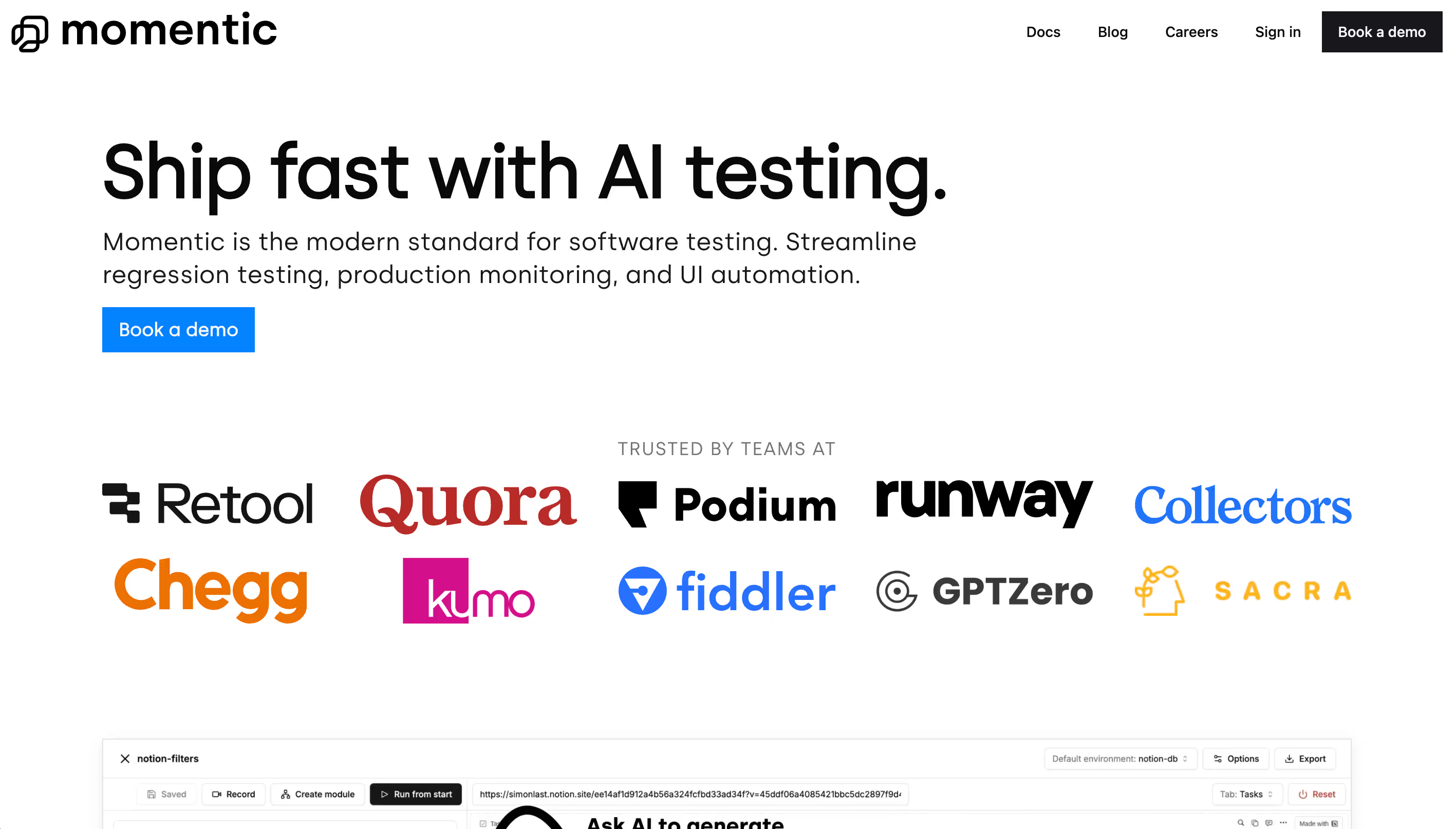
Overview
Momentic lets engineering and QA teams describe expected product behavior in plain English instead of maintaining long chains of selectors and browser commands. Its agents use signals such as the DOM, accessibility tree, screenshots, network activity, and console output to locate elements, perform actions, and decide whether behavior is correct.
The current product is CLI-first: tests live in the application repository as version-controlled YAML, run locally or in CI, and can use local or Momentic-hosted browsers, simulators, and emulators. The web dashboard remains the place for results, recordings, traces, triage, quarantine, settings, integrations, security, and billing.
Momentic also exposes a local MCP server for coding agents such as Claude Code and Cursor, enabling an AI that writes code to create, edit, run, and debug tests with live browser context. This can tighten the code-to-verification loop, but teams still need clear test intent and a broader quality strategy.
Use cases
The strongest fit depends on the job you need the product to complete, not the size of its feature list.
Engineering organizations shipping frequent UI changes and spending too much time repairing brittle end-to-end tests.
Teams that want coding agents to verify their own changes through an MCP-connected browser-testing loop.
Organizations testing web, iOS, and Android behavior from a shared agentic testing platform.
Teams that want behavioral tests reviewed and versioned alongside application code and executed consistently in local and CI environments.
Capabilities
Write behavioral steps and assertions in plain English while Momentic resolves the UI interactions required to execute them.
Agents can combine page structure, accessibility information, screenshots, network requests, and console logs instead of relying on one brittle selector.
Momentic can recover from changed interfaces, distinguish product regressions from test drift, suggest edits, and provide root-cause context.
Run Chromium web tests and iOS or Android tests on local machines, CI infrastructure, or Momentic-hosted environments.
Author repository-owned YAML tests through the local editor, command line, or MCP-compatible coding agents.
Integrate with GitHub Actions, GitLab, and other CI systems, then manage recordings, traces, retries, quarantine, suggestions, and results in the dashboard.
Process
Step 1
Run the onboarding wizard, authenticate, install the Momentic package and browser runtime, and create the project configuration.
Step 2
Write a concise test goal and assertions around the user-visible outcome, avoiding unnecessary step-by-step implementation detail.
Step 3
Execute the test against a safe environment, inspect the resolved actions, and refine ambiguous language or missing preconditions.
Step 4
Store the YAML specification and reusable modules with application code so changes can be reviewed and versioned together.
Step 5
Run critical suites on pull requests and deployments, upload results, and set blocking rules based on risk rather than raw test count.
Step 6
Review recordings, traces, auto-heal history, failure analysis, and quarantine signals; fix unclear specifications as well as product bugs.
Cost
Momentic uses usage-based credits rather than per-seat pricing. Free includes 2,000 monthly credits, roughly 200 typical test runs. Pay-as-you-go costs $125 per month for 10,000 credits, roughly 1,000 runs; additional usage is $0.01875 per credit, while 10,000-credit top-ups cost $125. One credit covers one executed test step, including AI-generated steps such as recovery and auto-heal. Enterprise pricing is custom.
$0
No-card plan for individuals and small projects.
$125/month
Self-serve team plan with usage billing and no per-user seat fees.
Custom pricing
Test-based pricing tailored to suite size, support, infrastructure, security, and compliance needs.
Pricing checked . Check current pricing at the source ↗
Assessment
Compare
The right alternative depends on the specific output, workflow, controls and budget your project requires.
Agents
Choose Lux when you need a general computer-use SDK that can be adapted for QA as well as non-testing workflows.
Explore Lux →Agents
Choose Gemini Computer Use when building a custom interface-testing agent directly on Google's model.
Explore Gemini Computer Use →Coding
Choose Claude Code with Playwright or another framework when your team prefers code-first tests and direct ownership of the automation stack.
Explore Claude Code →Questions
Momentic is an AI-powered end-to-end testing platform that turns natural-language behavioral specifications into web and mobile test execution, maintenance, and failure analysis.
Free includes 2,000 credits per month. Pay-as-you-go costs $125 per month for 10,000 credits, with additional credits billed or purchased in top-up blocks. Enterprise pricing is custom.
One credit covers one executed test step. AI-generated work such as failure recovery and auto-healing also uses steps. Momentic estimates a typical run at about 10 steps or 10 credits.
No. Current self-serve pricing is based on credits and usage rather than seats, so teams can invite more collaborators without a separate per-user fee.
Yes. Momentic supports iOS simulators and Android emulators as well as web testing. Free includes 30 emulator minutes; paid mobile usage is metered in credits.
The current CLI-first workflow stores tests as YAML files in the application repository. They run locally or in CI, while the dashboard handles results, triage, settings, integrations, and billing.
Yes. Its local MCP server exposes testing tools to compatible assistants such as Claude Code and Cursor so they can author, edit, run, and debug tests with browser context.
Bottom line
Momentic is a strong fit for teams that want repository-owned, behavior-focused end-to-end testing without spending engineering cycles on selector maintenance. Its credit model is transparent and seat-free, but buyers should estimate real step and mobile usage, audit self-healing behavior, and keep conventional testing layers around it.
Visit Momentic website ↗
Get access to all our AI courses, hundreds of real-world AI use cases, live expert-led workshops, an exclusive network of AI early adopters, and more.
Get unlimited access to all of our current & upcoming industry-specific AI courses for the duration of your subscription.
To keep up with the rapid pace of AI, our team publishes AI implementation guides daily. Our library contains 300+ practical use cases to automate real-world work.
Join weekly, live, interactive sessions with industry leaders who are at the forefront of AI for hands-on implementation guidance and exclusive insights.
Network with an exclusive community of AI-first professionals who are working smarter with AI. Learn how early adopters are using AI in their work and businesses.


