Personal knowledge capture
Collecting non-sensitive notes, links and spoken ideas and revisiting them through conversational search.
Independent tool overview
Me.bot remains active under the newer Second Me brand. Mindverse's product has evolved from a personal AI notebook and companion into an AI identity and social avatar trained on a user's notes, links, audio, memories, voice and preferences. It can organize information, chat from personal context, generate voice-and-visual talks and create shareable avatars that interact with other people. The official web pricing remains $0 for Free and $10/month or $100/year for Pro. This is an unusually intimate data product: its marketing promises anonymity, end-to-end encryption and even local-only data, while its legal privacy notice describes U.S. servers, Azure hosting, identifiers, usage, geolocation, inferences, cookies and multiple vendor categories. Those documents are not fully reconciled, so users should minimize uploads, keep backups and avoid treating the AI as a therapist, crisis service or authoritative version of themselves.
Visit the official Second Me (formerly Me.bot) site ↗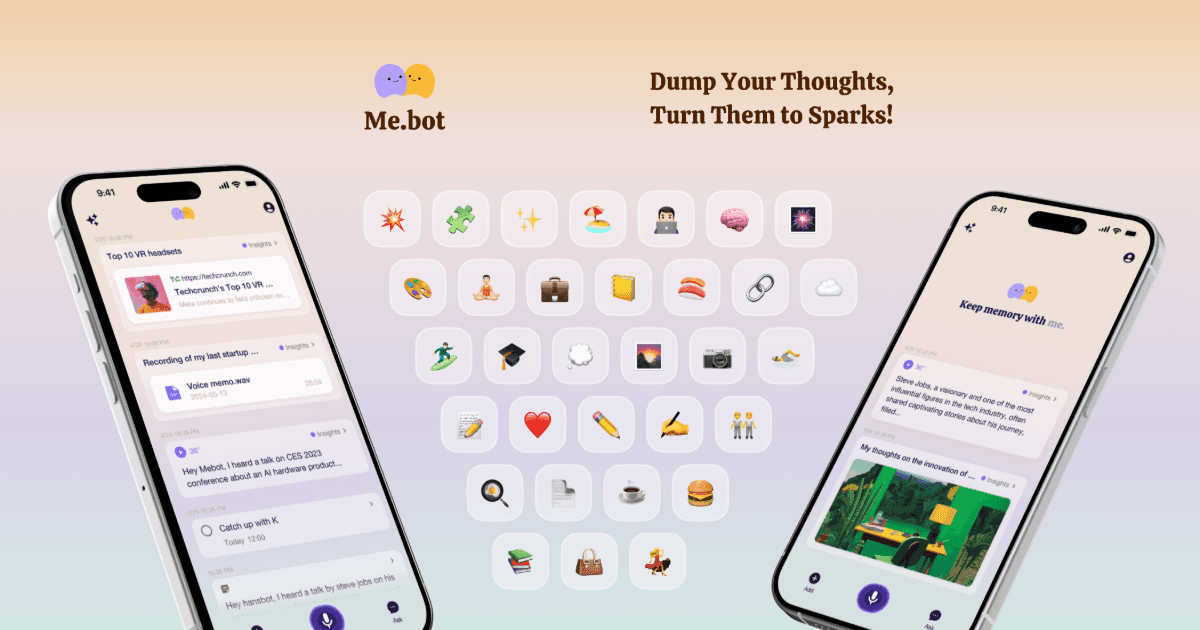
Overview
Me.bot is the earlier name and still-used product identity for Mindverse's personal AI, now branded primarily as Second Me. The current me.bot website directs users to create a Second Me, and the existing Android package has been renamed in the English store while retaining the same developer and app identity.
The original product combined AI chat, notes, task planning, link and recording summaries, memories and proactive personal insights. The current Second Me direction adds a social AI identity: users feed it materials, define personality and voice, create scenario-specific avatars and let other people interact with a representation of them.
Second Me can import notes, audio, links and other material, manage key memories, score or describe alignment with the user, generate voice-and-visual talks and share an interactive avatar or presentation. Current official docs also describe scheduled tasks and web, iOS and Android access.
This can be useful for organizing personal knowledge, preparing introductions, repurposing ideas, rehearsing how to explain a topic and creating a shareable Q&A presence. It should not be assumed to reproduce the user's intentions accurately, especially on sensitive, changing or high-stakes questions.
The current legal terms say the service is intended only for users age 18 or older. They also say the service is not tailored for HIPAA, FISMA or similar industry-specific obligations, so protected health or other regulated data should not be placed in it.
Emotional-support language in older app listings does not make Second Me a therapist, clinician or crisis service. It can mirror or reinforce a user's framing, invent memories and offer unsafe advice; urgent mental-health, abuse or medical situations require qualified human help.
Official pricing checked August 31, 2026 is Free or Pro at $10 monthly, with the annual option billed at $100. Free includes 100 new memories and 100 chat messages per month, three talks and 10 MB files; Pro lists unlimited memories and messages subject to 50-per-hour fair-use limits, 30 talks and 50 MB files.
The company publishes strong privacy marketing, including complete anonymity, end-to-end encryption, Azure Confidential Computing and a statement on one page that personal-model data lives and dies locally on the device. Its privacy FAQ, however, says data is encrypted and stored on Microsoft Azure.
The November 2025 legal privacy policy further describes U.S. servers; account, commercial, device, usage, location and inferred-profile data; targeted or marketing cookies; vendor categories; business transfers; and retention up to three months after account termination for listed categories. Users should rely on the complete legal notice rather than interpreting slogans as a guarantee of local-only storage or zero third-party processing.
Users can export memories as Markdown files in a ZIP, currently once per day, and request deletion. Export regularly because a personal AI becomes more difficult to replace as it accumulates unique memories, voice and identity context.
Use cases
The strongest fit depends on the job you need the product to complete, not the size of its feature list.
Collecting non-sensitive notes, links and spoken ideas and revisiting them through conversational search.
Turning existing thoughts into an introduction, story, short talk or audience-specific explanation.
Creating an intentionally scoped avatar that answers low-stakes questions about interests or published work.
Finding themes, shared interests and concise ways to introduce oneself without delegating real consent or commitments.
Using saved material as prompts for self-reflection while treating generated interpretations as hypotheses.
Building voice-and-visual talks that audiences can explore, with human review of every public claim.
Capabilities
Brings notes, Markdown, Evernote or Apple Notes exports and other material into a personal AI context.
Lets users shape which facts, relationships and expression patterns the AI should prioritize.
Responds using accumulated notes and memories rather than only the current prompt.
Accepts spoken notes and recordings as material to organize, summarize or use for personalization.
Creates a shareable representation with a chosen personality, voice, appearance and scenario.
Supports multiple avatars for introductions, Q&A, communication or other deliberately separated uses.
Turns saved records into voice-and-visual presentations that can be shared and explored by an audience.
Reframes a message for different listeners, such as colleagues, investors, students or family.
Uses a Lv.0–Lv.10 framing to show how closely the AI representation is aligned with the user's supplied material.
Official Second Me documentation lists tasks the AI identity can perform on a schedule.
The current mobile positioning lets Second Me avatars find common ground and facilitate conversation with other users.
Packages memories, content, resource links and insights as Markdown files in a downloadable ZIP.
Process
Step 1
Use only if the account holder is at least 18, and do not use the service for HIPAA, FISMA or other regulated information the terms say it is not designed to handle.
Step 2
Choose personal notes, public professional material or a networking avatar instead of uploading an entire life archive without a clear benefit.
Step 3
Read the policy's Azure, U.S. transfer, vendor, cookie, inference, retention and rights sections; do not rely only on anonymity or local-data marketing slogans.
Step 4
Exclude passwords, financial details, health records, legal strategy, intimate media, children's data, employer secrets, client material and third-party conversations without consent.
Step 5
Import a small set of writing you already make public and check how the system summarizes, infers and reproduces it before adding anything personal.
Step 6
Correct false facts, outdated relationships, unwanted inferences and tone drift rather than assuming the alignment score proves accuracy.
Step 7
Create intentionally scoped avatars and materials for each audience; never expose the complete private memory base through a share link.
Step 8
Test likely questions, adversarial prompts, privacy leakage, invented facts and inappropriate replies. Make clear to visitors that they are interacting with AI.
Step 9
Do not let the avatar consent, promise, negotiate, diagnose, advise, send sensitive messages or speak authoritatively for the user without contemporaneous review.
Step 10
For crisis, self-harm, abuse, severe symptoms or medical concerns, contact local emergency or qualified crisis and clinical support instead of relying on the companion.
Step 11
Download the Markdown archive regularly and verify the files so the accumulated memory is not locked to one account or product direction.
Step 12
Remove public shares, disconnect integrations, export needed records, request account deletion and account for the policy's stated post-termination and legal-retention windows.
Cost
Official web pricing checked August 31, 2026 lists a Free plan at $0 and Pro at $10/month or $100/year. Pro's 'unlimited' memories and chat messages are subject to fair-use limits of 50 new memories and 50 chat messages per hour. A 40% student discount is advertised after verification by email; applicants should redact unnecessary identifiers from proof documents.
$0/month
Entry access for building a smaller memory base and trying personalized chat and talks.
$10/month
Expanded memory, chat, talk and file allowances on month-to-month billing.
$100/year
The same published Pro allowances billed annually, shown as approximately $8.30 per month.
40% off Pro after verification
A published discount for eligible students who email proof and receive a Stripe code.
Pricing checked . Check current pricing at the source ↗
Assessment
Compare
The right alternative depends on the specific output, workflow, controls and budget your project requires.
Project Management
Better for structured notes and team knowledge inside an established workspace when a public AI avatar is unnecessary.
Explore Notion AI →Students
Better for source-grounded discussion of a deliberately chosen document collection rather than building a social digital identity.
Explore Gemini Notebook (formerly NotebookLM) →Business Operations
Better for a general assistant with memory and file tools when users do not need Second Me's avatar and social-network layer.
Explore ChatGPT →Students
Better for lightweight reflection when the goal is journaling rather than persistent AI identity and public interaction.
Explore Daily Bedtime Journal →Questions
It remains active but has transitioned toward the Second Me brand and product. The same Mindverse app and sites now emphasize personal AI avatars, identity, talks and social connection alongside memories and chat.
Yes in the current product lineage. The me.bot homepage directs users to create a Second Me, its docs are branded Second Me and the existing Android package is now titled Second Me in English.
The official web page lists Free at $0, Pro at $10 per month and annual Pro at $100 per year. It also advertises a 40% student discount after verification.
It lists 100 new memories, 100 chat messages and three talks per month, unlimited speak and text capture in the plan wording, and files up to 10 MB.
Not without limits. The pricing FAQ applies fair-use caps of 50 new memories and 50 chat messages per hour; Pro also lists 30 talks per month and 50 MB files.
No. It combines memories and personal knowledge with avatars, voice and visual talks, alignment, audience-specific communication, scheduled tasks and an emerging social network.
Do not assume that. Marketing pages make local and end-to-end-encryption claims, but the privacy FAQ says data is stored on Microsoft Azure and the legal policy describes U.S. servers and multiple processing categories. Ask the company to reconcile the exact architecture before uploading sensitive data.
A privacy FAQ says employees never access user data, but the broader policy allows processing by vendor categories and for service, security, legal and business purposes. That is not the same as a technical guarantee that no authorized process can ever access content.
Yes. Official docs say memories can be exported as Markdown files in a ZIP, including titles, content, resource links and insights. A new export can currently be generated once per day.
The legal privacy policy says the listed collected categories are not required for longer than three months after account termination, with exceptions where longer retention is legally permitted or required.
The current terms say the service is intended for users at least 18 years old and that people under 18 may not use or register for it.
No. It may offer reflective conversation, but it is not licensed care, diagnosis or crisis response. Use qualified human services for mental-health, medical, abuse or immediate-safety concerns.
Technically it can answer visitors, but it may invent, leak or misstate. Clearly label it as AI, restrict its source material, test adversarial questions and keep commitments, consent and high-stakes statements under direct human control.
Avoid credentials, financial details, health and legal records, intimate content, children's data, confidential employer or client information, and third-party conversations or recordings without informed consent.
Bottom line
Second Me is a distinctive evolution of Me.bot: part personal knowledge system, part creative presentation tool and part social AI avatar. The $0 plan makes it easy to test, and the $10 monthly Pro tier is straightforward. The deciding issue is trust, not feature count. A product that learns from a person's memories, voice and relationships needs exceptionally clear architecture and governance, yet its local-only and anonymity marketing is not fully reconciled with its Azure and U.S.-server legal disclosures. Use low-sensitivity material first, keep the account 18+, export often, restrict public avatars and never let the AI replace human consent, clinical care or consequential judgment.
Visit Second Me (formerly Me.bot) website ↗
The Reforge Extension helps improve your work.

Gamma: Creates beautiful, interactive presentations and docs using generative ai — no design skills needed.
Afforai: AI-powered research for reliable insights.

Replit Slides - Replit's new tool for creating beautiful slides in seconds

Get access to all our AI courses, hundreds of real-world AI use cases, live expert-led workshops, an exclusive network of AI early adopters, and more.
Get unlimited access to all of our current & upcoming industry-specific AI courses for the duration of your subscription.
To keep up with the rapid pace of AI, our team publishes AI implementation guides daily. Our library contains 300+ practical use cases to automate real-world work.
Join weekly, live, interactive sessions with industry leaders who are at the forefront of AI for hands-on implementation guidance and exclusive insights.
Network with an exclusive community of AI-first professionals who are working smarter with AI. Learn how early adopters are using AI in their work and businesses.