On-device structured extraction
Convert local text into a known schema without sending every input to a cloud model.
Independent tool overview
LFM2.5-350M is Liquid AI's 350-million-parameter text model for fast on-device extraction, structured output and tool calling across CPUs, GPUs and NPUs.
Visit the official LFM2.5-350M site ↗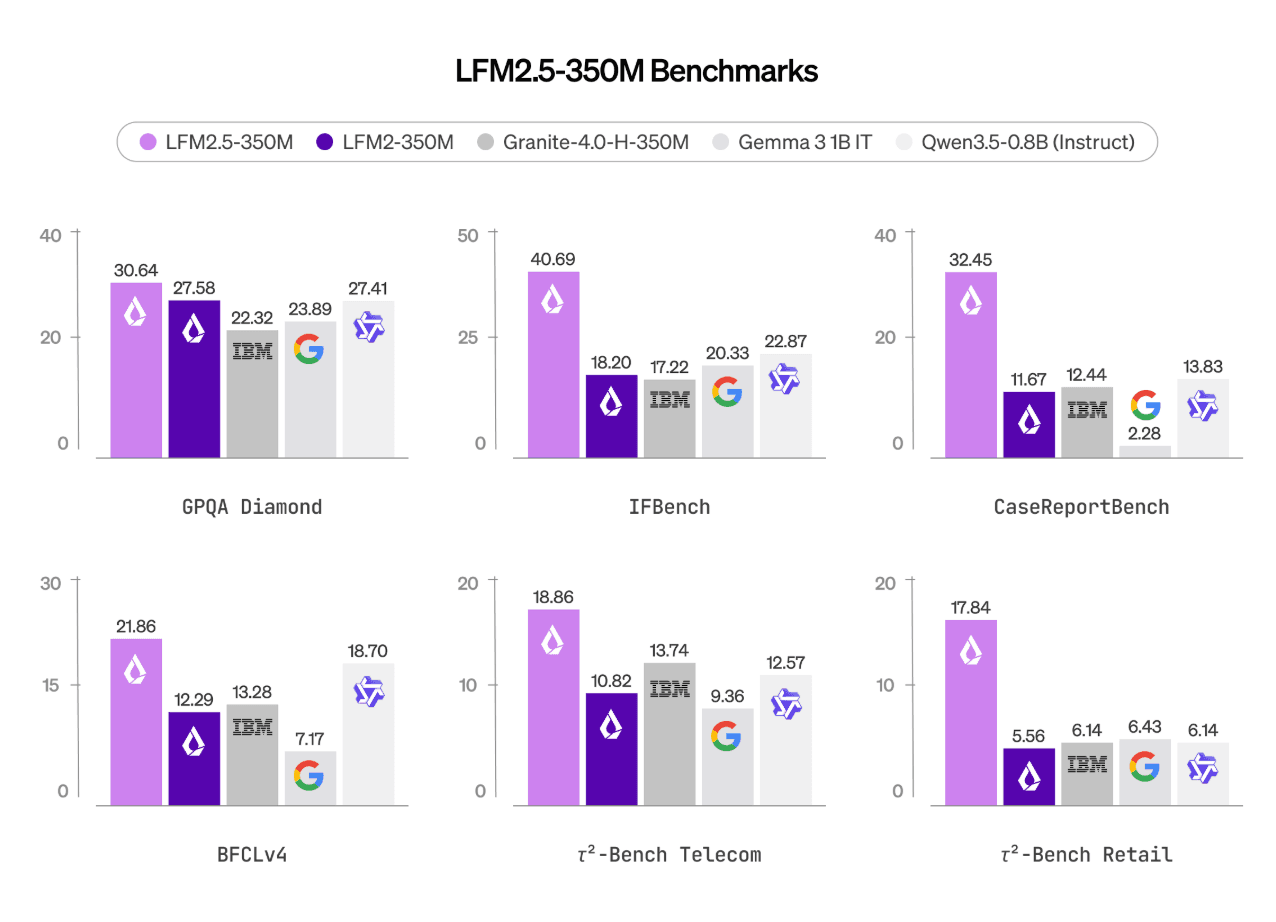
Overview
LFM2.5-350M is built for narrow edge workloads where a large general-purpose model would be too slow, expensive or memory-hungry. The official checkpoint is about 714 MB, and optimized builds can run below 1 GB of memory on phones, laptops, single-board computers and embedded devices.
Liquid AI recommends the instruction-tuned model for data extraction, structured outputs and tool use. Its small size makes local privacy, offline operation and high-volume processing practical, but it should be grounded in application data rather than trusted for broad world knowledge.
The model card explicitly advises against knowledge-intensive tasks and programming, while Liquid's launch post also excludes math and creative writing. A production design should give it a constrained schema, a small tool set and a larger-model or human fallback when the request leaves that lane.
Use cases
The strongest fit depends on the job you need the product to complete, not the size of its feature list.
Convert local text into a known schema without sending every input to a cloud model.
Route a bounded request to a short list of functions on phones, laptops or embedded systems.
Run a well-defined classification or extraction step cheaply at the edge or with high GPU concurrency.
Capabilities
Uses 350 million parameters across convolution and grouped-query-attention blocks for efficient inference.
Supports tool definitions and structured function-call output for constrained agent workflows.
Is post-trained for extraction and instruction following rather than broad open-ended reasoning.
Lists English, Arabic, Chinese, French, German, Japanese, Korean, Portuguese and Spanish.
Ships in formats or integrations for Transformers, GGUF/llama.cpp, ONNX, MLX, OpenVINO, vLLM and SGLang.
Provides a base model for customization and a post-trained model for direct instruction-following use.
Process
Step 1
Choose a task with a fixed schema, known inputs and a clear test for success.
Step 2
Match GGUF, ONNX, MLX, OpenVINO or the native checkpoint to the target hardware and runtime.
Step 3
Measure extraction and tool-call accuracy on real examples, then customize if prompting alone is not reliable.
Step 4
Validate every structured result and escalate low-confidence, out-of-scope or high-impact requests.
Cost
The weights are downloadable under Liquid AI's custom LFM Open License v1.0. Free commercial use has a $10 million annual-revenue threshold; larger companies need a separate paid license.
$0 license fee
The license permits research and qualifying nonprofit non-commercial use without the revenue threshold.
$0 license fee
Legal entities below $10 million in annual revenue can use the model commercially under the published terms.
Contact Liquid AI
The free commercial grant ends above the threshold and a separate license is required.
Pricing checked . Check current pricing at the source ↗
Assessment
Compare
The right alternative depends on the specific output, workflow, controls and budget your project requires.
Consumer
A family of compact open models for teams willing to trade a larger footprint for broader capability.
Explore Qwen3.5 Small →Consumer
A more capable open-weight family for tasks that exceed a narrowly scoped 350M edge model.
Explore Gemma 4 →Miscellaneous
An experimental larger local model focused on very fast generation on dedicated GPUs.
Explore DiffusionGemma →Questions
Liquid AI recommends it for data extraction, structured outputs and tool use, especially when the model needs to run locally or at high volume.
Yes. Liquid publishes mobile and edge deployment paths, and optimized versions have been demonstrated on iPhones, Android phones and other constrained devices.
The official materials say it can run under 1 GB, with actual peak memory depending on hardware, runtime, precision, context length and quantization. The native checkpoint is roughly 714 MB.
It is an open-weights model under the custom LFM Open License v1.0, not an OSI-standard open-source license. Commercial use above the license's $10 million annual-revenue threshold requires a separate agreement.
Yes. The model card documents tool definitions, function-call output, tool responses and final answers. Applications should still validate every call and restrict permissions.
Only for a narrow, grounded assistant. Its size is an advantage for edge deployment, but Liquid advises against knowledge-intensive, programming, math and creative-writing workloads.
Bottom line
LFM2.5-350M is a purpose-built edge component, not a miniature frontier chatbot. It is attractive when extraction or tool routing must happen locally with very little memory; its value depends on a tight task definition, evaluation on real data and a fallback for anything broader.
Visit LFM2.5-350M website ↗
Trinity-Large-Thinking - Arcee AI's new open-weight frontier reasoning model for long-horizon agents

GLM-5.1 — Z AI's new open-source flagship model built for long-horizon agentic coding

Qwen 3.5 Omni - Alibaba's native omnimodal model with text, image, audio, and video understanding across 113 languages

Muse Spark - Meta Superintelligence Labs' new multimodal reasoning model

Get access to all our AI courses, hundreds of real-world AI use cases, live expert-led workshops, an exclusive network of AI early adopters, and more.
Get unlimited access to all of our current & upcoming industry-specific AI courses for the duration of your subscription.
To keep up with the rapid pace of AI, our team publishes AI implementation guides daily. Our library contains 300+ practical use cases to automate real-world work.
Join weekly, live, interactive sessions with industry leaders who are at the forefront of AI for hands-on implementation guidance and exclusive insights.
Network with an exclusive community of AI-first professionals who are working smarter with AI. Learn how early adopters are using AI in their work and businesses.