Research sites with large EHR populations
Reducing the first-pass chart-review burden when manual screening across thousands of records is impractical.
Independent tool overview
HealthKey is an active business-to-business platform that connects to a clinical site's EHR and uses AI to prescreen patient records against clinical-trial inclusion and exclusion criteria. It now focuses on patient identification for research teams rather than the broad medical-record simplification described in its older directory listing. The product can narrow large chart populations and surface supporting evidence, but trained research staff must verify every criterion, privacy authority, contact decision, and final eligibility judgment.
Visit the official HealthKey site ↗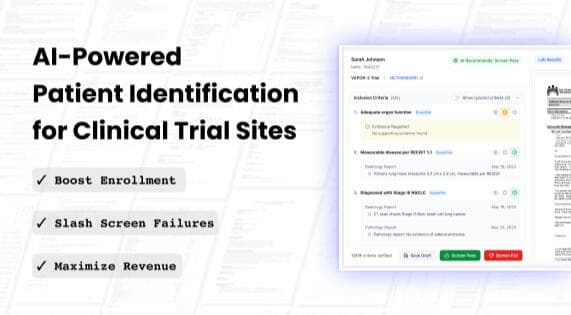
Overview
HealthKey's current product is AI-powered patient identification for clinical-trial sites. A research team supplies a protocol, HealthKey connects to the site's EHR, encodes eligibility criteria, scans structured and unstructured records, and returns potential matches with supporting chart evidence.
This is a substantial change from the older description of HealthKey as a general tool for simplifying medical records. The active gethealthkey.com service is not a consumer health-record app and should not be confused with unrelated products using the HealthKey name on other domains.
Public materials list integrations with Epic, athenahealth, Veradigm Allscripts, NextGen, eClinicalWorks, Modernizing Medicine EMA, MEDENT, UroChart, iSalus, MediTab, Practice Fusion, Office Ally, and Greenway. Actual connectivity, implementation scope, and data mapping require vendor and EHR confirmation.
HealthKey publishes customer case studies in which its system processed structured fields, clinical notes, PDFs, medication histories, laboratory results, and other records, then surfaced full matches and near matches. These are vendor-authored reports, not independent validation of sensitivity, specificity, fairness, or performance on a new site's population.
The homepage says HealthKey uses success fees per patient and previously promoted zero upfront cost, free implementation, five protocol setups, and premium support through July 31, 2026. That date has passed, so current pricing and contract terms are not publicly established and require a quote.
Use cases
The strongest fit depends on the job you need the product to complete, not the size of its feature list.
Reducing the first-pass chart-review burden when manual screening across thousands of records is impractical.
Finding candidate evidence spread across diagnoses, medications, labs, procedures, clinical notes, and imported documents.
Applying a defined protocol across several connected practices while preserving local human qualification and outreach controls.
Rechecking a site's existing population for overlooked potential candidates without treating an algorithmic match as enrollment.
Estimating likely candidate volume after validating data completeness, terminology, timing windows, and site-specific documentation patterns.
Presenting the chart passages and fields behind a potential match so trained staff can confirm or reject each criterion.
Capabilities
Connects to a clinical site's record system to analyze its patient population.
Uses uploaded inclusion and exclusion criteria as the basis for a screening configuration.
Converts protocol requirements into logic that can be evaluated against available records.
Reviews diagnoses, medications, laboratory values, procedures, encounters, and other coded fields described in vendor cases.
Processes clinical notes, reports, and PDFs where relevant eligibility evidence may be buried.
Evaluates large numbers of charts more quickly than sequential manual review.
Returns supporting record evidence so coordinators can inspect why a patient was surfaced.
Vendor case studies describe candidates with unresolved or borderline criteria being routed for manual judgment.
The homepage says sites can receive newly eligible patient candidates as records change.
Provides a site-facing interface for reviewing candidate results and supporting information.
Lists compatibility with a range of enterprise and specialty practice systems.
The vendor advertises connection and initial setup assistance, with exact obligations determined by contract.
Publishes detailed examples covering trial criteria, record volumes, surfaced candidates, and enrollment outcomes.
Process
Step 1
Document the specific trial, site, patient population, data elements, legal basis, and approved prescreening purpose.
Step 2
Obtain privacy, security, compliance, IRB or Privacy Board, sponsor, and EHR approvals applicable to the deployment.
Step 3
Review the BAA or other required agreement, retention, subprocessors, incident duties, access controls, audit rights, deletion, and model-training terms.
Step 4
Use the approved version and record every amendment, temporal window, cohort distinction, and site interpretation.
Step 5
Confirm terminology, units, source provenance, missingness, scanned-document coverage, latency, and patient identity resolution.
Step 6
Have qualified clinical and research staff verify the operational logic for every inclusion and exclusion requirement.
Step 7
Test against known cases and failures before allowing prospective candidate lists to influence outreach.
Step 8
Assess false negatives, false positives, unresolved criteria, data gaps, and disparities across relevant demographic and clinical groups.
Step 9
Run the reviewed configuration only against records and sites included in the approved scope.
Step 10
A trained coordinator or investigator should inspect the cited chart evidence and original source before classifying a candidate.
Step 11
Treat missing, conflicting, stale, or ambiguous data as unresolved rather than silently passing a patient.
Step 12
Follow the approved recruitment and privacy process; an algorithmic match is not permission for arbitrary outreach.
Step 13
Use the protocol's human screening, clinical assessment, and informed-consent process before enrollment.
Step 14
Log decisions, overrides, configuration changes, access, outcomes, complaints, and drift, and revalidate after protocol or EHR changes.
Cost
HealthKey does not publish a current rate card. Its homepage describes success fees per patient, but the visible zero-upfront-cost and free-services promotion was explicitly valid only through July 31, 2026 and is no longer current as of this review. Request a written quote covering what event triggers a fee.
Contact sales
Current commercial terms are negotiated rather than listed as a fixed software subscription.
No longer current
The homepage still displays an offer that was valid through July 31, 2026.
Pricing checked . Check current pricing at the source ↗
Assessment
Compare
The right alternative depends on the specific output, workflow, controls and budget your project requires.
Healthcare
An adjacent clinician-focused assistant for healthcare work, not a substitute for validated EHR-wide trial prescreening.
Explore ChatGPT for Clinicians →Healthcare
A healthcare-oriented AI workspace for general assistance where clinical-trial matching is not the primary need.
Explore CompliantChatGPT →Healthcare
A patient-facing health decision-support product rather than a research-site recruitment system.
Explore Docus →Healthcare
A personal health conversation and data experience for individuals, not an EHR population-screening platform for trial sites.
Explore Health in ChatGPT →Questions
HealthKey is a business-to-business AI platform that prescreens a clinical site's EHR population against clinical-trial inclusion and exclusion criteria and surfaces potential matches with supporting evidence.
Its older directory description emphasized simplifying medical records, but the current gethealthkey.com product is positioned specifically around clinical-trial patient identification.
It is aimed at clinical research sites, practices, and site networks. It is not presented as a consumer medical-record or self-diagnosis app.
The vendor connects to an EHR, translates a trial's approved eligibility criteria into screening logic, scans relevant records, and returns potential candidates with supporting chart evidence for staff review.
The public site lists Epic, athenahealth, Veradigm Allscripts, NextGen, eClinicalWorks, Modernizing Medicine EMA, MEDENT, UroChart, iSalus, MediTab, Practice Fusion, Office Ally, and Greenway. Confirm the exact version and integration scope.
No. It supports prescreening. Trained research staff and investigators must verify the protocol criteria, complete required assessments, and follow the approved consent and enrollment process.
The public site focuses on identifying candidates, not establishing universal permission to contact them. Each site must follow its approved privacy, IRB, recruitment, and patient-communication process.
HealthKey describes its EHR analysis as HIPAA compliant. A customer's obligations still depend on the actual data flow, agreements, safeguards, authorization or waiver basis, access, retention, and use.
Current prices are not published. The site describes success fees per patient, while its displayed zero-upfront promotion expired July 31, 2026. Request a written quote and exact fee trigger.
It should clearly define the fee event, implementation, integrations, support, data use, model training, retention, deletion, subprocessors, incident response, audit rights, performance obligations, exports, and termination.
The vendor publishes positive customer cases, but this review found no public independent validation establishing general sensitivity, specificity, precision, recall, or subgroup performance. Each site should run its own controlled validation.
Trial criteria often depend on clinical nuance, time windows, conflicting notes, missing data, and assessments outside the EHR. Evidence must be checked against the source record and current protocol.
The main risks are privacy or access failures, incorrect criteria encoding, missing or stale data, false negatives, false positives, biased selection, inappropriate outreach, and treating prescreening as final eligibility.
No. A match is only an internal prescreening signal. Informed consent is a separate process in which a potential participant receives and understands balanced information and voluntarily decides whether to join.
Use an approved retrospective sample with known outcomes, review every rule, measure false positives and negatives by relevant subgroup, investigate misses, confirm access controls, and repeat testing after protocol, model, or EHR changes.
Bottom line
HealthKey addresses a real bottleneck: finding a small number of plausible trial candidates inside large, messy EHR populations. Its evidence-linked prescreening could save meaningful coordinator time, but the stakes are too high for automation-only use. A serious deployment needs current commercial terms, a full privacy and security review, site-specific performance validation, subgroup monitoring, documented human verification, and a recruitment process that keeps consent and clinical judgment firmly with people.
Visit HealthKey website ↗
Get access to all our AI courses, hundreds of real-world AI use cases, live expert-led workshops, an exclusive network of AI early adopters, and more.
Get unlimited access to all of our current & upcoming industry-specific AI courses for the duration of your subscription.
To keep up with the rapid pace of AI, our team publishes AI implementation guides daily. Our library contains 300+ practical use cases to automate real-world work.
Join weekly, live, interactive sessions with industry leaders who are at the forefront of AI for hands-on implementation guidance and exclusive insights.
Network with an exclusive community of AI-first professionals who are working smarter with AI. Learn how early adopters are using AI in their work and businesses.