Long-running matters
Keep documents, parties, prior decisions, tasks, and work history attached to the matter as lawyers and agents move it forward.
Independent tool overview
Harvey II is the latest version of Harvey's enterprise legal AI platform, adding agents that inherit matter context, permissions, work history, and user preferences.
Visit the official Harvey II site ↗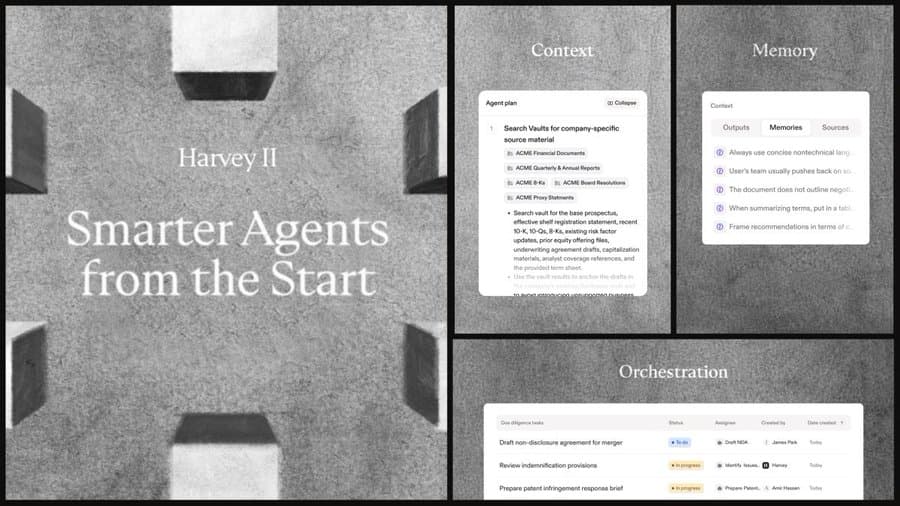
Overview
Harvey II brings legal agents into a persistent matter or project workspace instead of making a lawyer rebuild context for every prompt. Within a Harvey Space, an agent can start with the relevant documents, parties, tasks, permissions, ethical walls, and history of the work.
A separate Memory layer carries an individual user's style and preferences across Harvey, Word, and Outlook. Harvey says users can inspect, edit, or disable this memory and that it is not used to train models. Team playbooks and templates can also shape headings, numbering, defined terms, citation style, and other recurring output conventions.
The release also introduces Harvey Tenet, Harvey's legal-reasoning model. Harvey describes it as post-trained for legal work and more economical for continuous agent use. These are vendor claims, and Harvey's own legal-agent research shows that frontier models still complete fewer than 10% of long-horizon legal tasks end to end under its strict all-pass standard.
Use cases
The strongest fit depends on the job you need the product to complete, not the size of its feature list.
Keep documents, parties, prior decisions, tasks, and work history attached to the matter as lawyers and agents move it forward.
Apply approved playbooks, templates, citation practices, and review steps to recurring legal work.
Assign work between lawyers and agents while preserving matter-level permissions, ethical walls, and cost attribution.
Capabilities
Open an agent inside a Space with the documents, parties, tasks, permissions, and history relevant to that matter or project.
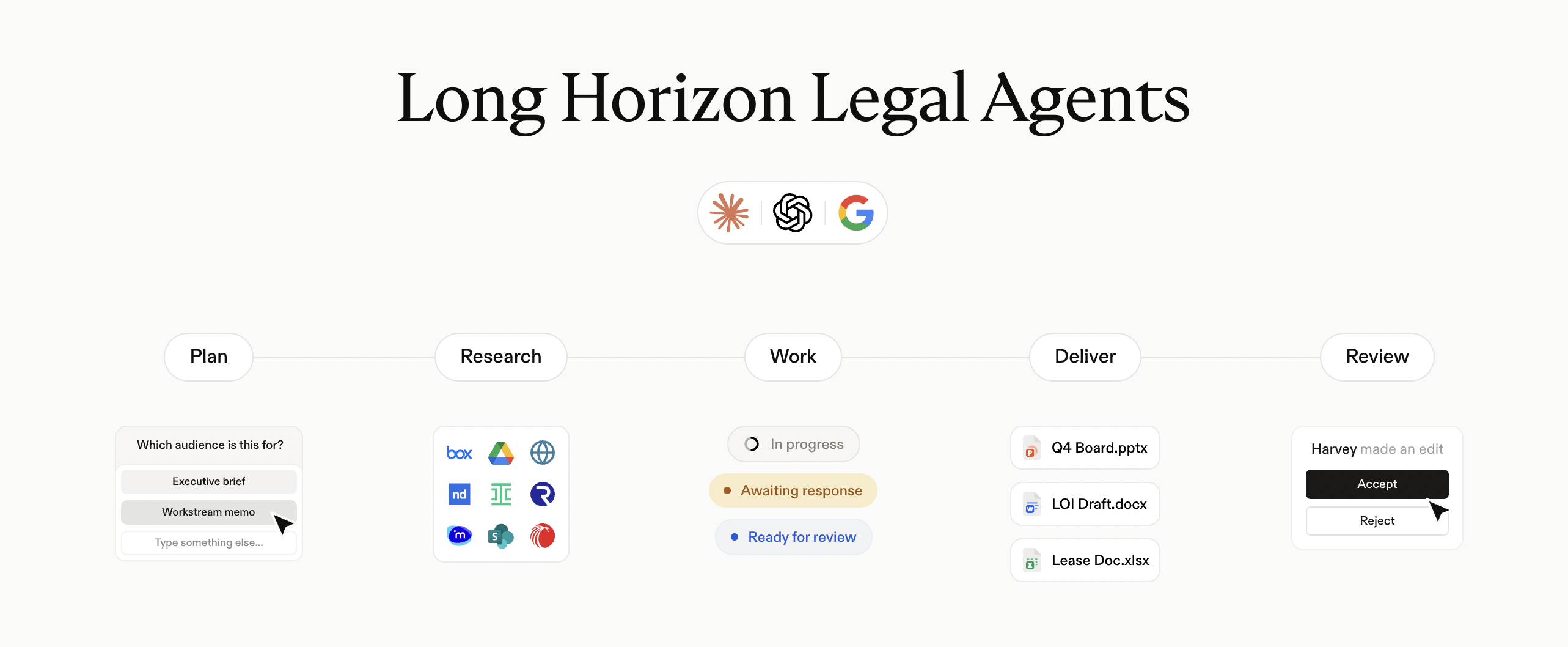
Organize work so tasks can move between agents, specialists, clients, and outside counsel without losing context.
Carry personal formatting, citation, writing, and workflow preferences across supported Harvey experiences.
Reuse team-approved structures, defined terms, negotiation positions, headings, and other work-product conventions.
Use Harvey's post-trained legal reasoning model for agent work where the platform makes it available.
Sync ethical walls and permissions from existing systems while tying usage and cost to the corresponding matter or project.
Process
Step 1
Choose a repeatable task with clear sources, review criteria, privilege requirements, and an accountable lawyer.
Step 2
Add only the relevant documents, people, tasks, permissions, ethical walls, retention rules, and approved playbooks.
Step 3
Give the agent a precise objective and require citations, issue flags, assumptions, and escalation points in the output.
Step 4
A qualified lawyer should verify authorities, facts, privilege, confidentiality, jurisdiction, reasoning, and final work product before use.
Cost
Harvey does not publish a self-serve Harvey II price list. The platform is sold through demos and organization-specific agreements. Buyers should request a written quote covering users, matters, agent usage, models, research content, integrations, storage, implementation, support, data region, and any usage-based charges.
Custom quote
A negotiated Harvey platform deployment for a law firm, legal department, or professional-services organization.
Pricing checked . Check current pricing at the source ↗
Assessment
Compare
The right alternative depends on the specific output, workflow, controls and budget your project requires.
Legal
Consider Leya for another enterprise legal workspace combining research, drafting, document analysis, and firm knowledge.
Explore Leya →Legal
Consider fynk when the priority is contract creation, collaboration, approval, and lifecycle management.
Explore fynk →Legal
Consider Legaliser for a narrower contract analysis and drafting workflow.
Explore Agreements.ai (formerly Legaliser) →Questions
Harvey II is the latest version of Harvey's legal AI platform. Its agents open inside matters or projects with the relevant Space context, work history, permissions, tasks, and user preferences.
The central change is continuity. Agents no longer need to start only from the current prompt; they can inherit the context and boundaries of a Space plus an individual's Harvey Memory.
Harvey says Memory can retain preferences such as summary structure, citation expectations, and writing patterns. Users can see what is remembered, change it, or turn it off.
Harvey says it does not use customer inputs, outputs, or uploaded documents to train underlying general models and requires zero data retention from model providers. A bespoke customer model can be created only when the customer explicitly requests it.
Harvey does not publish a standard Harvey II price. Organizations must request a demo and obtain a quote that defines included users, usage, products, integrations, support, and data terms.
No. It can perform first-pass research, review, drafting, and workflow tasks, but a qualified lawyer remains responsible for checking law, facts, citations, privilege, confidentiality, professional duties, and the final advice or work product.
Bottom line
Harvey II addresses a genuine weakness in legal AI: complex matters cannot be reduced to isolated prompts. Persistent Space context, editable Memory, ethical-wall syncing, and matter-level workflows could remove substantial repetitive setup. The same persistence raises the stakes of permissions and source quality, so the strongest implementation will pair the platform with strict matter governance and mandatory lawyer review.
Visit Harvey II website ↗
Crosby - Agentic law firm for sales teams to speed up time to signature
OpenAI's GPT-6 setup for legal research and drafting
Harvey Agents - End-to-end legal AI agents for drafting memos, diligence reports, and presentations

The only portal automating secure document sharing.

Get access to all our AI courses, hundreds of real-world AI use cases, live expert-led workshops, an exclusive network of AI early adopters, and more.
Get unlimited access to all of our current & upcoming industry-specific AI courses for the duration of your subscription.
To keep up with the rapid pace of AI, our team publishes AI implementation guides daily. Our library contains 300+ practical use cases to automate real-world work.
Join weekly, live, interactive sessions with industry leaders who are at the forefront of AI for hands-on implementation guidance and exclusive insights.
Network with an exclusive community of AI-first professionals who are working smarter with AI. Learn how early adopters are using AI in their work and businesses.