Small-business contracts
Teams creating and tracking repeatable, lower-risk agreements with a defined lawyer-review and approval process.
Independent tool overview
Agreements.ai is the current product on the former Legaliser listing. It combines AI contract analysis and chat, template-based drafting, a document editor, negotiation, version history, e-signatures, contract tracking, and higher-tier API, webhook, and MCP workflows. The Free plan supports three documents; Pro is $20 per month and Business is $100 per month. It can reduce routine contract work, but its AI risk scores, clause suggestions, templates, and electronic-signature claims still require jurisdiction-specific legal, privacy, security, and execution review.
Visit the official Agreements.ai (formerly Legaliser) site ↗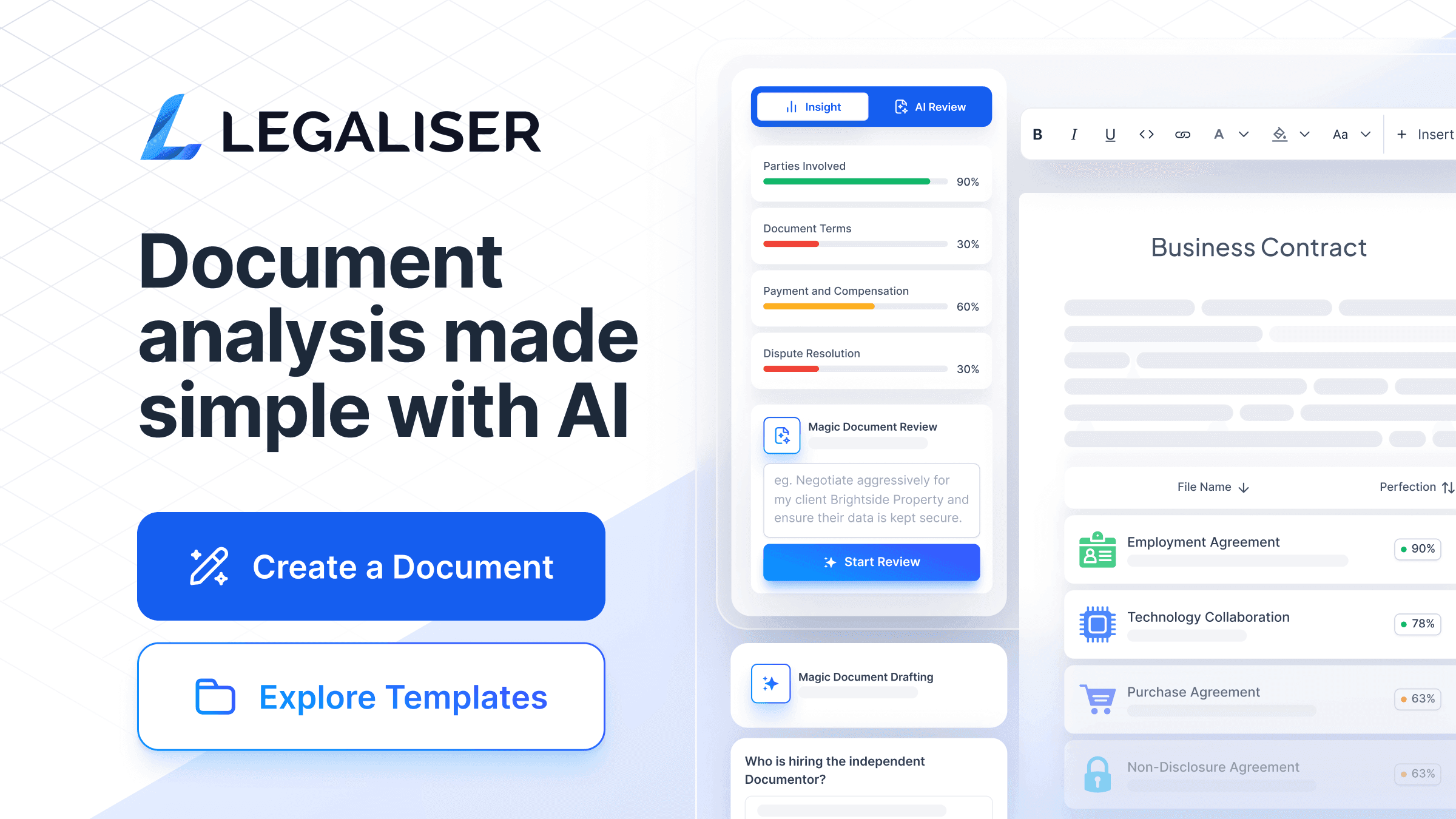
Overview
Legaliser now operates as Agreements.ai, a broader contract workflow product rather than only an analysis and drafting tool. The current platform covers document creation, AI review, editing, collaborative negotiation, signatures, audit records, storage, lifecycle tracking, and integrations from one account.
For analysis, users can upload a contract, ask questions, receive a plain-language summary, review clause-level risks, and generate suggested language. These outputs are triage aids. A risk score does not know the client's full negotiating position, related agreements, governing law, litigation posture, regulatory duties, facts, or business tolerance unless those are deliberately provided and checked.
For drafting, the service advertises more than 370 templates on paid plans, merge variables, a clause library, WYSIWYG editing, PDF and DOCX export, attachments, and version history. Many public templates cover high-impact topics such as employment, finance, property, privacy, family matters, healthcare, and powers of attorney. The site itself says important agreements should be reviewed by a qualified attorney in the relevant jurisdiction.
Agreements.ai also handles e-signatures, signing order, reminders, access codes, multi-party roles, audit trails, SHA-256 document integrity, certificates of completion, bulk sending, and Business-level lifecycle and signing analytics. Electronic-signature validity depends on applicable law and the transaction, consent, intent, attribution, record retention, exclusions, authority, and process—not simply the presence of a platform badge.
The product says customer documents are not used to train AI, and its DPA lists OpenAI as a subprocessor for contract analysis and generation. The security page advertises AES-256 at rest, TLS 1.3 in transit, Google Cloud and Firebase infrastructure, deletion controls, role-based access, and signing audit trails. Buyers should obtain evidence for Agreements.ai's own control environment rather than treating a cloud provider's certification as the application's certification.
Use cases
The strongest fit depends on the job you need the product to complete, not the size of its feature list.
Teams creating and tracking repeatable, lower-risk agreements with a defined lawyer-review and approval process.
Operations and legal teams that want fast summaries, clause extraction, issue spotting, and a structured first-pass review.
Organizations standardizing approved templates, clauses, merge fields, exports, and version history.
Businesses that want drafting, negotiation, signing, evidence records, and status tracking in the same system.
Business and Enterprise users that need bulk send, signing templates, PowerForms, analytics, API access, or webhooks.
Teams experimenting with MCP-based review or approval automation behind least-privilege access and mandatory human gates.
Capabilities
Produces summaries, clause explanations, document chat, risk scoring, issue flags, and proposed revisions.
Provides 50 templates on Free and more than 370 across business, employment, finance, family, property, technology, and other categories on paid plans.
Generates or modifies contract language in plain English within a document workflow.
Includes WYSIWYG editing, merge variables, clause reuse, attachments, PDF export, and paid DOCX and CSV options.
Tracks document changes, comments, threads, visual redlines, sharing, and the progression toward an agreed version.
Supports signatures, signing fields, multiple roles, order, reminders, access codes, bulk send, and certificates depending on plan.
Uses SHA-256 document hashing and signing-event audit trails with time, IP, device, and e-consent metadata.
Business and Enterprise plans add agreement status, signing analytics, organization, and post-signature management.
Business users can create reusable signing flows and forms for repeated agreements.
Business supports API keys and HMAC-SHA256 webhooks for document and signing automation.
Advertises AI-agent connections to contracts for review, approval, and compliance tasks, creating broader access and action risk.
Agreements.ai says documents are not used for model training and offers document or account deletion, with DPA deletion or return within 90 days after termination.
Process
Step 1
Record jurisdiction, parties, value, subject matter, deadline, risk tier, regulatory issues, related contracts, and required legal approver.
Step 2
Make sure the organization may process every party's personal data, confidential information, signatures, and protected material through Agreements.ai and its subprocessors.
Step 3
Use a lawyer-approved organizational template or clause library when available; treat a public platform template only as a draft.
Step 4
Define required terms, unacceptable positions, fallback language, approval thresholds, governing law, data obligations, and commercial facts.
Step 5
Request a summary, key dates, obligations, missing terms, unusual clauses, defined-term issues, and citations to exact document text.
Step 6
Read the full clause and related definitions, schedules, amendments, incorporation terms, and governing law rather than accepting the score or summary.
Step 7
Use approved language where possible, explain each material change, and preserve a clean comparison with the counterparty version.
Step 8
Route high-value, unusual, regulated, employment, finance, property, family, healthcare, litigation, and cross-border matters to qualified counsel and accountable owners.
Step 9
Confirm names, entities, authority, dates, exhibits, version, signature blocks, blanks, links, calculations, and negotiated changes before sending.
Step 10
Set consent, authentication, signing order, witness or counterparty roles, reminders, access controls, retention, and applicable e-sign exclusions.
Step 11
Use least-privilege API and MCP credentials, scoped environments, webhook verification, rate limits, approval gates, secret rotation, and audit monitoring.
Step 12
Export the executed agreement and evidence, record obligations and renewals, test retrieval, and enforce retention, legal hold, access, and deletion policy.
Cost
Agreements.ai offers monthly and annual billing, with the pricing page advertising a 17% annual saving. Free covers three documents and limited analysis and signatures. Pro is $20 monthly with 100,000 analysis words, unlimited uploads, 50 monthly e-signatures, and the full template library. Business is $100 monthly with 500,000 words, unlimited e-signatures, lifecycle features, API, and webhooks. Enterprise is custom. Confirm whether listed prices are per account, workspace, or seat and verify taxes, overages, retention, cancellation, and annual terms at checkout.
$0
For evaluating basic document creation, analysis, and signing.
$20/month
For individual power users and higher-volume contract work.
$100/month
For teams needing higher analysis limits, signing automation, lifecycle tools, and integrations.
Custom quote
For larger organizations needing custom scale, collaboration, integration, and support.
Pricing checked . Check current pricing at the source ↗
Assessment
Compare
The right alternative depends on the specific output, workflow, controls and budget your project requires.
Legal
An enterprise legal-agent platform for professional legal teams needing governed research, diligence, drafting, and matter workflows.
Explore Harvey Agents →Business Operations
A general assistant that can explain supplied contract text or help organize questions, but lacks Agreements.ai's dedicated templates, signing evidence, lifecycle tools, and contract workflow.
Explore ChatGPT →Project Management
A general long-context assistant useful for document comparison and drafting under a controlled enterprise workflow, without built-in contract signing or lifecycle management.
Explore Claude →Questions
Yes, but the current product is branded Agreements.ai. The legaliser.com domain serves the same current Agreements.ai platform, and the primary public site is agreements.ai.
It combines AI contract summaries, document chat, risk and clause review, templates, drafting, editing, comments, versions, e-signatures, audit records, and higher-tier lifecycle and integration features.
Yes. The Free plan includes three documents, 5,000 analysis words per month, five e-signatures per month, 50 templates, and basic AI analysis up to five times per day.
As checked August 31, 2026, Pro is $20 per month, Business is $100 per month, and Enterprise is custom. Annual billing advertises a 17% saving; confirm checkout scope and taxes.
No. It can accelerate routine intake, analysis, drafting, and execution, but important agreements and legal decisions require a qualified lawyer who understands the jurisdiction, facts, strategy, and consequences.
A template is only a starting point. Validity and enforceability depend on the parties, terms, governing law, required formalities, facts, and execution. The platform's template pages recommend lawyer review for important agreements.
The company claims ESIGN Act and UETA compliance. Actual enforceability depends on whether the law covers the transaction and whether consent, intent, identity, authority, attribution, record retention, and other formalities are satisfied.
The company says customer documents are never used to train AI models. Its DPA lists OpenAI as a subprocessor for analysis and generation, so organizations should still review processing, retention, transfer, access, and deletion terms.
The homepage displays a SOC 2 Type II claim, while the security page describes SOC 2 Type II infrastructure on Google Cloud and Firebase. Request the current report to confirm whether Agreements.ai itself, and which systems, are in scope.
The security page says users can delete documents or an account, while the DPA allows up to 90 days to delete or return personal data after termination. Confirm active-system, backup, legal-hold, and subprocessor timing for your use case.
Yes. The Business plan lists REST API keys and HMAC-SHA256 webhooks. Use scoped credentials, verify webhook signatures, rotate secrets, monitor actions, and keep human approval for consequential steps.
It connects compatible AI agents to contract workflows. Because an agent may retrieve sensitive documents or initiate reviews and approvals, test exact permissions, prompt injection, confirmation, audit, and revocation before production use.
Bottom line
Agreements.ai is a materially more complete product than the old Legaliser listing suggests. At $20 for Pro, it offers an unusually broad combination of analysis, templates, versioning, negotiation, and e-signatures for individuals or small teams; Business adds credible workflow automation. The danger is the product's ease and marketing: fast drafting is not legal correctness, a risk score is not advice, and an audit trail is not universal enforceability. Use approved templates, verify every citation and clause, obtain lawyer review for consequential work, and resolve the current security, entity, data-transfer, deletion, and SOC 2 scope questions before sensitive deployment.
Visit Agreements.ai (formerly Legaliser) website ↗
Get access to all our AI courses, hundreds of real-world AI use cases, live expert-led workshops, an exclusive network of AI early adopters, and more.
Get unlimited access to all of our current & upcoming industry-specific AI courses for the duration of your subscription.
To keep up with the rapid pace of AI, our team publishes AI implementation guides daily. Our library contains 300+ practical use cases to automate real-world work.
Join weekly, live, interactive sessions with industry leaders who are at the forefront of AI for hands-on implementation guidance and exclusive insights.
Network with an exclusive community of AI-first professionals who are working smarter with AI. Learn how early adopters are using AI in their work and businesses.


