Multilingual search teams
Evaluate one model family across retrieval workloads that span many languages.
Independent tool overview
Harrier is Microsoft's open-source family of multilingual text-embedding models for retrieval, RAG, semantic similarity, clustering, classification and reranking.
Visit the official Harrier site ↗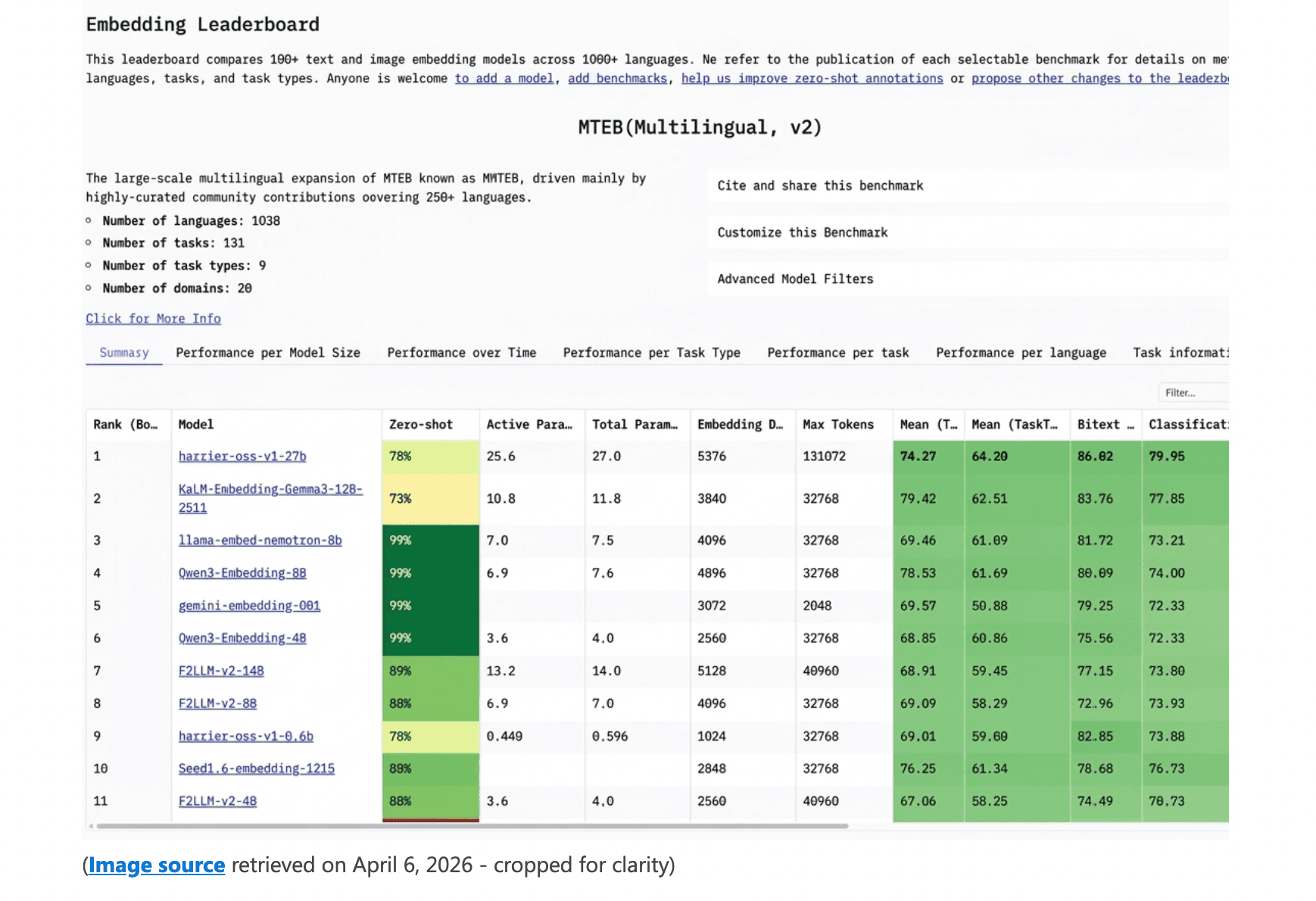
Overview
Harrier turns text into dense numerical vectors that applications can compare for semantic search, retrieval-augmented generation, clustering and related tasks. It is a model family for developers, not a chatbot or a hosted end-user search product.
Microsoft released three sizes under the MIT license: 270M parameters for lighter deployments, 0.6B for a stronger quality-to-compute balance, and 27B for maximum benchmark performance. All support inputs up to 32,768 tokens, but each produces a different fixed embedding dimension.
At release, Microsoft reported that the 27B model ranked first on Multilingual MTEB v2 across 131 tasks. That makes Harrier an important candidate for multilingual retrieval evaluation, but benchmark leadership does not establish that it will be best on a specific company's documents, queries or latency budget.
Use cases
The strongest fit depends on the job you need the product to complete, not the size of its feature list.
Evaluate one model family across retrieval workloads that span many languages.
Embed long documents and queries before vector search and generation.
Run MIT-licensed embedding weights on controlled infrastructure rather than sending text to a proprietary API.
Benchmark three model sizes with different vector dimensions and resource requirements.
Capabilities
Choose 270M, 0.6B or 27B parameters depending on the available hardware and retrieval target.
Represents text from many languages in a shared semantic vector space for cross-language and language-specific retrieval.
Accepts as many as 32,768 tokens per input according to Microsoft's model cards.
Uses last-token pooling and L2 normalization to produce fixed-size embeddings suitable for vector similarity search.
Supports query-to-document matching as the grounding layer before a generative model answers.
Can be evaluated for semantic similarity, clustering, classification, bitext mining and reranking.
Loads through Sentence Transformers or Transformers using the published Hugging Face repositories.
The MIT license permits broad commercial and internal use subject to its terms.
Process
Step 1
Collect real queries, relevant documents, hard negatives, languages and edge cases from the intended production workload.
Step 2
Start with 270M or 0.6B for practical latency, then test whether the 27B model's quality gain justifies its compute and vector-storage cost.
Step 3
Follow the model card's current instructions and keep the same model, preprocessing and vector dimension across an index.
Step 4
Compare recall, ranking quality, latency, memory, index size and downstream answer accuracy rather than relying only on public benchmarks.
Step 5
Record the exact model revision and rebuild stored document vectors when changing the model, dimension or preprocessing.
Cost
Microsoft publishes the Harrier model weights under the MIT license, so there is no model license fee. Running the models still incurs compute, memory, storage and engineering costs. Harrier is not currently presented as a Microsoft-hosted embedding API with a public usage price.
Free model weights
The smallest Harrier variant for constrained and lower-latency deployments.
Free model weights
A middle-size option intended to balance retrieval quality and deployment cost.
Free model weights
The flagship benchmark model with much higher hardware requirements.
Pricing checked . Check current pricing at the source ↗
Assessment
Compare
The right alternative depends on the specific output, workflow, controls and budget your project requires.
Miscellaneous
A managed multimodal embedding model for teams that need text, images, video and audio in one vector space.
Explore Gemini Embedding 2 →Coding
A hosted AI platform for teams that prefer managed open-model inference instead of operating model infrastructure directly.
Explore Together AI →Coding
A local model runner that may suit smaller private prototypes, though it is not a dedicated embedding benchmark family like Harrier.
Explore Ollama →Questions
Harrier is an open-source family of multilingual text-embedding models used to represent text as vectors for semantic search, RAG, similarity, clustering, classification and reranking.
The 270M model favors smaller deployments, 0.6B is the practical middle option, and 27B targets maximum benchmark quality. Test at least two sizes on real queries because the best choice depends on accuracy, latency, memory and index cost.
The model weights are available under the MIT license with no model fee. You still pay for the hardware, hosting, vector database, storage and engineering needed to run a production retrieval system.
Microsoft's model cards list a maximum of 32,768 tokens for all three Harrier OSS v1 variants.
The 270M model outputs 640 dimensions, the 0.6B model outputs 1,024, and the 27B model outputs 5,376.
Microsoft's release post says more than 100 languages, while its Hugging Face pages currently carry a 94-language label. Validate performance for each language required by your application.
Better retrieval can supply more relevant evidence to a generator and reduce unsupported answers, but the embedding model cannot guarantee factual output. Chunking, reranking, prompts, source quality and answer evaluation still matter.
Microsoft currently publishes downloadable model weights and usage examples. The release announcement discusses future grounding services, but does not present Harrier OSS as a separately priced Microsoft-hosted API.
Bottom line
Harrier is a high-priority embedding candidate for teams building multilingual search or RAG with open weights. The 0.6B model is the sensible first benchmark for most teams; the 270M version favors constrained deployments, while 27B should be justified by measured retrieval gains. Treat the leaderboard result as a reason to test Harrier, not as a substitute for evaluating real queries.
Visit Harrier website ↗
Google Edge Eloquent - Google AI Edge Eloquent — Free voice dictation app that turns messy speech into polished text, runs fully offline, no subscription, no usage caps

Lyra 2.0 - NVIDIA's new model that turns text and camera paths into explorable 3D scenes

MAI-Transcribe-1 - Microsoft's speech-to-text model with best-in-class accuracy across 25 languages
Gemini 3.1 Flash TTS - Google's new speech model with inline tags for voice direction across 70+ languages

Get access to all our AI courses, hundreds of real-world AI use cases, live expert-led workshops, an exclusive network of AI early adopters, and more.
Get unlimited access to all of our current & upcoming industry-specific AI courses for the duration of your subscription.
To keep up with the rapid pace of AI, our team publishes AI implementation guides daily. Our library contains 300+ practical use cases to automate real-world work.
Join weekly, live, interactive sessions with industry leaders who are at the forefront of AI for hands-on implementation guidance and exclusive insights.
Network with an exclusive community of AI-first professionals who are working smarter with AI. Learn how early adopters are using AI in their work and businesses.