Maintaining an existing 1.0 deployment
Teams can pin the versioned model while they evaluate whether Think Fast 2.0 changes prompts, tools, voices, latency, or customer outcomes.
Independent tool overview
Grok Voice Think Fast 1.0 is xAI's previous-generation real-time speech-to-speech model for phone support, sales, scheduling, and other tool-using voice agents; it remains documented but is deprecated in favor of Think Fast 2.0.
Visit the official Grok Voice Think Fast 1.0 site ↗
Overview
Grok Voice Think Fast 1.0 was introduced as xAI's flagship API model for real-time voice agents. It was designed to listen and speak in a single live session while reasoning through ambiguous requests, calling business tools, collecting structured details, and handling interruptions, accents, noise, and multi-turn conversations.
The model is still listed in xAI's speech-to-speech documentation as a versioned option, but xAI now marks it deprecated. On August 5, 2026, the grok-voice-latest alias moved to Grok Voice Think Fast 2.0. New deployments should use the latest alias or pin 2.0 after testing; pinning 1.0 is mainly useful when an existing production workflow depends on its exact behavior.
Think Fast 1.0 can be connected over xAI's real-time API and used with custom functions plus xAI tools such as file search, web search, X search, and remote MCP servers. The surrounding Grok Voice platform also supports WebSocket and SIP integrations, configurable voices, turn detection, live transcripts, and human handoff patterns.
This is infrastructure for developers and operations teams, not a finished call-center replacement. A production deployment still needs telephony, identity checks, permission boundaries, reliable backend tools, compliance disclosures, escalation paths, monitoring, and careful testing with real accents, noise, interruptions, and failure cases.
Use cases
The strongest fit depends on the job you need the product to complete, not the size of its feature list.
Teams can pin the versioned model while they evaluate whether Think Fast 2.0 changes prompts, tools, voices, latency, or customer outcomes.
The model was built for multi-step conversations that retrieve account information, follow policy, update records, and escalate to a person when required.
Voice agents can qualify callers, check availability, book appointments, place structured tool calls, and confirm important details aloud.
xAI positioned the model for noisy, accented, and multilingual call environments where interruptions and corrections are normal.
Capabilities
The model accepts live audio and returns streamed speech in the same real-time conversation rather than requiring teams to manually chain separate transcription, text-model, and speech APIs.
xAI designed Think Fast 1.0 to reason while the conversation continues, supporting complex and ambiguous requests without adding a separate visible reasoning step.
Agents can invoke developer-defined functions and supported xAI tools during a call, then use the results to continue the conversation.
The launch focused on capturing and reading back names, addresses, phone numbers, account identifiers, and corrected details during natural speech.
Server-side voice activity detection can identify turns and allow callers to interrupt, with configurable silence, threshold, and padding behavior.
The broader API supports SIP and common telephony audio codecs for routing phone-system and contact-center calls into real-time sessions.
Developers can choose supported built-in or custom voices, while the voice system is designed for multilingual speech and code-switching.
Teams can configure the system prompt, tools, reasoning behavior, voice, audio formats, turn detection, and other session parameters.
The explicit grok-voice-think-fast-1.0 identifier keeps an integration on this model instead of following the grok-voice-latest alias to newer releases.
Process
Step 1
For a new agent, start with Think Fast 2.0. Keep 1.0 only when testing shows that an existing production workflow needs its current behavior during migration.
Step 2
Define the permitted tasks, required disclosures, identity checks, prohibited actions, failure handling, and exact points where a human takes over.
Step 3
Authenticate server-side or use short-lived client tokens, then connect over the supported real-time API with the versioned model name.
Step 4
Expose only the functions the agent needs, validate every argument, enforce authorization in the backend, and make consequential writes reversible where possible.
Step 5
Choose the voice, input and output formats, interruption behavior, silence timing, and any pronunciation replacements needed for the use case.
Step 6
Use noisy telephony audio, accents, interruptions, corrections, ambiguous requests, tool failures, prompt injection attempts, and requests that must be refused or escalated.
Step 7
Run matched evaluations for task completion, transcription, latency, tool accuracy, cost, and customer outcomes, then move to 2.0 unless 1.0 has a documented business requirement.
Cost
xAI currently lists the deprecated Think Fast 1.0 model at $0.05 per audio minute, or $3.00 per audio hour, plus $0.004 per text input. Think Fast 2.0 costs more per audio minute and is the recommended current model.
$0.05 per audio minute
Pay-as-you-go access to the previous-generation, deprecated speech-to-speech model.
$0.08 per audio minute
The current flagship speech-to-speech model and recommended upgrade for new and existing integrations.
Pricing checked . Check current pricing at the source ↗
Assessment
Compare
The right alternative depends on the specific output, workflow, controls and budget your project requires.
Sales
A developer platform for assembling and operating voice agents across model, speech, telephony, and tool providers.
Explore Vapi →Business Operations
A managed conversational voice-agent platform focused on production phone calls and business workflows.
Explore Retell AI →Sales
A phone-agent platform aimed at automating customer calls with configurable workflows and integrations.
Explore Bland AI →Questions
xAI's current documentation still lists the versioned grok-voice-think-fast-1.0 model, but marks it deprecated. Teams should confirm availability for their account and plan a migration.
Grok Voice Think Fast 2.0 is the current flagship successor. The grok-voice-latest alias moved from 1.0 to 2.0 on August 5, 2026.
xAI currently lists 1.0 at $0.05 per audio minute, equal to $3.00 per audio hour, plus $0.004 per text input. Telephony and other infrastructure are separate.
Usually no. xAI recommends the newer 2.0 model, and its latest alias points there. The versioned 1.0 model is most relevant to existing integrations that need a controlled migration.
Pinning prevents an automatic model change while a team compares prompts, tools, voices, latency, costs, and customer outcomes. It should be a temporary compatibility decision with a migration plan.
Yes. The real-time API supports custom functions and tool types such as file search, web search, X search, MCP, and other configured functions. Backend systems must still enforce permissions and validate every action.
Yes. xAI also offers a Voice Agent Builder in beta with telephony, knowledge retrieval, tools, guardrails, and observability. That product is separate from directly integrating the model API.
The speech-to-speech platform supports SIP and telephony-oriented codecs, allowing phone-system calls to be routed into real-time sessions. Carrier, number, routing, and compliance requirements still need to be handled.
Not by default. Teams should require identity verification, narrow tool permissions, server-side policy checks, auditable logs, human approval for consequential actions, and immediate escalation when confidence or authorization is insufficient.
Bottom line
Grok Voice Think Fast 1.0 was an important step toward fast, reasoning, tool-using voice agents, but it is now a compatibility model rather than the best default. Existing users can pin it while testing migration, but new deployments should start with Think Fast 2.0 and adopt the operational controls required for any agent that can speak to customers and change business records.
Visit Grok Voice Think Fast 1.0 website ↗
Gemini Enterprise Agent Platform - Google's successor to Vertex AI and platform for building, scaling, and governing enterprise agents across 200+ models

Workflows - Mistral's enterprise tool for chaining AI agents into multi-step business processes
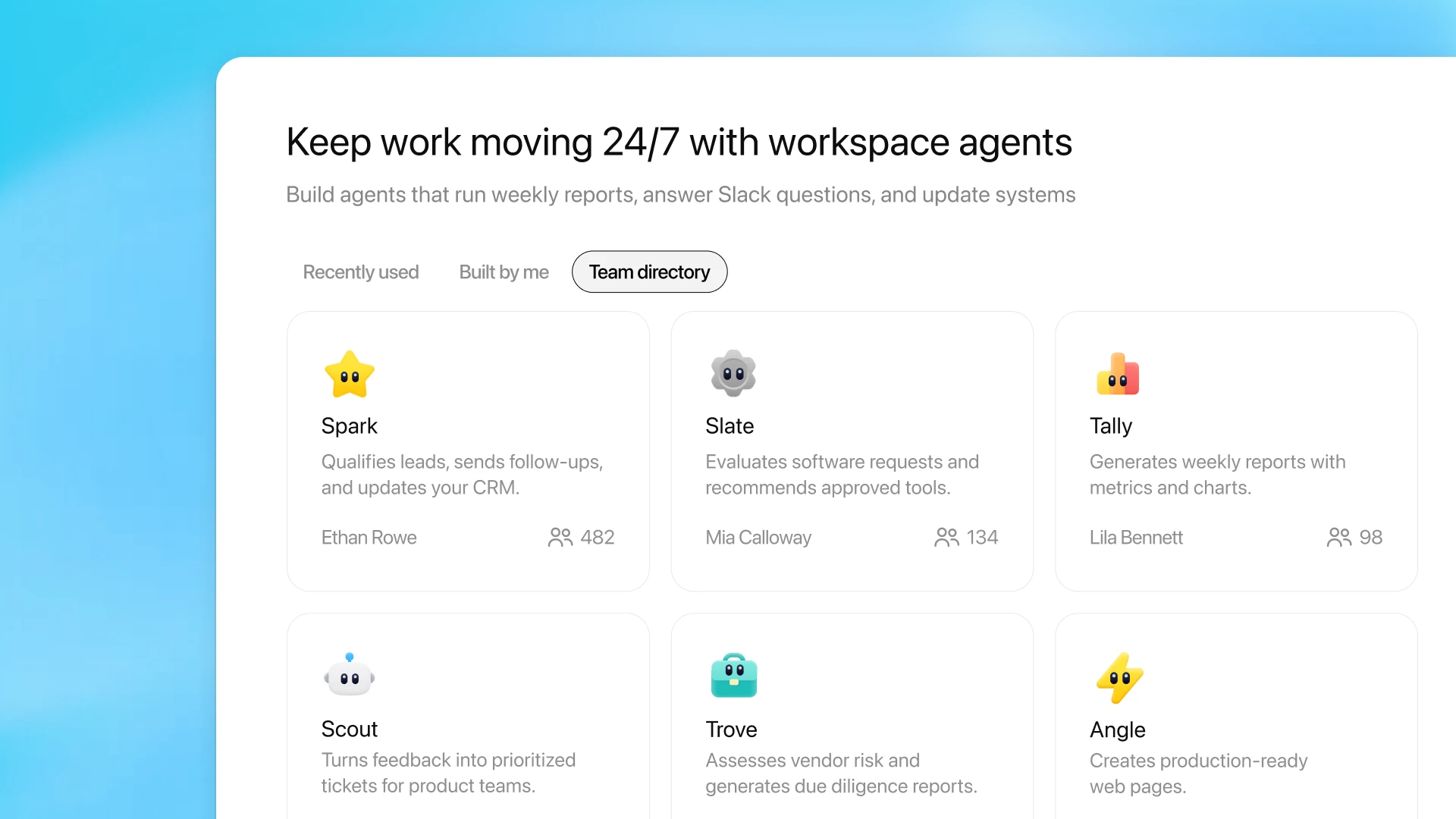
Workspace Agents - OpenAI's new Codex-powered team agents for shared multi-step workflows in ChatGPT and Slack

Manus Cloud computer - No-code environment for deploying always-on agents, scrapers, and self-hosted apps

Get access to all our AI courses, hundreds of real-world AI use cases, live expert-led workshops, an exclusive network of AI early adopters, and more.
Get unlimited access to all of our current & upcoming industry-specific AI courses for the duration of your subscription.
To keep up with the rapid pace of AI, our team publishes AI implementation guides daily. Our library contains 300+ practical use cases to automate real-world work.
Join weekly, live, interactive sessions with industry leaders who are at the forefront of AI for hands-on implementation guidance and exclusive insights.
Network with an exclusive community of AI-first professionals who are working smarter with AI. Learn how early adopters are using AI in their work and businesses.