Teams coordinating people and agents
Keep human owners, connected coding or research agents, plans, dependencies, progress, and results in one work system.
Independent tool overview
Dart is an active AI-native work management platform that has expanded from faster project administration into a shared workplace for people and software agents. Teams can manage tasks and documents, use Dart's own AI, connect outside agents such as Codex or Claude Code, coordinate multi-agent work, and keep results attached to the plan where the work began.
Visit the official Dart site ↗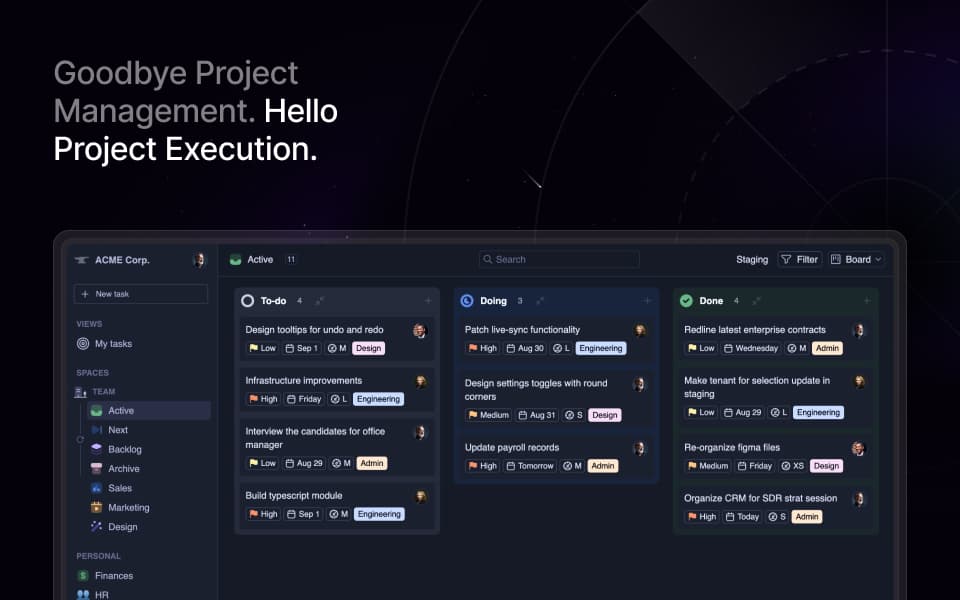
Overview
Dart still includes the project-management foundation behind its earlier time-saving pitch: tasks, documents, boards, lists, roadmaps, calendars, sprints, time tracking, dependencies, comments, notifications, and customizable workflows.
The current product is broader. Dart positions itself as a workplace for the agent era, where teams can create agents inside Dart or connect tools such as Codex, Claude Code, Cursor, Manus, OpenClaw, and other model or agent systems.
A lead agent can break a goal into a plan and coordinate specialists working in parallel or sequence. Human teammates can set direction, review progress, provide missing context, and approve results while tasks preserve ownership, status, dependencies, and outputs.
This evolution keeps the original Dart page active rather than historical. The old itsdart.com destination now leads to dartai.com, and buyers should evaluate the current agent-workplace product rather than assume it is only an AI task-writing assistant.
Use cases
The strongest fit depends on the job you need the product to complete, not the size of its feature list.
Keep human owners, connected coding or research agents, plans, dependencies, progress, and results in one work system.
Generate subtasks, fill properties, detect duplicates, prepare reports, brainstorm roadmaps, and update work through natural language.
Assign implementation to coding agents, review work from the original task, connect GitHub, and track work through test and release.
Capabilities
Creates and executes tasks, fills properties, generates subtasks, detects duplicates, and prepares reports from workspace context.
Create agents in Dart or connect external systems including Codex, Claude Code, Cursor, Manus, OpenClaw, and model-provider tools.
Lead agents plan and delegate to specialists that can research, design, build, analyze, test, or update work in parallel or sequence.
Includes tasks, docs, projects, sprints, dependencies, custom types, time tracking, comments, notifications, and multiple planning views.
Explore ideas conversationally, then move into execution while preserving the task, status, context, and delivered result.
Supports Slack, Discord, GitHub, Notion, email, calendars, Zapier, n8n, webhooks, API libraries, CLI tools, and an MCP server.
Available through web, macOS, Windows, Linux, iOS, and Android, with keyboard shortcuts and voice controls.
Process
Step 1
Set work types, statuses, owners, permissions, required fields, approval points, dependencies, and the actions agents may take.
Step 2
Start with one team and one agent workflow such as issue triage, release reporting, campaign research, or customer onboarding.
Step 3
Provide only the repositories, tasks, documents, integrations, and credentials each agent needs; require humans for consequential changes.
Step 4
Keep plans, evidence, code or content links, status changes, test results, decisions, and approvals attached to the originating task.
Step 5
Compare cycle time, administrative work, handoff delays, reopened tasks, escaped errors, and agent cost before expanding rollout.
Cost
Dart's current yearly pricing selection lists Personal at $0, Premium at $8 per teammate per month, and Business at $12 per teammate per month. Personal supports up to four teammates; paid plans allow unlimited teammates. The page advertises unlimited AI model usage, tasks, documents, and storage, but integration, governance, and advanced workflow features vary by tier. Confirm monthly rates, fair-use terms, and any costs charged by connected third-party agents or model providers before purchase.
$0/user/month
Free workspace for individuals and small teams.
$8/user/month yearly
Paid team plan with advanced AI, customization, and integrations.
$12/user/month yearly
Governance and analytics tier for larger organizations.
May cost extra
External agents, models, automation products, and infrastructure connected to Dart.
Pricing checked . Check current pricing at the source ↗
Assessment
Compare
The right alternative depends on the specific output, workflow, controls and budget your project requires.
Project Management
Consider Asana AI Teammate when the organization already runs projects in Asana and wants AI within that established work graph.
Explore Asana AI Teammates →Project Management
Consider Notion AI when documents, knowledge, and flexible databases matter more than dedicated multi-agent project orchestration.
Explore Notion AI →Business Operations
Consider Airtable when custom operational databases and app-building are the center of the workflow.
Explore Airtable →Questions
Yes. The product is active at dartai.com. Its original itsdart.com address redirects to the current site, and the platform has expanded from AI project management into a workplace for people and agents.
Dart can execute and organize tasks, fill properties, generate subtasks, detect duplicates, report on work, brainstorm and plan roadmaps, create agents, and coordinate connected agents around shared goals.
Yes. Dart currently highlights connections for Codex, Claude Code, Cursor, OpenClaw, and other agent and model systems, with GitHub integration available on paid plans.
On the yearly selection reviewed August 29, 2026, Personal was free for up to four teammates, Premium was $8 per teammate per month, and Business was $12 per teammate per month.
No. It can automate planning and administration and coordinate agent work, but humans still need to set goals, resolve ambiguity, own tradeoffs, verify results, manage risk, and approve consequential actions.
Bottom line
Dart is now more interesting as an agent workplace than as a simple AI-enhanced task manager. Teams that already coordinate work across coding agents, research agents, humans, and many integrations can gain a shared execution layer without losing conventional project controls. The product is less compelling when a team only needs lightweight tasks or cannot define clear permissions and review gates for automated work.
Visit Dart website ↗
Get access to all our AI courses, hundreds of real-world AI use cases, live expert-led workshops, an exclusive network of AI early adopters, and more.
Get unlimited access to all of our current & upcoming industry-specific AI courses for the duration of your subscription.
To keep up with the rapid pace of AI, our team publishes AI implementation guides daily. Our library contains 300+ practical use cases to automate real-world work.
Join weekly, live, interactive sessions with industry leaders who are at the forefront of AI for hands-on implementation guidance and exclusive insights.
Network with an exclusive community of AI-first professionals who are working smarter with AI. Learn how early adopters are using AI in their work and businesses.


