AWS data teams
Fits organizations already storing analytics data in Redshift and governed through AWS IAM.
Independent tool overview
Amazon Redshift is a managed cloud data warehouse that adds machine learning to SQL workflows. Redshift ML can train models through SageMaker AI, register prediction functions in the warehouse, and invoke Amazon Bedrock models for generative AI use cases.
Visit the official Amazon Redshift site ↗
Overview
Redshift's AI value starts with keeping governed warehouse data close to model work. Analysts can use SQL to create models and run predictions, while engineering teams can connect Bedrock foundation models for text generation, sentiment analysis, or translation.
It is infrastructure rather than an end-user chatbot. Teams must plan IAM, network access, warehouse cost, SageMaker or Bedrock charges, data governance, and operational monitoring before treating it as an AI application layer.
Use cases
The strongest fit depends on the job you need the product to complete, not the size of its feature list.
Fits organizations already storing analytics data in Redshift and governed through AWS IAM.
Useful when analysts need predictions or foundation-model calls without exporting every dataset into a separate application.
Capabilities
Creates, trains, and deploys models with SQL while SageMaker AI handles training.
Registers prediction functions that can run inside Redshift queries.
Official documentation covers calling Bedrock models from Redshift for generative AI tasks.
Process
Step 1
Choose training or inference data and configure IAM roles, permissions, and any required network access.
Step 2
Use CREATE MODEL for Redshift ML or configure an external model backed by Amazon Bedrock.
Step 3
Run predictions or generation from SQL, validate outputs, and track warehouse plus model-service costs.
Cost
AWS lists separate Redshift compute and storage charges; SageMaker AI or Bedrock usage can add cost.
Provisioned from $0.543/hour; Serverless from $1.50/hour
AWS lists separate Redshift compute and storage charges; SageMaker AI or Bedrock usage can add cost.
Pricing checked . Check current pricing at the source ↗
Assessment
Compare
The right alternative depends on the specific output, workflow, controls and budget your project requires.
Data Analysis
Databricks Mosaic AI is an enriched alternative for governed data and model workflows.
Explore Databricks Mosaic AI →Coding
Zep is an enriched alternative for memory and context infrastructure in AI applications.
Explore Zep →Questions
It is an AI-capable data platform. Redshift itself is a warehouse, while Redshift ML and Bedrock integrations provide native model training and generative AI functions.
Use it to prepare governed warehouse data, create or connect a model, then call predictions or generative functions from SQL.
AWS lists separate Redshift compute and storage charges; SageMaker AI or Bedrock usage can add cost.
Bottom line
Redshift is most compelling for AWS teams that want AI on warehouse data under existing controls. It is excessive for small projects that only need a lightweight vector store or hosted model API.
Visit Amazon Redshift website ↗
Serverless Google Cloud analytics platform with BigQuery ML and SQL functions for model-backed generation and analysis.

Kyligence: AI-powered analytics for data insights.
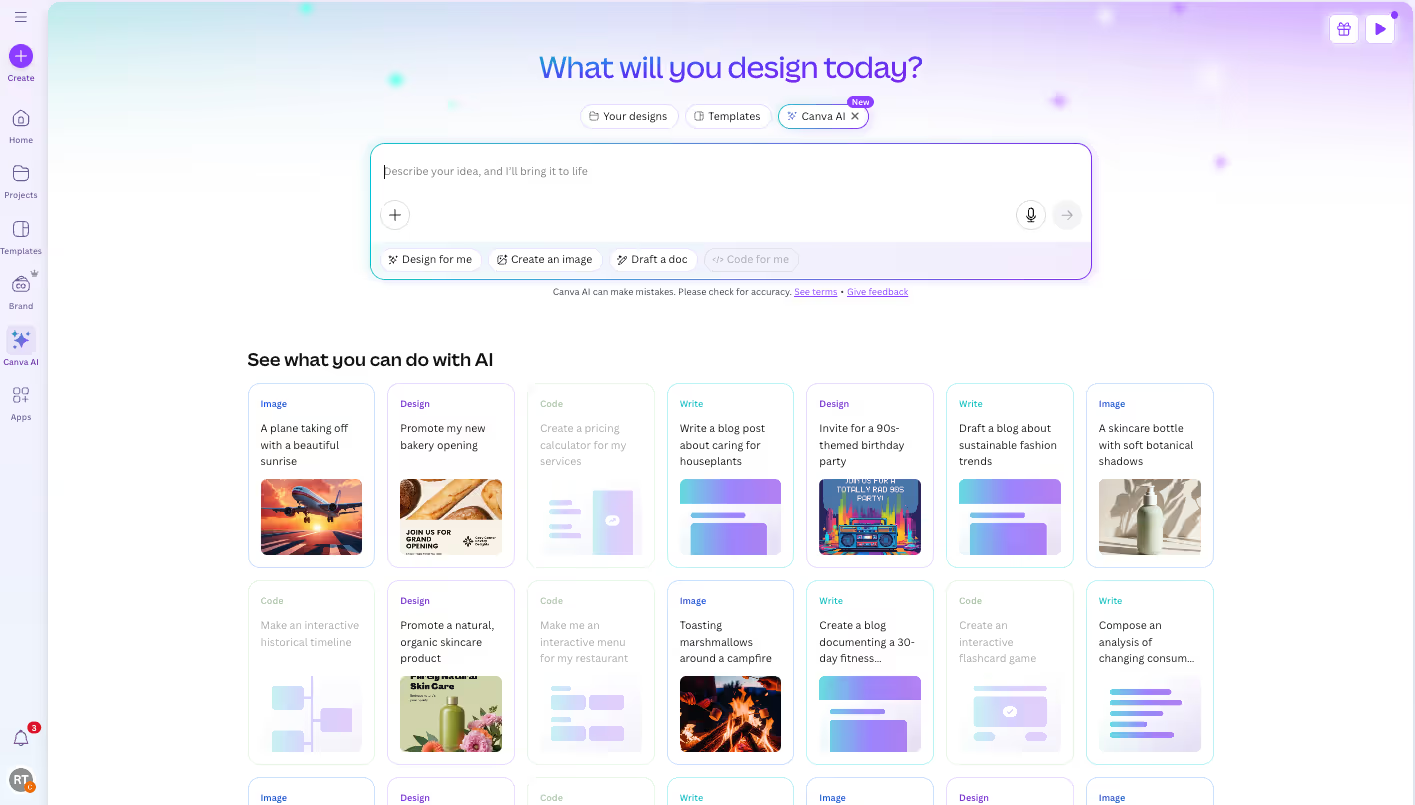
Analyze data and turn spreadsheet rows into visual, on-brand content inside Canva.

Excel queries made simple with Spreadsheet Sage.

Get access to all our AI courses, hundreds of real-world AI use cases, live expert-led workshops, an exclusive network of AI early adopters, and more.
Get unlimited access to all of our current & upcoming industry-specific AI courses for the duration of your subscription.
To keep up with the rapid pace of AI, our team publishes AI implementation guides daily. Our library contains 300+ practical use cases to automate real-world work.
Join weekly, live, interactive sessions with industry leaders who are at the forefront of AI for hands-on implementation guidance and exclusive insights.
Network with an exclusive community of AI-first professionals who are working smarter with AI. Learn how early adopters are using AI in their work and businesses.