Cross-site data extraction
Reuse one semantic schema across sites that expose similar products, listings, profiles or records with different markup.
Independent tool overview
AgentQL is an AI-powered query language and developer platform for extracting structured web data and locating elements for browser automation. Instead of brittle CSS or XPath selectors, developers describe the content or control they want and receive typed JSON or Playwright locators. It is useful for cross-site data workflows and changing interfaces, provided teams still validate every result and respect site access rules.
Visit the official AgentQL site ↗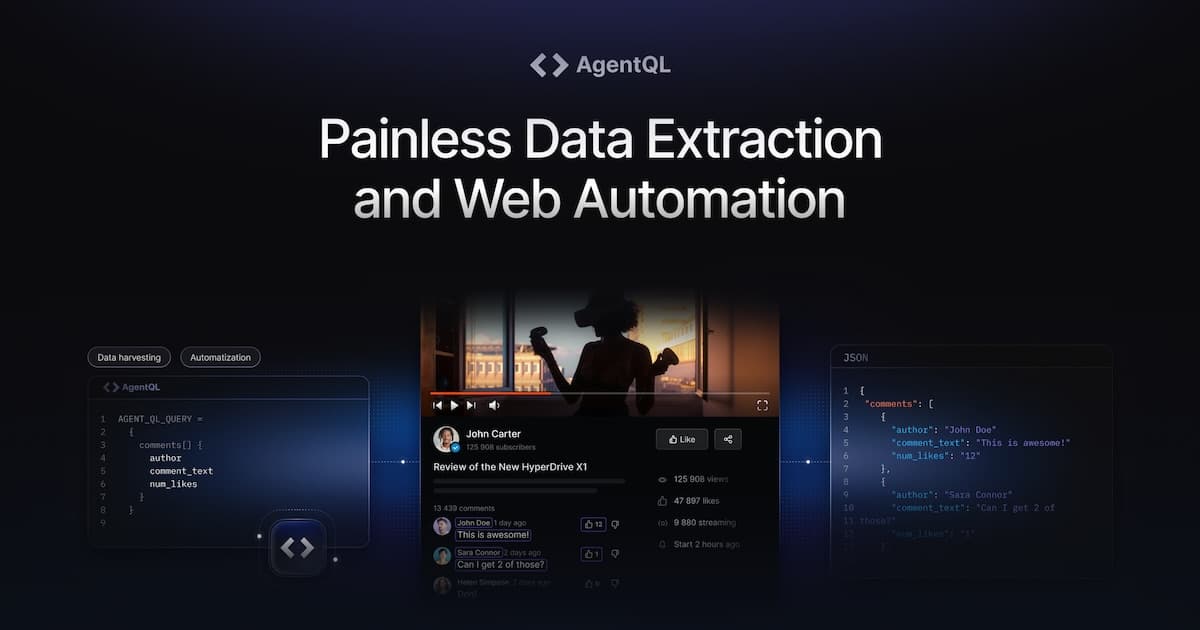
Overview
An AgentQL query resembles a small schema: name a single field, a list or nested fields, and optionally add a plain-language description. The service interprets the page semantically and returns data in the requested shape. For automation, the same approach returns elements that can be clicked, filled or otherwise controlled through Playwright.
Developers can use Python and JavaScript SDKs, a REST API, a Chrome debugger and AgentQL's managed remote browsers. The REST API can query public URLs, supplied HTML, PDFs and images, while remote sessions provide CDP access, streaming and configurable browser profiles.
Semantic selectors reduce maintenance but do not remove test engineering. A page can contain ambiguous labels, stale content, bot defenses or a redesigned user flow that is semantically similar but operationally wrong. Production automations need schema validation, assertions, screenshots, retries, rate limits and human approval before consequential actions.
Use cases
The strongest fit depends on the job you need the product to complete, not the size of its feature list.
Reuse one semantic schema across sites that expose similar products, listings, profiles or records with different markup.
Reduce maintenance when DOM structure, class names, A/B tests or minor layouts change frequently.
Add natural-language element discovery while keeping explicit browser steps, assertions and error handling in code.
Give an agent structured page data or element handles without sending entire pages through a custom LLM parsing pipeline.
Capabilities
Describe desired fields and elements with readable names, nested structure, lists and optional contextual prompts.
Return JSON shaped by the query, including type hints for fields such as integers and nested collections.
Convert semantic queries or one-off prompts into locators that a Python or JavaScript automation can interact with.
Query URLs, raw HTML, PDFs and images through HTTP from languages that do not use the native SDKs.
Allocate managed browsers with CDP connectivity, page streaming, user-agent presets, profiles and concurrency.
Test and inspect AgentQL queries in Chrome DevTools or an online playground before putting them into code.
Process
Step 1
Write the exact fields, types, required values and acceptable null behavior before choosing the semantic query.
Step 2
Test representative pages, ambiguous elements, lists and contextual descriptions with the Chrome extension or playground.
Step 3
Use local Playwright when infrastructure and sessions are controlled; use remote browsers when managed concurrency or CDP streaming is valuable.
Step 4
Check URLs, counts, types, values, page state and screenshots before accepting data or performing the next action.
Step 5
Respect site terms, robots guidance, authentication boundaries and rate limits; add retries and alerts for changed page semantics.
Step 6
Track API calls, browser hours, null rates, schema failures, incorrect matches and manual-review volume by workflow.
Cost
AgentQL bills API calls and managed remote-browser time separately. The trial includes 300 API calls and one remote-browser hour. Starter has no monthly fee but moves to usage overages after its allowances; Professional bundles larger call, browser-hour, rate-limit and concurrency allocations. Prices below were reviewed on August 29, 2026.
$0; no credit card required
A one-time evaluation allowance with full developer tools.
$0/month plus usage
For developers building smaller agents and data workflows.
$99/month
For regular data pipelines and web automations.
Custom pricing
For managed datasets, dedicated infrastructure and organizational support.
Pricing checked . Check current pricing at the source ↗
Assessment
Compare
The right alternative depends on the specific output, workflow, controls and budget your project requires.
Business Operations
A visual no-code automation platform for teams that want broader workflow orchestration without writing Playwright scripts.
Explore Gumloop →Business Operations
A browser-centered automation option for business users building repeatable workflows with less developer infrastructure.
Explore Bardeen →Agents
A computer-use model for agent developers who want model-driven interface control rather than a specialized semantic query layer.
Explore Gemini Computer Use →Questions
AgentQL is an AI-powered query language and developer platform that finds web data and interface elements by semantic description instead of fixed DOM selectors.
It is both. It can return structured page data for scraping or Playwright locators that a script uses to click, type and navigate.
Yes. Its Python and JavaScript SDK workflows wrap Playwright pages, while remote browser sessions expose CDP for compatible browser control.
Yes. The REST API includes document querying for PDFs and image files in addition to URLs and supplied HTML.
Starter is $0 monthly with 50 included API calls and 10 remote-browser hours, followed by per-call and per-hour charges. Professional is $99 monthly.
The trial includes 300 API calls, one managed-browser hour, 10 calls per minute and one concurrent remote-browser session.
AgentQL markets consistent structured results, but semantic interpretation still needs assertions and monitoring because real pages and meanings can change.
Its SDK can operate on authenticated browser pages, but the implementer is responsible for authorized access, secure credential handling and the target site's rules.
It offers browser profiles, proxies and stealth-related guidance, but those capabilities do not grant permission to ignore access controls, terms, robots rules or applicable law.
Bottom line
AgentQL is a strong fit when selector maintenance is the expensive part of a web data or Playwright workflow. Its compact schemas and semantic element lookup can reduce glue code across changing pages. Treat it as a probabilistic discovery layer inside a deterministic system: validate outputs, constrain actions, monitor two separate usage meters and obtain authorization for every site and account automated.
Visit AgentQL website ↗
Get access to all our AI courses, hundreds of real-world AI use cases, live expert-led workshops, an exclusive network of AI early adopters, and more.
Get unlimited access to all of our current & upcoming industry-specific AI courses for the duration of your subscription.
To keep up with the rapid pace of AI, our team publishes AI implementation guides daily. Our library contains 300+ practical use cases to automate real-world work.
Join weekly, live, interactive sessions with industry leaders who are at the forefront of AI for hands-on implementation guidance and exclusive insights.
Network with an exclusive community of AI-first professionals who are working smarter with AI. Learn how early adopters are using AI in their work and businesses.


