ML teams monitoring production models
Run scheduled batch checks for data quality, drift, and model performance when labels arrive.
Independent tool overview
An open-source Python evaluation library plus a managed observability platform for testing and monitoring LLM applications, predictive ML models, data quality, and drift.
Visit the official Evidently AI site ↗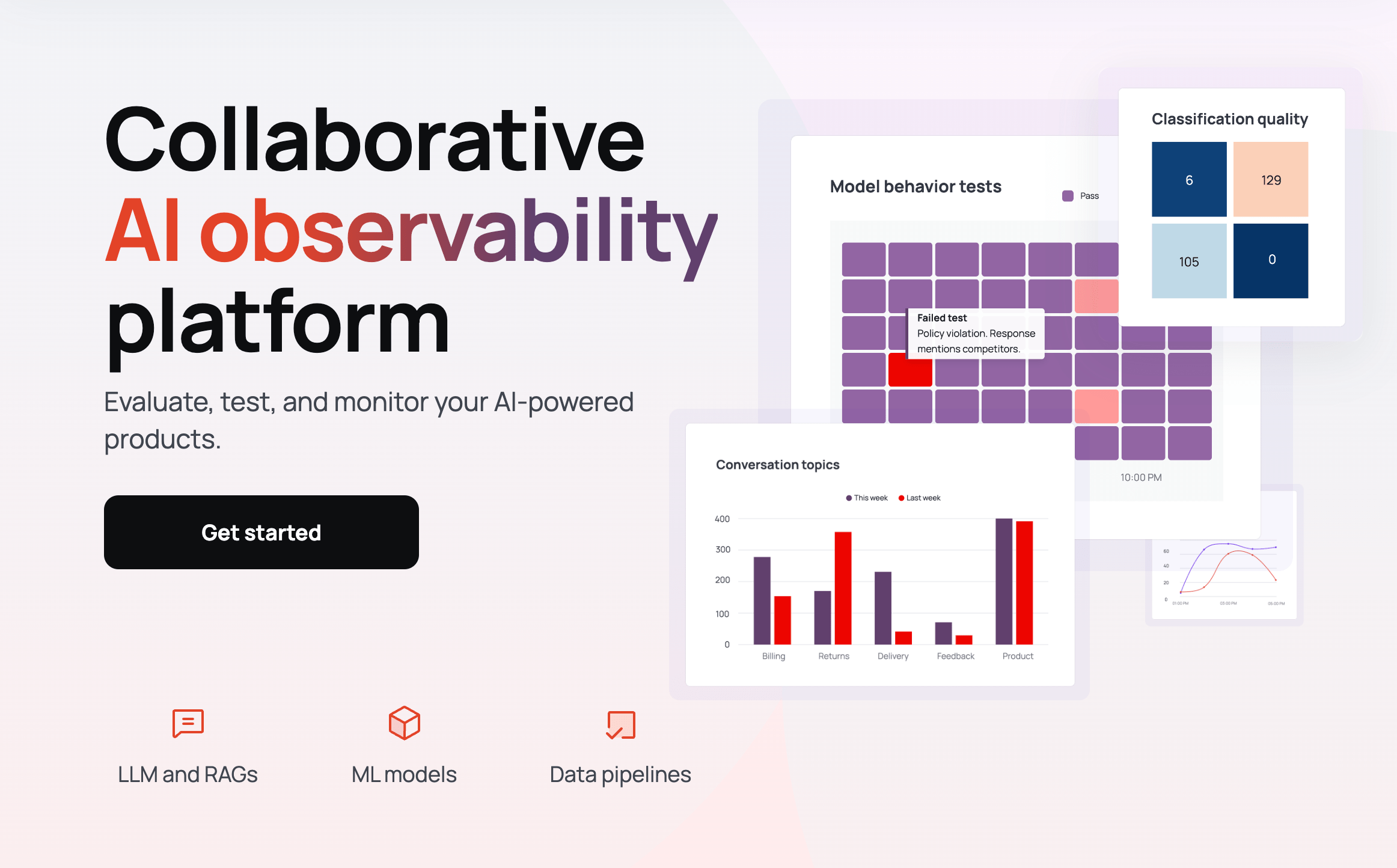
Overview
Evidently helps teams evaluate, test, and monitor AI-powered systems from experiments through production. Its Apache 2.0 open-source Python library provides more than 100 evaluations, a declarative testing API, reports, and a lightweight self-hosted interface. Evidently Cloud adds tracing, datasets, synthetic-data generation, evaluation orchestration, dashboards, alerts, collaboration, and no-code workflows.
The platform covers both generative and predictive AI. For LLM products, teams can evaluate text outputs, RAG context, prompts, models, agents, and traces using deterministic checks, custom metrics, or LLM judges. For tabular ML, it supports data quality, data and prediction drift, classification, regression, ranking, recommendation, and delayed-label monitoring.
Evidently supplies evaluation infrastructure, not the definition of quality. Teams still need representative datasets, reliable labels, product-specific rubrics, calibrated thresholds, human review, incident ownership, and a plan for privacy and cost. A dashboard full of metrics is not useful unless failures connect to release gates or operational action.
Use cases
The strongest fit depends on the job you need the product to complete, not the size of its feature list.
Run scheduled batch checks for data quality, drift, and model performance when labels arrive.
Trace agent and RAG behavior, build evaluation datasets, compare prompts or models, and monitor output quality.
Use the open-source library first, then add managed collaboration, scheduled evaluation, alerting, and governance when needed.
Capabilities
Use built-in metrics and presets for text, tabular data, embeddings, ML quality, data quality, drift, and LLM output assessment.
Turn expectations into pass, warning, or fail conditions for experiments, CI workflows, and release comparisons.
Capture inputs, outputs, intermediate steps, tool calls, latency, sessions, and dialogue using the OpenTelemetry-based Tracely library.
Organize traces or uploaded data, attach evaluation scores, compare runs, and inspect failures at row level.
Use prompt-based evaluators, deterministic checks, custom code, or external model providers for domain-specific scoring.
Track experiment and production metrics over time, drill into source reports, and configure alerts or scheduled jobs on supported plans.
Generate structured evaluation data and optimize prompts against labeled or annotated targets.
Run locally, upload scored results, store aggregated reports without raw predictions, or send traces to the managed platform.
Process
Step 1
Translate user outcomes and known failure modes into measurable criteria, severity, thresholds, and owners.
Step 2
Include normal traffic, rare segments, adversarial inputs, multilingual cases, regressions, and trusted human labels where possible.
Step 3
Prefer deterministic checks for objective rules; calibrate model-based judges against human decisions before trusting them.
Step 4
Compare prompt, model, retrieval, and pipeline changes on stable datasets and block releases on critical failures.
Step 5
Use traces or scheduled batch jobs with deliberate redaction, sampling, retention, and access controls.
Step 6
Connect sustained or high-severity failures to investigation playbooks rather than alerting on every metric movement.
Step 7
Add real production failures, re-label ambiguous examples, audit segment performance, and recalibrate judges and thresholds over time.
Cost
The open-source library is free. Evidently Cloud offers a free Developer plan, Pro at $80 per month, and custom Enterprise pricing. Pro overages are listed at $10 per additional 10,000 rows per month and $1 per extra GB of snapshot storage; external LLM judges can also create separate model-provider costs.
Free
For local evaluation, testing, and lightweight self-hosted monitoring.
$0
Managed evaluation for hobby projects and experiments.
$80/month
For teams running production AI systems.
Custom
For organizations needing custom scale, deployment, governance, and support.
Pricing checked . Check current pricing at the source ↗
Assessment
Compare
The right alternative depends on the specific output, workflow, controls and budget your project requires.
Coding
Better suited to teams primarily focused on prompt management, testing, deployment, and LLM application operations.
Explore Langtail →Educators
A lighter alternative when prompt experimentation is the core need rather than a full ML and LLM observability program.
Explore Prompt EASY →Sales
For voice-agent teams that need a production platform and telephony stack in addition to evaluation and observability.
Explore Vapi →Questions
Yes. The core Python library is open source under the Apache 2.0 license and includes more than 100 evaluation metrics, testing APIs, reports, and a lightweight local interface. Cloud and enterprise layers add managed collaboration and operational features.
Yes. It supports text and LLM evaluations, traces, RAG and agent data, deterministic checks, custom metrics, LLM judges, datasets, regression testing, dashboards, and production monitoring.
Yes. It supports tabular data quality and drift plus classification, regression, ranking, recommendation, prediction-quality, and delayed-label workflows.
Open source is suited to local evaluation, code-driven reports, and lightweight self-hosting. Cloud adds a managed web platform for traces, datasets, no-code evaluation, dashboards, alerts, scheduled workflows, collaboration, and user management.
Open source and the Developer Cloud plan are free. Pro is listed at $80 per month with 100,000 rows, 100 GB snapshots, 10 projects, and five seats. Enterprise is custom, and Pro can incur row and storage overages.
No. It gives teams a framework and a catalog of evaluators. You must supply representative data, product-specific criteria, thresholds, and validated judges, then connect failures to release or incident decisions.
Bottom line
Evidently is a strong choice for teams that want an open-source evaluation foundation with a credible path to managed LLM and ML observability. Its breadth is a strength, but the decisive work remains organizational: define quality, curate datasets, calibrate evaluators, protect production data, and make alerts operationally meaningful.
Visit Evidently AI website ↗
Get access to all our AI courses, hundreds of real-world AI use cases, live expert-led workshops, an exclusive network of AI early adopters, and more.
Get unlimited access to all of our current & upcoming industry-specific AI courses for the duration of your subscription.
To keep up with the rapid pace of AI, our team publishes AI implementation guides daily. Our library contains 300+ practical use cases to automate real-world work.
Join weekly, live, interactive sessions with industry leaders who are at the forefront of AI for hands-on implementation guidance and exclusive insights.
Network with an exclusive community of AI-first professionals who are working smarter with AI. Learn how early adopters are using AI in their work and businesses.