Short-form social publishing
Turn a repeatable idea pipeline into vertical videos for channels such as TikTok, Instagram Reels, YouTube Shorts, and LinkedIn.
Independent tool overview
Zebracat is an AI social-video platform that turns prompts, scripts, URLs, websites, and audio into edited videos with visuals, voiceovers, music, captions, branding, and optional scheduling.
Visit the official Zebracat site ↗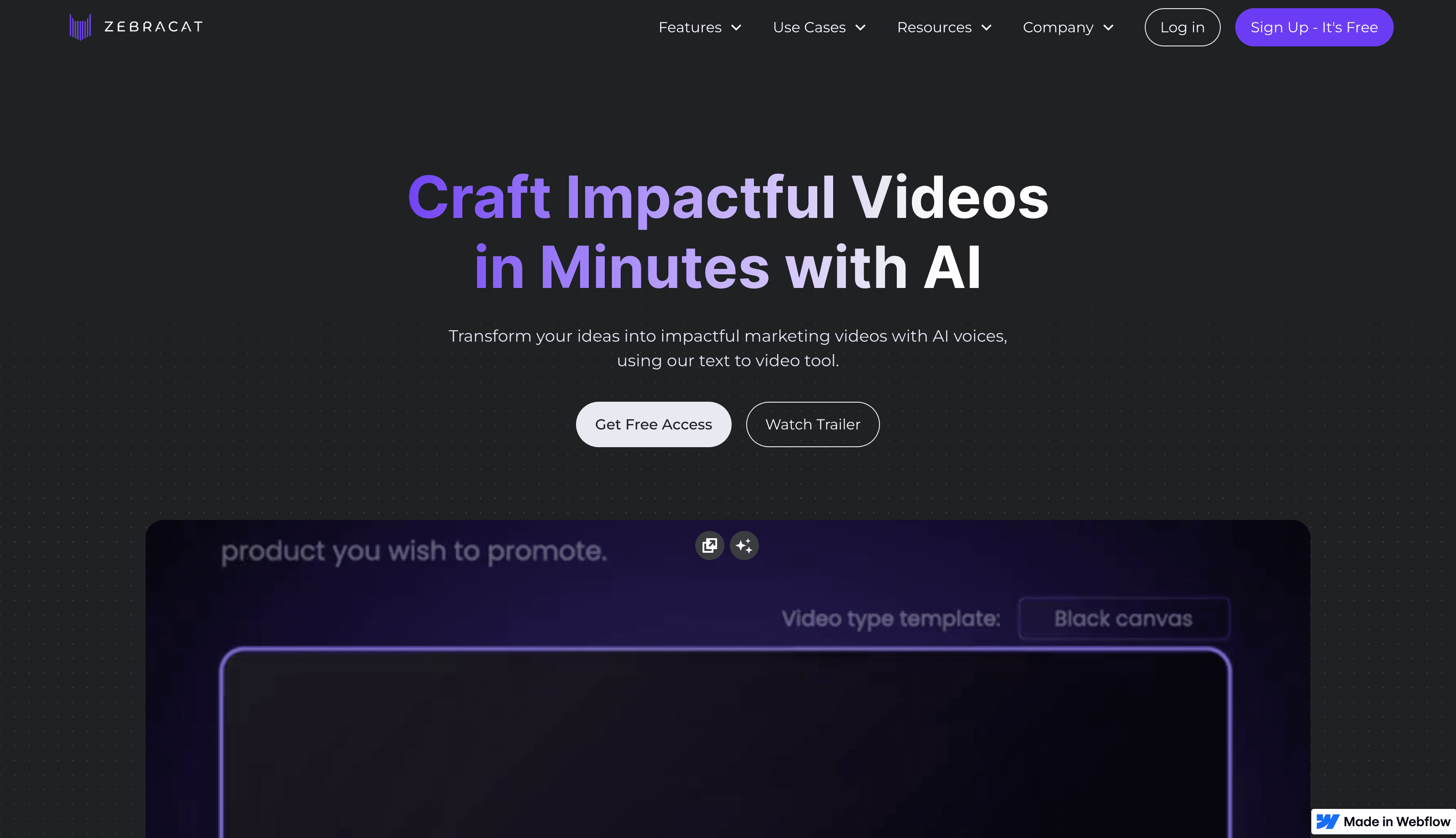
Overview
Zebracat has grown beyond a basic text-to-video generator into what it calls an AI video growth agent. It can propose content themes from a website and niche, create short-form videos, let the user revise scripts and production choices, schedule approved posts, and learn from performance data.
The creation pipeline accepts a prompt, full script, URL, website, or audio recording. Zebracat assembles a script, AI-generated or stock visuals, voiceover, captions, music, pacing, and branding, with editor controls for replacing or regenerating individual elements before export.
Higher plans add generative video credits, custom avatars, voice cloning, translation, more brand kits, and faster processing. Zebracat also offers an MCP connection that lets compatible AI clients request videos using the user's existing account and credits; Enterprise adds API access and broader governance.
The platform can accelerate repeatable social content, but the finished video still needs editorial, factual, legal, accessibility, and brand review. Paid commercial permission does not transfer rights to a third party's voice, face, logo, footage, claims, music outside its license, or other material the user was never authorized to use.
Use cases
The strongest fit depends on the job you need the product to complete, not the size of its feature list.
Turn a repeatable idea pipeline into vertical videos for channels such as TikTok, Instagram Reels, YouTube Shorts, and LinkedIn.
Combine scripts, stock or generated scenes, synthetic voices, music, and captions without recording an on-camera presenter.
Convert an existing URL or audio asset into a visual cut instead of beginning from a blank timeline.
Produce first drafts quickly, then revise scenes, text, timing, voice, and brand elements in one browser workflow.
Use higher tiers for custom avatars, voice clones, translation, lip-sync, and multiple brand kits—with documented consent and review.
Capabilities
Builds a complete first cut from a short idea, prepared script, article, or website content.
Transcribes a voiceover, podcast, or interview clip and adds scenes, captions, music, and editing.
Uses generative video or image models plus stock libraries depending on plan, credit balance, and creative choice.
Generates hooks, narrative structure, and calls to action that remain editable before publication.
Offers standard and premium synthetic voices, with higher tiers supporting reusable voice clones.
Provides public avatar options and higher-plan custom avatars or digital twins for presenter-led videos.
Automatically captions videos and supports multilingual voice workflows, with higher tiers adding video translation and lip-sync.
Applies logos, colors, fonts, styles, and reusable brand kits, with plan-dependent limits.
Can schedule approved videos to connected social channels and use performance results to inform future concepts.
MCP uses an existing Zebracat account and credits; Enterprise advertises API access for custom integrations.
Process
Step 1
Define the audience, placement, duration, aspect ratio, desired action, and success metric before generating.
Step 2
Paste an approved script or source page and identify the exact facts, quotations, product details, and claims the video may use.
Step 3
Choose stock versus generated scenes, faceless versus avatar-led presentation, voice, language, music mood, captions, and brand kit.
Step 4
Use a short test to learn how video counts, generative credits, edits, and voice regeneration affect the plan allowance.
Step 5
Check every visual against the narration and replace hallucinated products, people, places, interfaces, diagrams, or events.
Step 6
Correct pronunciation, emphasis, translation, names, numbers, timing, caption text, and reading order.
Step 7
Confirm ownership or permission for uploaded assets, brands, people, voices, music, likenesses, testimonials, and client material.
Step 8
Apply ad disclosures, synthetic-media labels, accessibility requirements, music-license evidence, and each destination's current policy.
Step 9
Keep automatic publishing behind a human gate until the final render, destination, caption, links, timing, and account are verified.
Step 10
Track retention, qualified clicks, conversions, comments, and production cost—not only views—and use results to revise the next batch.
Cost
Zebracat's live plan cards list Cat Mode at $39/month, Super Cat at $99/month, Unlimited Cat at $199/month, and Enterprise from $599/month. Annual equivalents are displayed as $23, $59, and $119 per month. Plan limits combine video counts, generative AI credits, editing allowances, avatar or voice-clone quotas, and other features. Public free-plan descriptions conflict, so confirm the exact allowance inside the current signup and billing interface.
$0
Testing access with 720p, short videos, standard voices, and no credit card.
$39/month or $23/month billed yearly
Entry paid plan for frequent short social videos.
$99/month or $59/month billed yearly
Adds custom presenters, more credits, localization, and richer media.
$199/month or $119/month billed yearly
Highest self-serve tier for larger output volume.
From $599/month
Custom plan for teams and embedded workflows.
Pricing checked . Check current pricing at the source ↗
Assessment
Compare
The right alternative depends on the specific output, workflow, controls and budget your project requires.
Marketing
Consider Synthesia when structured presenter-led business, training, and localization workflows matter more than social-first faceless content.
Explore Synthesia →Content Creator
Consider OpusClip when the main job is finding and reframing short clips from existing long-form video rather than generating a full video from text.
Explore OpusClip →Content Creator
Consider LTX Studio when shot planning, storyboarding, scene continuity, and more hands-on generative filmmaking control are the priority.
Explore LTX Studio →Questions
Zebracat is an AI video and social-growth platform that turns prompts, scripts, pages, websites, and audio into edited videos with narration, visuals, music, captions, and branding.
It offers no-card testing access, but its public pages currently describe the Free allowance differently. The live pricing FAQ says up to five 30-second 720p videos total, while other pages mention recurring credits. Confirm inside the account.
As reviewed September 1, 2026, monthly prices are $39 for Cat Mode, $99 for Super Cat, and $199 for Unlimited Cat. Annual equivalents are shown as $23, $59, and $119 per month. Enterprise starts at $599 monthly.
Plans combine a number of videos, generative AI credits, free edits, avatar creation, voice-clone creation, and feature limits. A single finished video can use more than one kind of allowance.
Yes. It can use a URL or source text to draft the script and assemble scenes, voiceover, captions, music, and editing. Verify every claim and visual against the source.
Yes. It can transcribe a voiceover, podcast, or interview and create supporting visuals and captions around it.
Yes. Cat Mode has limited public avatars; Super Cat and Unlimited Cat include monthly custom-avatar creation, and Enterprise advertises unlimited enterprise-quality custom avatars.
No. Zebracat says a person may clone someone else's voice only with that speaker's explicit permission. Keep documented consent and define the permitted scripts, languages, channels, duration, and revocation process.
Zebracat grants commercial use on paid subscriptions and excludes it from Free. You still need rights to all uploaded or depicted people, voices, brands, assets, claims, and client materials.
Zebracat says it does not claim ownership of the user's videos and grants paid users publishing and commercial rights to included media. That promise does not eliminate third-party rights or platform rules.
Paid plans remove the Zebracat watermark. Free exports are described as watermarked.
Yes. Zebracat says its licensed music can still be flagged by automated systems. Download the track license from the project and follow the platform's dispute process carefully.
Its current product positioning includes scheduling and posting to connected social channels. Keep final publishing behind human approval until content, account, timing, caption, links, rights, and disclosures are checked.
It is an MCP connection that lets compatible AI clients call Zebracat video creation. It uses the existing Zebracat account and credits rather than a separate plan.
Create a representative video, record every credit and edit consumed, test factual accuracy, scene quality, captions, pronunciation, brand controls, export, music licensing, and the exact monthly or annual limits shown at checkout.
Bottom line
Zebracat is a practical choice for creators and small marketing teams that need a high cadence of short social videos and value an integrated path from idea to scheduled post. The strongest fit is repeatable, human-reviewed content rather than cinematic control. Before paying, run a representative project and verify credit consumption and checkout terms, because the public site currently mixes new plan cards with conflicting older Free and pricing descriptions.
Visit Zebracat website ↗
Get access to all our AI courses, hundreds of real-world AI use cases, live expert-led workshops, an exclusive network of AI early adopters, and more.
Get unlimited access to all of our current & upcoming industry-specific AI courses for the duration of your subscription.
To keep up with the rapid pace of AI, our team publishes AI implementation guides daily. Our library contains 300+ practical use cases to automate real-world work.
Join weekly, live, interactive sessions with industry leaders who are at the forefront of AI for hands-on implementation guidance and exclusive insights.
Network with an exclusive community of AI-first professionals who are working smarter with AI. Learn how early adopters are using AI in their work and businesses.


