Existing Transistor publishers
The add-on keeps transcription, editing, RSS delivery, and the episode website in the same hosting dashboard.
Independent tool overview
Transistor AI Transcription is a paid add-on for Transistor podcast-hosting accounts that converts episodes to editable, speaker-labeled transcripts and publishes or exports them in common caption and web formats.
Visit the official Transistor AI Transcription site ↗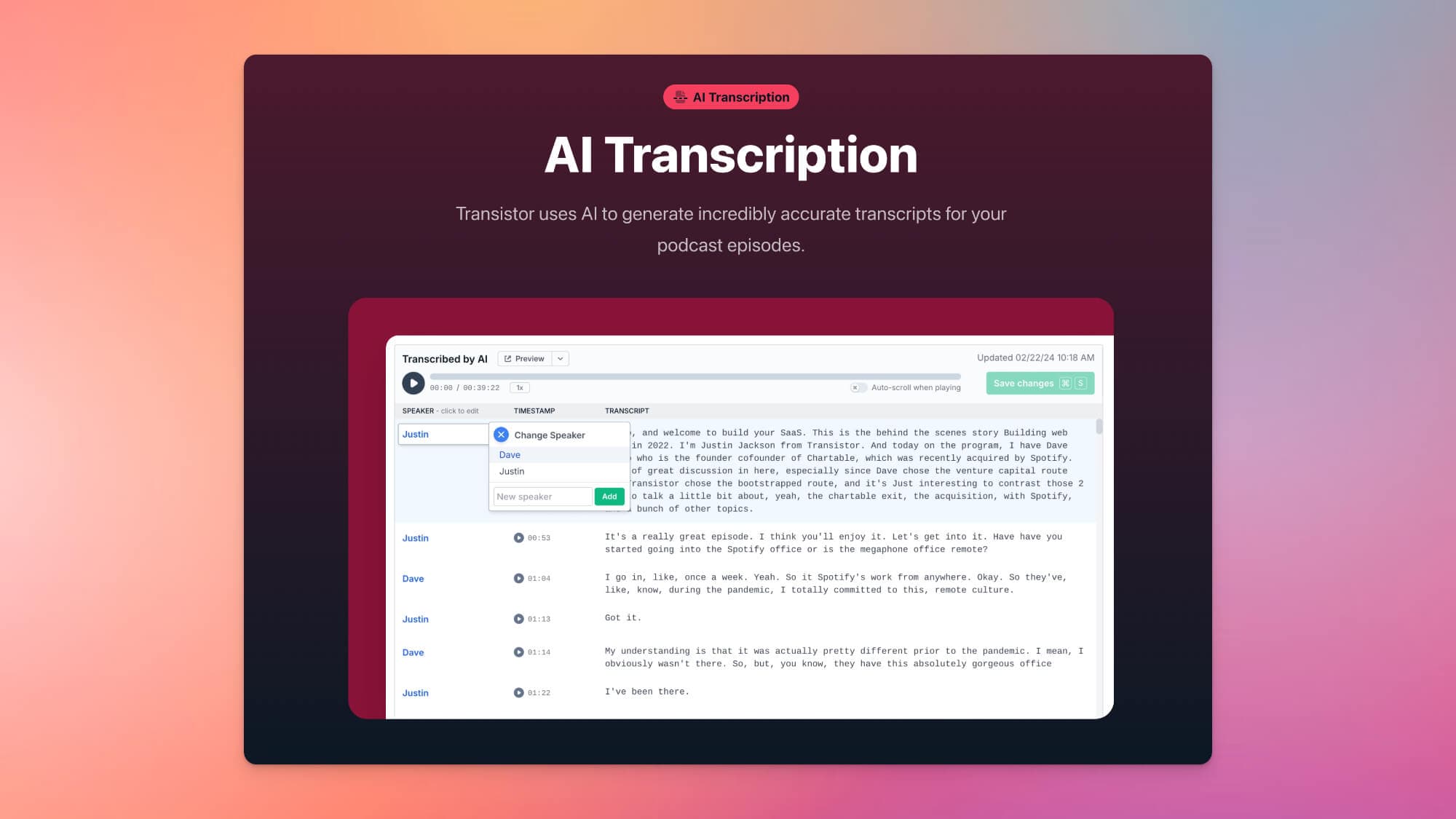
Overview
Transistor AI Transcription is not a standalone transcription service. It sits inside Transistor's podcast-hosting workflow: a publisher opens an episode, spends transcription credits, reviews the generated text, fixes wording and speaker labels, and can expose the finished transcript through a hosted episode page and podcast RSS metadata.
The feature uses Deepgram for speech-to-text, automatically detects speakers, supports more than 50 spoken languages, and exports SRT, VTT, JSON, HTML, and plain text. That makes it useful for accessibility, searchable episode pages, captions, quotations, and repurposing, particularly for publishers already paying Transistor to host several shows.
Transistor explicitly says the output is not 100% accurate. Names, jargon, accents, overlapping speech, low-quality audio, and speaker changes require editorial review. A transcript should never be published as an exact record—or used for sensitive legal, medical, personnel, or compliance decisions—without checking it against the audio.
Use cases
The strongest fit depends on the job you need the product to complete, not the size of its feature list.
The add-on keeps transcription, editing, RSS delivery, and the episode website in the same hosting dashboard.
Transistor allows multiple podcasts and collaborators on one base account, so shared transcription credits can fit a network workflow.
VTT, SRT, and RSS-linked transcript pages can make spoken content available to more listeners after a human quality pass.
Editable text and timestamped formats can speed up show notes, quotations, articles, social clips, and research.
Capabilities
Generates a transcript from audio already attached to an episode in a Transistor account.
Automatically separates speakers into labeled sections, which users can rename and correct in the editor.
Lets publishers edit individual words, split or merge paragraphs, correct speaker labels, replay timestamps, and delete text.
Downloads plain text, SRT and VTT captions, timestamped JSON, or web-ready HTML.
Creates a shareable web transcript with timestamps for each episode.
Adds the transcript location to the RSS feed so compatible podcast applications can display it.
Advertises transcription for more than 50 spoken languages.
Publishers can instead paste or upload an externally created SRT, VTT, TXT, or JSON transcript.
Process
Step 1
Use clean, separated microphones where possible and listen for severe noise, crosstalk, or missing audio before spending credits.
Step 2
Save the episode in Transistor and select its Transcripts tab.
Step 3
Start transcription and spend one account credit per minute of audio.
Step 4
Correct names, numbers, technical language, paragraph boundaries, and speaker identities while replaying the relevant timestamps.
Step 5
For sensitive interviews or quotations, confirm the text with the responsible editor or speaker before making it public.
Step 6
Use the hosted page and RSS transcript, or download the format required by a website, video platform, caption tool, or archive.
Step 7
Verify formatting, accessibility, timestamp links, indexing intent, redactions, and mobile readability after publication.
Cost
AI transcription requires a Transistor hosting plan plus an optional monthly credit add-on. On September 1, 2026, base hosting started at $19 per month, and transcription cost $5 for 300 minutes or $20 for 1,200 minutes. Credits replenish on the account renewal date; retranscribing an episode uses more credits.
60 minutes included
A limited test allocation for eligible Transistor accounts.
$5/month add-on
Monthly pool for lower-volume podcast transcription.
$20/month add-on
Larger monthly pool for frequent or multi-show publishing.
$19/month
Lowest-priced base subscription required to use the add-on.
$49/month
Base hosting plan with higher audience limits and publishing automation.
$99/month
Base hosting plan for larger publishers.
Pricing checked . Check current pricing at the source ↗
Assessment
Compare
The right alternative depends on the specific output, workflow, controls and budget your project requires.
Content Creator
Choose Descript when transcript-based audio and video editing, recording, and broader production tools matter more than an integrated hosting add-on.
Explore Descript →Content Creator
Choose Riverside when high-quality remote recording and an end-to-end studio workflow are the primary requirements.
Explore Riverside →Project Management
Choose Otter.ai for meeting-oriented live notes and collaboration rather than podcast hosting and RSS transcript delivery.
Explore Otter.ai →Questions
It is an optional add-on inside Transistor's podcast-hosting service that converts episode audio into editable, speaker-labeled text.
No. It is designed for episodes in a Transistor account and requires a base hosting subscription after the trial.
On September 1, 2026, it cost $5 per month for 300 minutes or $20 per month for 1,200 minutes, in addition to hosting, which started at $19 per month.
Transistor says eligible accounts receive 60 transcription credits, enough to test up to one hour of audio. The hosting service separately offers a 14-day trial.
Transistor explicitly says it is not 100% accurate. Quality depends on the recording, speakers, language, accent, crosstalk, names, and subject matter, so every public transcript needs review against the audio.
The feature outputs SRT, VTT, JSON, HTML, and TXT. These cover common caption, structured-data, web, and plain-text uses.
It attempts automatic speaker detection. Editors can correct speaker names, split or merge paragraphs, and revise labels in the transcript editor.
Transistor can publish a timestamped web page and include the transcript reference in the episode RSS feed for compatible podcast apps. Publishers can also download it for other destinations.
Yes. Transistor supports pasted or uploaded SRT, VTT, TXT, and JSON transcripts, so the built-in AI is optional.
Yes. The help documentation says reprocessing a transcript consumes credits again.
Do not assume so from the feature page alone. Audio is hosted by Transistor and processed by Deepgram for transcription. Obtain current data-processing, retention, subprocessor, geographic, and security details before handling confidential or regulated material.
A well-edited, useful transcript can make episode content indexable and easier to navigate. Search value is not guaranteed, and a raw machine transcript should be corrected, structured, and paired with a clear episode summary.
Bottom line
Transistor AI Transcription is a strong convenience add-on for publishers already hosting on Transistor: it is inexpensive, produces useful formats, and removes several steps between episode audio and an accessible web transcript. Its main limitation is the same as every automated transcript—plausible text is not necessarily correct. Budget for editorial review, obtain consent for sensitive recordings, and test a representative hour before committing the back catalog.
Visit Transistor AI Transcription website ↗
LTX Studio empowers creators with AI-driven filmmaking capabilities.

Evaluates website content for helpfulness, relevance, and quality.

Make your Twitter game go viral.

Save time with AI-powered podcast optimization.

Get access to all our AI courses, hundreds of real-world AI use cases, live expert-led workshops, an exclusive network of AI early adopters, and more.
Get unlimited access to all of our current & upcoming industry-specific AI courses for the duration of your subscription.
To keep up with the rapid pace of AI, our team publishes AI implementation guides daily. Our library contains 300+ practical use cases to automate real-world work.
Join weekly, live, interactive sessions with industry leaders who are at the forefront of AI for hands-on implementation guidance and exclusive insights.
Network with an exclusive community of AI-first professionals who are working smarter with AI. Learn how early adopters are using AI in their work and businesses.