Topic-based RSS digests
Combine trusted publications and blogs into a scheduled briefing about one subject.
Independent tool overview
Tidyread is an AI-assisted RSS reader that groups feeds into customizable recipes, filters and summarizes articles, translates titles, and delivers digests on a schedule.
Visit the official Tidyread site ↗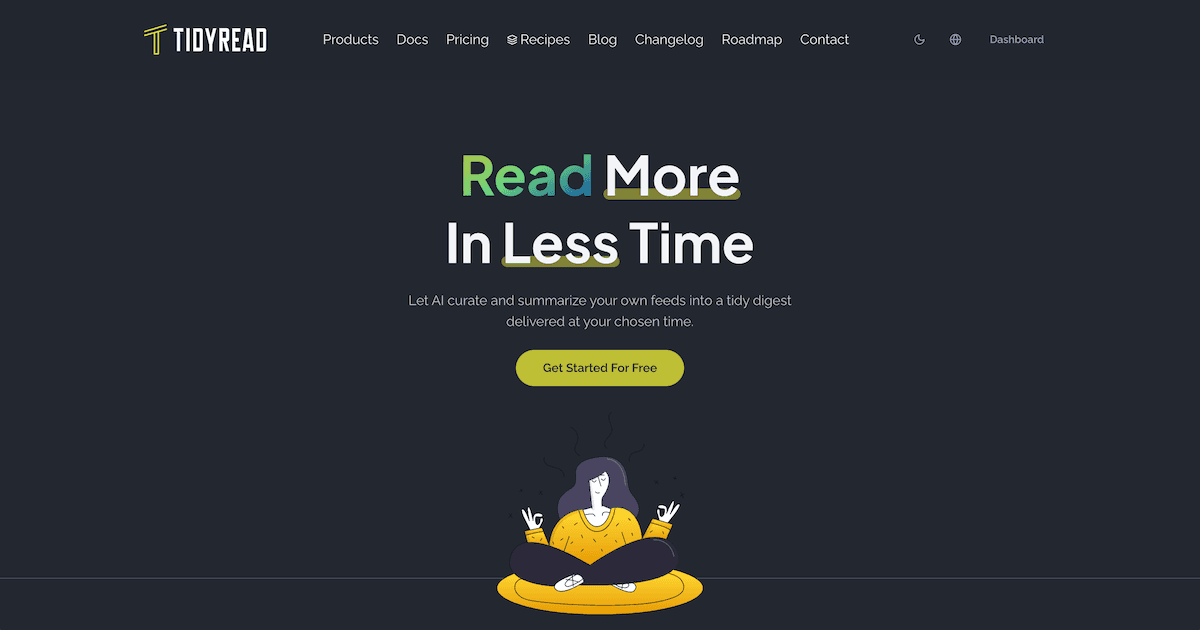
Overview
Tidyread is built around deliberate subscription reading rather than an endless algorithmic feed. Users import or add RSS sources, group them into topic-specific Recipes, choose summary and filter prompts, and select when each digest should arrive.
The core reader, feeds, recipes, filters, and full-text extraction are available on the free tier. AI summaries, translation, AI filtering, custom prompts, and email delivery consume a separate token allowance. Most feed and digest data is described as living locally in the browser.
The product is active, but one adjacent feature—Magic Feed, which generated new RSS feeds—is explicitly no longer maintained. Tidyread is therefore best understood as a reader and summarizer for sources that already expose usable feeds, not a universal feed-creation service.
Use cases
The strongest fit depends on the job you need the product to complete, not the size of its feature list.
Combine trusted publications and blogs into a scheduled briefing about one subject.
Translate titles and create summaries that help triage sources written in other languages.
Receive material at chosen times instead of repeatedly checking an infinite feed.
Use keywords and AI prompts to reduce irrelevant items inside a known set of subscriptions.
Capabilities
Add feeds directly, use the built-in source search, or import an existing OPML file.
Group sources by topic and give each group its own description, prompts, filters, schedule, and pause state.
Summarize feed entries or optionally fetched full article text with a default or custom prompt.
Uses AI tokens to translate titles and support multilingual triage.
Remove items that do not meet a stated topic or relevance rule before they reach a digest.
Build digests at chosen times and, on the paid token package, push them through email.
Set input, output, daily, monthly, global, and Recipe-level limits and pause AI work.
Presents collected items in a cleaner interface while preserving access to the source.
Process
Step 1
Subscribe to publications and authors you would still trust without an AI summary; use OPML for an existing collection.
Step 2
Keep each digest focused enough that one prompt and filter policy make sense across its sources.
Step 3
Use feed content first, enabling full-text scraping only where the publisher permits it and summary quality justifies the extra tokens.
Step 4
Open representative originals and compare names, numbers, qualifications, uncertainty, dates, and conclusions.
Step 5
Set token caps, pause low-value feeds, and adjust delivery frequency based on what you actually read.
Step 6
Use the digest for triage, then consult the full primary source before citing, sharing, investing, treating, or acting on important information.
Cost
Tidyread's current page is framed as buying more tokens, not a conventional monthly subscription. It shows Free with 2 million tokens, a Silver package at $9.99 for 15 million tokens, and custom service. The page does not clearly label whether Silver is a one-time purchase or recurring charge, so verify checkout and token expiration before paying.
$0
Core RSS reading plus an initial token allowance.
$9.99
Adds 15 million tokens and unlocks the paid AI and email features shown.
Contact Tidyread
One-to-one service for needs beyond the published packages.
Pricing checked . Check current pricing at the source ↗
Assessment
Compare
The right alternative depends on the specific output, workflow, controls and budget your project requires.
Students
Choose Gemini Notebook when you want deeper synthesis and questions across a curated source collection rather than recurring RSS delivery.
Explore Gemini Notebook (formerly NotebookLM) →Data Analysis
Consider Perplexity for on-demand web research with citations when live discovery matters more than a fixed subscription feed.
Explore Perplexity →Data Analysis
Consider Link Reader for a lighter workflow centered on reading or summarizing individual links instead of managing scheduled Recipes.
Explore Link Reader →Questions
Tidyread is an AI-assisted RSS reader that organizes subscriptions into topic Recipes, filters and summarizes entries, and generates digests on a chosen schedule.
Yes. The core site, pricing, account, and documentation remain active. Its separate Magic Feed generator is explicitly no longer maintained.
The public page shows Free with 2 million tokens, Silver at $9.99 for 15 million tokens, and custom service. It does not clearly state whether Silver recurs or whether tokens expire, so confirm checkout terms.
AI summaries, title translation, and prompt debugging consume tokens. Long source text, longer outputs, full-text scraping, and complex prompts use more.
Yes. Tidyread supports OPML import as well as direct feed entry and a small built-in source search.
The Silver package advertises digest email push. The free product can build and display digests in the extension.
Its privacy page says subscribed feeds and generated digests are mostly stored locally in browser IndexedDB, while identity, billing, and usage data are stored in Supabase. AI processing still requires a clearer current data-flow explanation.
It can fetch full text when enabled, subject to site access and permissions. This consumes more tokens and should not be used to bypass paywalls or publisher restrictions.
Use summaries for triage only. Open the original for important facts, quotations, risk, health, finance, law, or any decision where missing context matters.
Gemini Notebook is stronger for a curated source notebook, Perplexity is better for live on-demand research, and Link Reader is a lighter single-link workflow.
Bottom line
Tidyread offers a thoughtful antidote to feed overload: user-chosen sources, topic Recipes, scheduled delivery, and strong usage controls. Its core workflow is useful and inexpensive, but buyers should clarify the Silver billing model and the current AI data flow. The safest habit is to let summaries decide what to read—not what to believe.
Visit Tidyread website ↗
Get access to all our AI courses, hundreds of real-world AI use cases, live expert-led workshops, an exclusive network of AI early adopters, and more.
Get unlimited access to all of our current & upcoming industry-specific AI courses for the duration of your subscription.
To keep up with the rapid pace of AI, our team publishes AI implementation guides daily. Our library contains 300+ practical use cases to automate real-world work.
Join weekly, live, interactive sessions with industry leaders who are at the forefront of AI for hands-on implementation guidance and exclusive insights.
Network with an exclusive community of AI-first professionals who are working smarter with AI. Learn how early adopters are using AI in their work and businesses.


