Deep podcast listeners
Skim an episode first, capture its main ideas, and return to the exact transcript section later.
Independent tool overview
Podwise converts podcast episodes and uploaded audio into searchable transcripts, summaries, mind maps, clips, translations, Q&A, and reusable notes for listeners and research workflows.
Visit the official Podwise site ↗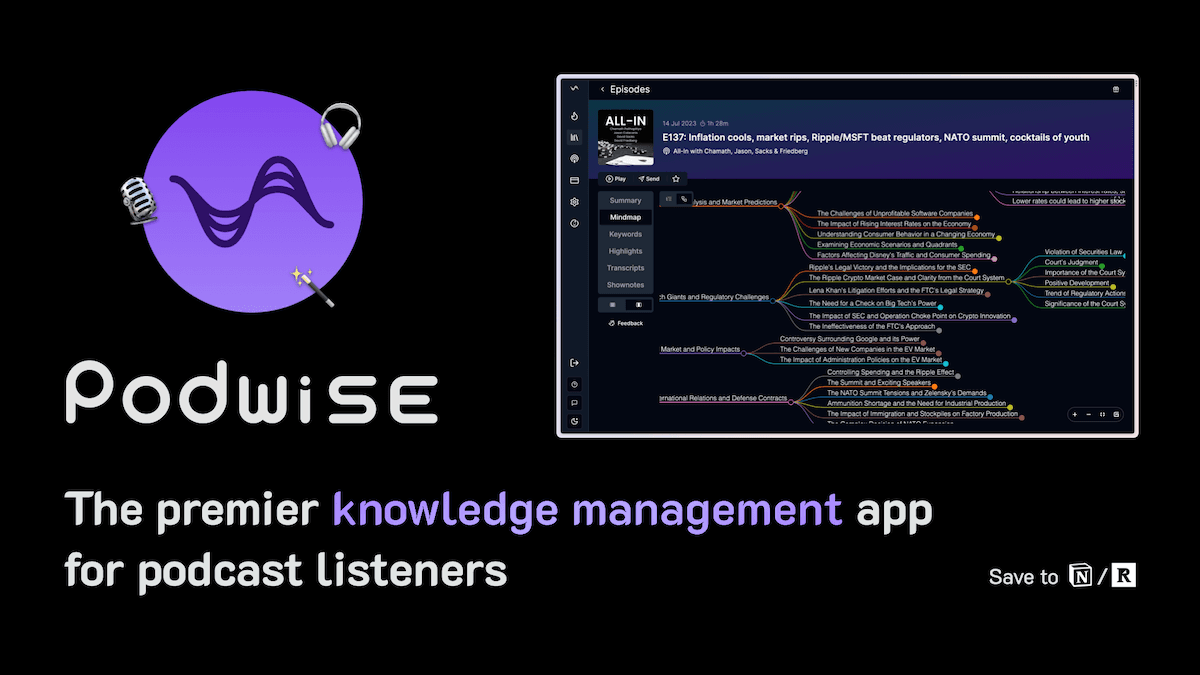
Overview
Podwise is built for people who listen to learn. It turns long podcast episodes into structured material—transcripts, summaries, key insights, mind maps, clips, and searchable passages—so a useful idea can be found and reused without replaying an entire conversation.
The service accepts public podcast sources including Apple Podcasts, Spotify, YouTube, and RSS, plus private feeds and uploaded audio where the account and content rights allow. Results can be sent to Notion, Readwise, Obsidian, or Logseq, or downloaded as XMind, Markdown, and PDF files.
Podwise has also expanded into automation. Pro and Enterprise include an Open API, command-line client, skills, and an MCP server so AI assistants can search episodes, retrieve transcripts, answer questions, and export structured results. That is unusually capable for a listener-oriented product, but summaries and quotations still need to be checked against the recording.
Use cases
The strongest fit depends on the job you need the product to complete, not the size of its feature list.
Skim an episode first, capture its main ideas, and return to the exact transcript section later.
Search across episodes, compare claims, and export source material into an existing notes system.
Turn lectures or educational shows into structured notes and use translation to study material across supported languages.
Find quotations, themes, and reusable clips without manually scrubbing every recording.
Use Pro’s API, CLI, skills, or MCP server to retrieve and transform podcast knowledge programmatically.
Capabilities
Generate summaries, top takeaways, key insights, outlines, transcripts, and mind maps from podcast audio.
Ask questions about an episode and receive answers grounded in its processed content.
Find topics, quotations, and relevant moments across the episodes in a Podwise library.
Process and read episodes across 12 languages to make foreign-language shows easier to study.
Select a point in a transcript and produce a focused excerpt with text, takeaways, and playable media.
Use supported public directories, RSS and private feeds, or upload audio when you have the right to process it.
Send material to Notion, Readwise, Obsidian, and Logseq or download XMind, Markdown, and PDF files.
Pro and Enterprise expose podcast discovery, processing, transcripts, Q&A, clips, and exports through an API, CLI, skills, and MCP.
Podwise links to an iOS app and a direct Android APK in addition to its web experience.
Process
Step 1
Find a public episode, bring an RSS or private feed, or upload audio you are authorized to process.
Step 2
Use an included monthly credit when an episode is not already available in Podwise’s processed corpus.
Step 3
Start with the summary, outline, takeaways, and mind map to identify the sections worth deeper attention.
Step 4
Open the transcript around a cited moment and listen to the original audio before relying on a quotation or conclusion.
Step 5
Question a single episode or search the broader library for recurring ideas, people, or evidence.
Step 6
Save notes and clips into the preferred knowledge app or download them in a portable file format.
Step 7
Connect the API, CLI, skill, or MCP server when the same podcast-research process needs to run repeatedly.
Cost
Podwise has basic free access plus Standard, Pro, and Enterprise subscriptions. Standard costs $9.90 monthly or $70.80 yearly; Pro costs $19.90 monthly or $142.80 yearly. Enterprise starts at $299 per month. Standard and Pro include a 7-day trial, and extra processing credits cost more.
$0
Basic access for trying the Podwise library and workflow.
$9.90/month or $70.80/year
For regular listeners who need core processing, Q&A, translations, clips, uploads, and exports.
$19.90/month or $142.80/year
Adds higher processing capacity and automation access.
From $299/month
For teams and higher-volume or private processing workflows.
Pricing checked . Check current pricing at the source ↗
Assessment
Compare
The right alternative depends on the specific output, workflow, controls and budget your project requires.
Content Creator
Choose this for a broader knowledge base that summarizes and organizes several content types, not only podcasts.
Explore Recall →Content Creator
Use this when the primary need is transcription inside a podcast-publishing workflow.
Explore Transistor AI Transcription →Content Creator
Compare this for a simpler YouTube-focused summarization experience.
Explore Video Summarizer AI →Content Creator
Consider Async, formerly Podcastle, when producing and editing podcasts is more important than learning from them.
Explore Async (formerly Podcastle) →Questions
Podwise turns podcast episodes and uploaded audio into transcripts, summaries, takeaways, mind maps, searchable passages, clips, translations, and question-answering interfaces.
A free account is available for basic access, but Podwise does not fully itemize its limits on the public plan comparison. Standard and Pro include a 7-day trial.
Standard is $9.90 monthly or $70.80 yearly. Pro is $19.90 monthly or $142.80 yearly. Enterprise starts at $299 per month, and additional processing or seats can cost extra.
A credit is used to process a public podcast episode that is not already available in Podwise’s AI corpus. Standard includes 20 each month and Pro includes 50.
Podwise lists YouTube among its supported listening sources. It is optimized around podcast and spoken-audio knowledge rather than general visual-video analysis.
Yes. Standard, Pro, and Enterprise can save to Notion, Readwise, Obsidian, and Logseq and download XMind, Markdown, and PDF files.
Yes. The Open API is included with Pro and Enterprise. Enterprise also includes a separate API for customer-provided audio processing.
Yes. Pro and Enterprise include a command-line client, agent skills, and an MCP server that expose Podwise content and actions to compatible assistants.
Its privacy policy says uploaded audio is stored to provide transcription and related features and can be deleted from the account. It says original public-podcast audio is not retained, though transcripts and generated results may be.
Bottom line
Podwise is one of the more complete tools for converting podcasts into a durable research library. Standard is the sensible choice for a regular listener who processes fewer than 20 new episodes monthly; Pro earns its higher price when 50 credits, unlimited Q&A, or agent access are genuinely useful. The product saves review time, but it does not remove the need to listen to source passages before publishing a quote, making a decision, or treating a summary as fact.
Visit Podwise website ↗
Get access to all our AI courses, hundreds of real-world AI use cases, live expert-led workshops, an exclusive network of AI early adopters, and more.
Get unlimited access to all of our current & upcoming industry-specific AI courses for the duration of your subscription.
To keep up with the rapid pace of AI, our team publishes AI implementation guides daily. Our library contains 300+ practical use cases to automate real-world work.
Join weekly, live, interactive sessions with industry leaders who are at the forefront of AI for hands-on implementation guidance and exclusive insights.
Network with an exclusive community of AI-first professionals who are working smarter with AI. Learn how early adopters are using AI in their work and businesses.


