Smart-home prototypes
Build voice control for known devices through MQTT, REST APIs or custom integrations.
Independent tool overview
OpenHome is an open-source voice-agent platform for developers and device makers who want to build conversational smart speakers, IoT controls and custom hardware without being locked to one model vendor. Its Voice SDK combines wake words, speech recognition, model routing, speech generation and hardware I/O; developers extend agents with Python-based Abilities. The platform is promising for prototypes and controlled deployments, but buyers should treat its developer hardware program, local-processing claims and production enterprise terms as separate decisions.
Visit the official OpenHome site ↗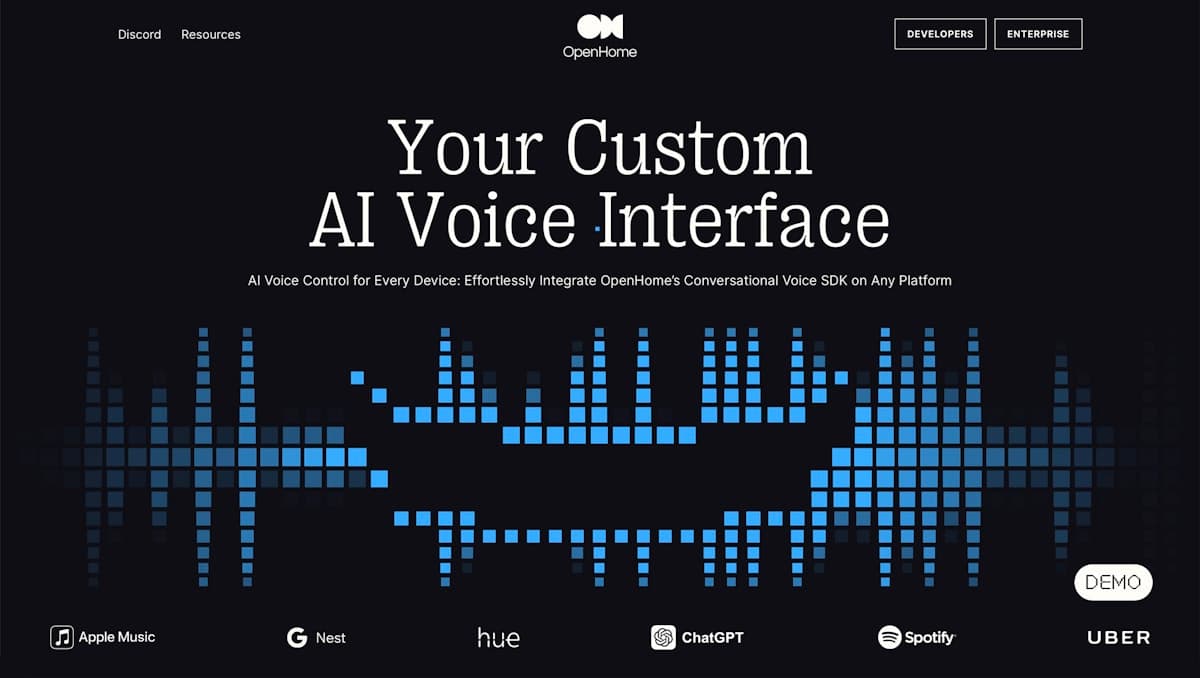
Overview
OpenHome is a developer platform for putting conversational AI into smart speakers, appliances, robots and other Linux-based hardware.
The Voice SDK bundles the voice pipeline—wake word, speech-to-text, LLM routing, text-to-speech and hardware input/output—so teams can focus on their device behavior.
Agents, also called Personalities, combine a model, voice and prompt; Abilities are Python plugins that add actions such as API calls, device control and multi-step conversations.
Abilities can run on a spoken trigger, be selected by the agent, operate as background daemons or interact directly with local DevKit hardware.
The platform is model-agnostic and advertises compatibility with providers such as OpenAI, Anthropic and Google, plus support for simple quantized models on-device.
Smart-home integrations can use REST APIs, MQTT, Bluetooth and custom hardware interfaces; published examples include Hue lights, calendars, email and scheduled briefings.
OpenHome's DevKit is aimed at builders rather than ordinary consumers and requires an application while the limited program rolls out.
The companion iPhone app provisions Wi-Fi, manages personalities and controls supported DevKit settings; it is not a standalone replacement for the hardware.
Open-source Ability templates and the Python client lower the barrier to prototyping, but a production product still needs hardware engineering, observability, security and support.
Local hardware ownership can improve control, yet privacy depends on the complete configuration because selected speech, model and third-party API providers may still process data in the cloud.
Voice-triggered device actions should be narrowly scoped and require confirmation for purchases, locks, alarms, messages and other consequential operations.
OpenHome is best evaluated as an extensible voice-AI stack, not as a finished mass-market Alexa or Google Home replacement.
Pricing and availability were checked on August 31, 2026; public pages did not publish a standard paid software plan or a generally available DevKit retail price.
Use cases
The strongest fit depends on the job you need the product to complete, not the size of its feature list.
Build voice control for known devices through MQTT, REST APIs or custom integrations.
Add an end-to-end conversational stack to speakers, appliances, toys or robots.
Choose among hosted providers or compatible local models instead of tying the product to one LLM.
Create focused Abilities from templates and use familiar code for actions and multi-turn flows.
Test ambient and multimodal device concepts with configurable personalities, sensors and hardware I/O.
Assess a licensable voice intelligence layer before negotiating production requirements and support.
Capabilities
Coordinates wake words, transcription, model routing, speech output and device I/O in one stack.
Configures voices, prompts, conversation styles and capabilities as reusable Personalities.
Extends an agent with API calls, device commands, file operations and multi-step workflows.
Supports triggered skills, agent-selected actions, background daemons and local hardware routines.
Routes to different model providers and supports some local quantized-model configurations.
Works with MQTT, REST interfaces, Bluetooth devices, sensors and supported smart-home hardware.
Provides a reference hardware platform with compute, audio, Wi-Fi, Bluetooth, Matter/Thread and expansion options.
Lets teams create personalities and manage abilities through a visual dashboard.
Offers starter patterns for simple commands, APIs, loops, background work and hardware control.
Supports shared official and community abilities, with source available for review and adaptation.
Uses an iPhone companion app for nearby discovery, Wi-Fi setup and DevKit controls.
Offers custom licensing and deployment discussions for OEM and larger device programs.
Process
Step 1
Choose a narrow voice use case and list the devices, data and real-world actions it can reach.
Step 2
Apply for a DevKit or verify compatible Linux hardware, microphones, speakers and connectivity.
Step 3
Decide which wake-word, speech, LLM and voice components run locally or through hosted services.
Step 4
Set the Personality's voice, model, behavior and boundaries in the OpenHome dashboard.
Step 5
Use the closest official Ability pattern instead of beginning with unrestricted custom code.
Step 6
Give the Ability access only to the specific API endpoints, devices and credentials it needs.
Step 7
Require an explicit confirmation for transactions, entry controls, alarms, communications and destructive actions.
Step 8
Evaluate accents, background noise, interruptions, ambiguous device names and accidental trigger phrases.
Step 9
Simulate network loss, unavailable providers, stale device state and partial execution before deployment.
Step 10
Document which audio, transcripts, prompts and identifiers leave the device and how long each provider retains them.
Step 11
Keep API keys out of shared code, rotate them, and isolate device credentials from general agent context.
Step 12
Start with a noncritical room or test environment and limit the people able to issue commands.
Step 13
Log device calls and errors without storing unnecessary raw audio or sensitive transcript content.
Step 14
Add integrations only after the previous Ability is reliable, understandable and recoverable.
Cost
OpenHome does not publish a conventional self-service pricing table. The open-source Ability ecosystem can be used without a software license fee, a limited DevKit is offered at no cost to accepted program applicants, and enterprise deployments require a sales conversation. Hardware, model, speech, hosting and third-party API charges can still apply.
Free
MIT-licensed Ability templates and community code.
Free for accepted applicants
Limited hardware access through an application-based developer program.
Hardware and usage costs vary
Run compatible components on developer-supplied Linux hardware.
Contact sales
Licensing and support for OEM or larger device deployments.
Pricing checked . Check current pricing at the source ↗
Assessment
Compare
The right alternative depends on the specific output, workflow, controls and budget your project requires.
Business Operations
Choose Voiceflow for a more mature visual platform for designing and managing conversational agents.
Explore Voiceflow →Sales
Choose Vapi for developer-focused hosted voice agents, telephony and programmable call infrastructure.
Explore Vapi →Business Operations
Choose Retell AI when the main requirement is production phone agents rather than custom physical hardware.
Explore Retell AI →Marketing
Choose ElevenLabs when high-quality speech generation and hosted conversational voice are the priority.
Explore ElevenLabs →Questions
OpenHome is an open-source voice-agent SDK and device platform for building conversational smart speakers, IoT controls, robots and other hardware.
Not primarily. It is a development platform and DevKit for builders; a production-ready household experience still requires configuration, integrations and operational work.
The published Ability ecosystem is open source, and accepted applicants may receive a free limited DevKit. Hardware, hosted models, speech services, APIs and enterprise support can still cost money.
It supports local processing and some quantized models on compatible hardware, but an installation may still use hosted speech, LLM or API providers. Verify the entire data path.
An Ability is a Python plugin that lets an agent call APIs, control devices, play media, store data or run a multi-step workflow.
Builders can use the OpenHome DevKit or compatible Linux-based hardware with suitable compute, microphone, speaker and network connectivity.
Yes. OpenHome supports patterns such as MQTT, REST APIs, Bluetooth and custom hardware I/O, but every integration must be configured and tested.
Yes. OpenHome positions the SDK as model-agnostic, with hosted-provider options and some local-model support.
Do not rely on an unconstrained LLM command alone. Use strong authentication, narrow permissions, explicit confirmation, logs and a manual fallback for consequential actions.
Privacy depends on configuration. Review whether audio, transcripts and prompts stay on the device or are sent to each selected provider, plus their retention terms.
OpenHome advertises an enterprise path for OEM and larger deployments, but terms and prices require a direct sales discussion.
It is best for developers and device teams that value hardware ownership, extensibility and model choice and are prepared to own integration and safety work.
Bottom line
OpenHome is an appealing starting point for developers who want a voice-AI layer they can adapt to real hardware, particularly when model choice, MQTT or custom Abilities matter. Its open ecosystem and DevKit make experimentation accessible, but it should be bought and deployed as infrastructure—not mistaken for a finished, fully local consumer assistant. Confirm the actual data path and costs, review every Ability, and keep consequential device actions behind explicit authorization.
Visit OpenHome website ↗
Get access to all our AI courses, hundreds of real-world AI use cases, live expert-led workshops, an exclusive network of AI early adopters, and more.
Get unlimited access to all of our current & upcoming industry-specific AI courses for the duration of your subscription.
To keep up with the rapid pace of AI, our team publishes AI implementation guides daily. Our library contains 300+ practical use cases to automate real-world work.
Join weekly, live, interactive sessions with industry leaders who are at the forefront of AI for hands-on implementation guidance and exclusive insights.
Network with an exclusive community of AI-first professionals who are working smarter with AI. Learn how early adopters are using AI in their work and businesses.