Deep source-code review
Security teams investigating logic flaws, memory-safety issues and multi-file exploit paths that rule-based scanners may miss.
Independent tool overview
MAI-Cyber-1-Flash is Microsoft's active compact cybersecurity model for finding difficult source-code vulnerabilities inside Codename MDASH, not a standalone chatbot or public API. MDASH combines it with more than 100 specialist agents and other models, using MAI-Cyber for up to 90% of tasks and larger models for the hardest remainder. Microsoft reports 96% on CyberGym's any-crash measure and about 50% lower model cost than its earlier MDASH configuration, but does not publish a standalone model price. Current access requires the MDASH preview, an eligible Defender XDR plan and customer-provisioned Microsoft Foundry inference. Treat findings and fixes as evidence to investigate, never proof that code is safe or permission to deploy an unreviewed patch.
Visit the official MAI-Cyber-1-Flash site ↗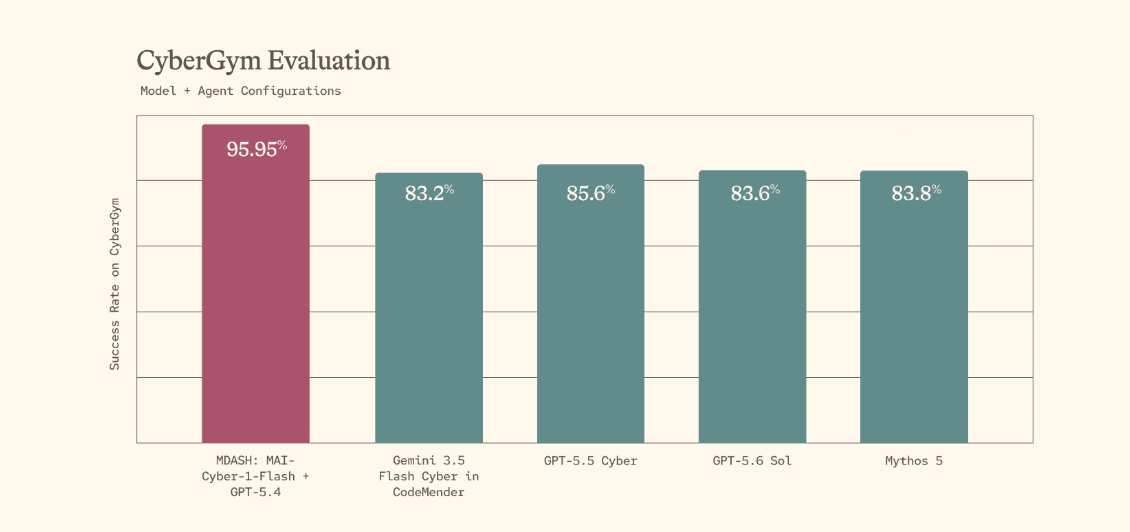
Overview
MAI-Cyber-1-Flash is Microsoft's first specialist cyber model. It is a compact, code-heavy descendant of the MAI-Thinking-1 lineage, tuned to reason across complex codebases and help identify vulnerabilities that simple pattern matching can miss.
The model is currently delivered inside Codename MDASH, Microsoft Defender's multi-model agentic code scanner. Microsoft does not document a direct MAI-Cyber API, downloadable weights or a consumer playground for this model.
MDASH builds language-aware indices, maps call paths and the attack surface, ranks risky code, runs more than 100 specialist agents, debates candidate findings across models, deduplicates results and, where possible, constructs triggering inputs in a sandbox to help validate a vulnerability.
Microsoft says MAI-Cyber-1-Flash is efficient enough to handle up to 90% of MDASH tasks, with a larger model such as GPT-5.4 used for the hardest 10%. The published comparison describes roughly 50% lower cost than the earlier GPT-5.4, 5.4 mini and 5.3 Codex configuration; that is a relative system result, not a customer price list.
Microsoft reports 95.95%, rounded to 96%, on CyberGym's any-crash score, 90.4% on target any-of and 86.3% on final submission. These measures test candidate exploit-triggering inputs under benchmark conditions; they do not establish recall across a customer's code, an acceptable false-positive rate or freedom from vulnerabilities.
MDASH is read-only. It produces SARIF, an HTML view, severity and confidence signals, and remediation guidance, but does not patch the environment, open pull requests or merge changes. A separate Defender CLI plus GitHub Copilot flow can propose a local function-level fix for developer review.
The current FAQ calls MDASH a private preview and requires an eligible Microsoft Defender XDR plan plus Foundry configuration. Microsoft Learn documents approximately 256 MB per repository and one concurrent scan per tenant during this phase, both subject to change.
Microsoft says source and scan results are persistently stored, encrypted at rest, in the customer's Defender XDR tenant region, while inference runs in the region selected for connected Foundry endpoints. Preview terms under the Microsoft DPA apply, and retention and deletion timelines are handled separately.
This is an additional security-analysis layer, not a replacement for threat modeling, SAST, dependency and secret scanning, dynamic testing, fuzzing, penetration testing, secure review, incident response or an accountable release decision.
Use cases
The strongest fit depends on the job you need the product to complete, not the size of its feature list.
Security teams investigating logic flaws, memory-safety issues and multi-file exploit paths that rule-based scanners may miss.
Enterprises already using Defender XDR, Microsoft Foundry, GitHub or Azure DevOps and willing to participate in the current preview.
Adding reasoning-based candidate discovery and proof generation to a broader application-security program.
Organizing findings by severity and confidence, exporting SARIF and directing critical work to human investigators.
Periodic or CI-triggered analysis where non-deterministic, long-running scans do not have to act as the sole deterministic build gate.
Capabilities
Builds call graphs and language-aware indices and prioritizes complex or exposed functions before deeper analysis.
Uses more than 100 roles such as injection, memory-safety and authentication-bypass auditors.
Independent agents argue for and against candidate findings to refine confidence and reduce weak hypotheses.
Constructs and runs triggering inputs in applicable cases to test whether a candidate vulnerability can actually manifest.
Groups semantically equivalent findings so teams can work from a consolidated recommendation set.
Combines Critical, High, Medium or Low severity with Likely, Suspect or Unlikely confidence for triage.
Supports machine-readable security-tool ingestion and a detailed human review surface in the Defender portal.
Connects with GitHub and Azure DevOps or scans a locally cloned git repository through Defender CLI.
Supports asynchronous pipeline scans using Entra authentication, with Microsoft cautioning against treating non-deterministic results as a sole blocking gate.
A separate Defender CLI and GitHub Copilot CLI workflow can propose a function-level change on a branch for review.
Shows a dedicated score, trends, recent scans, common CWEs, repository hotspots and finding history for the latest 90 days.
Microsoft describes role-based access, tenant isolation, encryption, audit trails and no-internet sandboxed execution.
Process
Step 1
Scan only repositories your organization owns or is expressly permitted to test, and define who may view source, findings and proof artifacts.
Step 2
Review eligible Defender XDR licensing, MDASH preview terms, the Microsoft DPA preview section, Foundry regions, model providers, retention, deletion, legal restrictions and incident procedures.
Step 3
Provide read-only repository access, limit administrators by role, isolate service identities and protect Entra credentials, pipeline secrets and exported SARIF.
Step 4
Keep SAST, dependency, secret, infrastructure, container, license and malware scanning in place so MDASH adds coverage rather than replacing controls.
Step 5
Start with a representative repository within the preview size and concurrency limits and document branch, commit, build assumptions and reachable interfaces.
Step 6
Launch through Defender CLI, CI or a configured repository connector; monitor token use, duration and status without making one AI result the only release gate.
Step 7
Review the code path, preconditions, proof input, severity, confidence, CWE, runtime exposure and compensating controls for every high-impact finding.
Step 8
Confirm suspected flaws in an isolated authorized environment with representative builds, sanitizers, tests and logging; never aim proof inputs at production without an approved plan.
Step 9
Prefer a root-cause fix with an accountable developer and security reviewer. MDASH offers code-level guidance, not architectural redesign or alternative remediation strategies.
Step 10
If using defender fix with GitHub Copilot, inspect every change for correctness, hidden behavior, new vulnerabilities, compatibility, performance and test coverage before merge.
Step 11
Add a regression test, rerun conventional scanners and MDASH, execute unit and integration suites, fuzz affected boundaries and perform manual security review.
Step 12
For third-party or newly discovered vulnerabilities, preserve evidence and follow coordinated disclosure, embargo, legal and customer-notification procedures.
Step 13
Track confirmed findings, false positives, duplicate rate, missed issues, time to validate, remediation quality, token cost and recurrence before expanding coverage.
Cost
Microsoft does not publish a standalone price or direct purchasing path for MAI-Cyber-1-Flash. Access is through the MDASH preview and requires an eligible Defender XDR plan plus customer-provisioned Microsoft Foundry inference. MDASH shows per-model token consumption, and canceled scans still incur tokens already used. Microsoft's 50% figure is a relative cost reduction against its previous MDASH model mix, not a guaranteed bill or list price.
Not publicly sold
No public standalone API, model download or per-token price is documented.
Eligible license + Foundry usage
Enterprise preview access through Microsoft Defender.
Pricing checked . Check current pricing at the source ↗
Assessment
Compare
The right alternative depends on the specific output, workflow, controls and budget your project requires.
Coding
A public-beta security scanner with scheduled repository scans, patch suggestions and issue-export workflows outside the Defender stack.
Explore Claude Security →Agents
A research-preview security agent for repository analysis and proposed vulnerability fixes in OpenAI's ecosystem.
Explore Codex Security →Coding
A more focused pull-request and code-change security review option for teams that want contextual feedback earlier in development.
Explore DryRun Security →Questions
It is Microsoft's compact specialist cybersecurity model for source-code vulnerability discovery. It currently operates as one model inside the multi-agent Codename MDASH scanner.
Microsoft does not currently document a standalone public API, model download or playground. Access is described through MDASH in Microsoft Defender.
No free standalone offering is published. MDASH preview participation requires an eligible Defender XDR plan and customer-provisioned Foundry models, with token consumption visible to the customer.
Microsoft has not published a unit price for the model. Its announcement says the new MDASH model mix cuts cost about 50% versus the prior MDASH configuration, but actual cost depends on licensing, model usage, repository complexity and the preview agreement.
It is Microsoft's reported any-crash benchmark result for the combined MDASH system. Microsoft separately reports 90.4% target any-of and 86.3% final submission. None of these numbers proves a customer repository has no remaining vulnerabilities.
No. MDASH is read-only and supplies findings and guidance. A separate developer-triggered Defender CLI plus GitHub Copilot CLI flow can propose a local fix, which must be reviewed, tested and approved.
Microsoft emphasizes difficult multi-file and logic-heavy flaws, including use-after-free, double-free, buffer overflow and other memory-safety issues, while its specialist agents also cover classes such as injection and authentication bypass.
No. Microsoft explicitly says MDASH does not replace static analysis or manual review. Teams still need layered scanning, threat modeling, dynamic testing, fuzzing, penetration testing and secure release controls.
Microsoft says customer source and results are persistently stored encrypted at rest in the same region as the customer's Defender XDR tenant. Inference runs in the Foundry region the customer selects, subject to service terms.
It works with git-based source repositories through connectors or a local clone. It does not support compiled binaries or JAR files, and current preview documentation lists an approximate 256 MB repository limit.
Microsoft supports CI/CD integration but recommends asynchronous security review rather than relying on it as a deterministic blocking gate because scans can be long-running and AI analysis is non-deterministic.
No by default. Reproduce findings only in an isolated, authorized environment with a defined test and disclosure plan. A model-generated exploit candidate can cause crashes, corruption, exposure or operational impact.
Bottom line
MAI-Cyber-1-Flash is a promising specialist component in Microsoft's unusually deep agentic security pipeline, especially for large organizations already committed to Defender and Foundry. The meaningful product is MDASH's orchestration, evidence and governance, not the model name alone. Its preview status, unpublished standalone price, persistent source storage and benchmark-to-production gap make a measured pilot essential. Use it to generate and prioritize hypotheses, then require human reproduction, code review, layered testing and controlled deployment before accepting any finding or patch.
Visit MAI-Cyber-1-Flash website ↗
Cursor Router - Cursor's auto-router picking the cheapest capable model per task

Muse Code - Meta's terminal-based AI coding agent

Laguna S 2.1 - Poolside's open-weight coding model with a 1M-token context
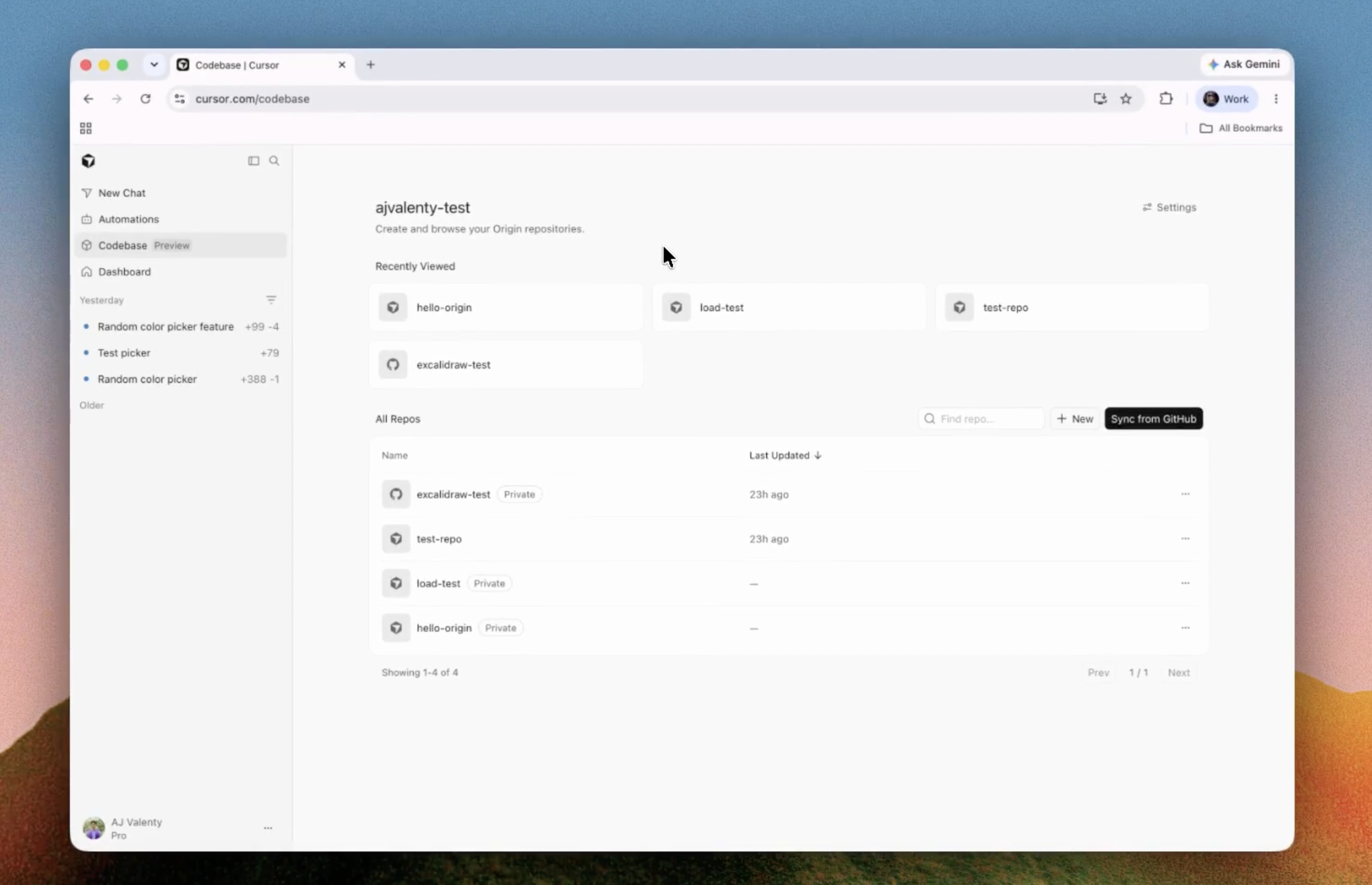
Origin - Cursor's code hosting with GitHub sync and built-in agents

Get access to all our AI courses, hundreds of real-world AI use cases, live expert-led workshops, an exclusive network of AI early adopters, and more.
Get unlimited access to all of our current & upcoming industry-specific AI courses for the duration of your subscription.
To keep up with the rapid pace of AI, our team publishes AI implementation guides daily. Our library contains 300+ practical use cases to automate real-world work.
Join weekly, live, interactive sessions with industry leaders who are at the forefront of AI for hands-on implementation guidance and exclusive insights.
Network with an exclusive community of AI-first professionals who are working smarter with AI. Learn how early adopters are using AI in their work and businesses.