Long-horizon coding agents
Run multi-step software engineering tasks involving repository exploration, edits, tests, debugging, and repeated tool calls.
Independent tool overview
Kimi K2.6 is Moonshot AI's open-weight multimodal model for long-horizon coding, visual understanding, tool use, autonomous agents, and parallel agent-swarm workflows.
Visit the official Kimi K2.6 site ↗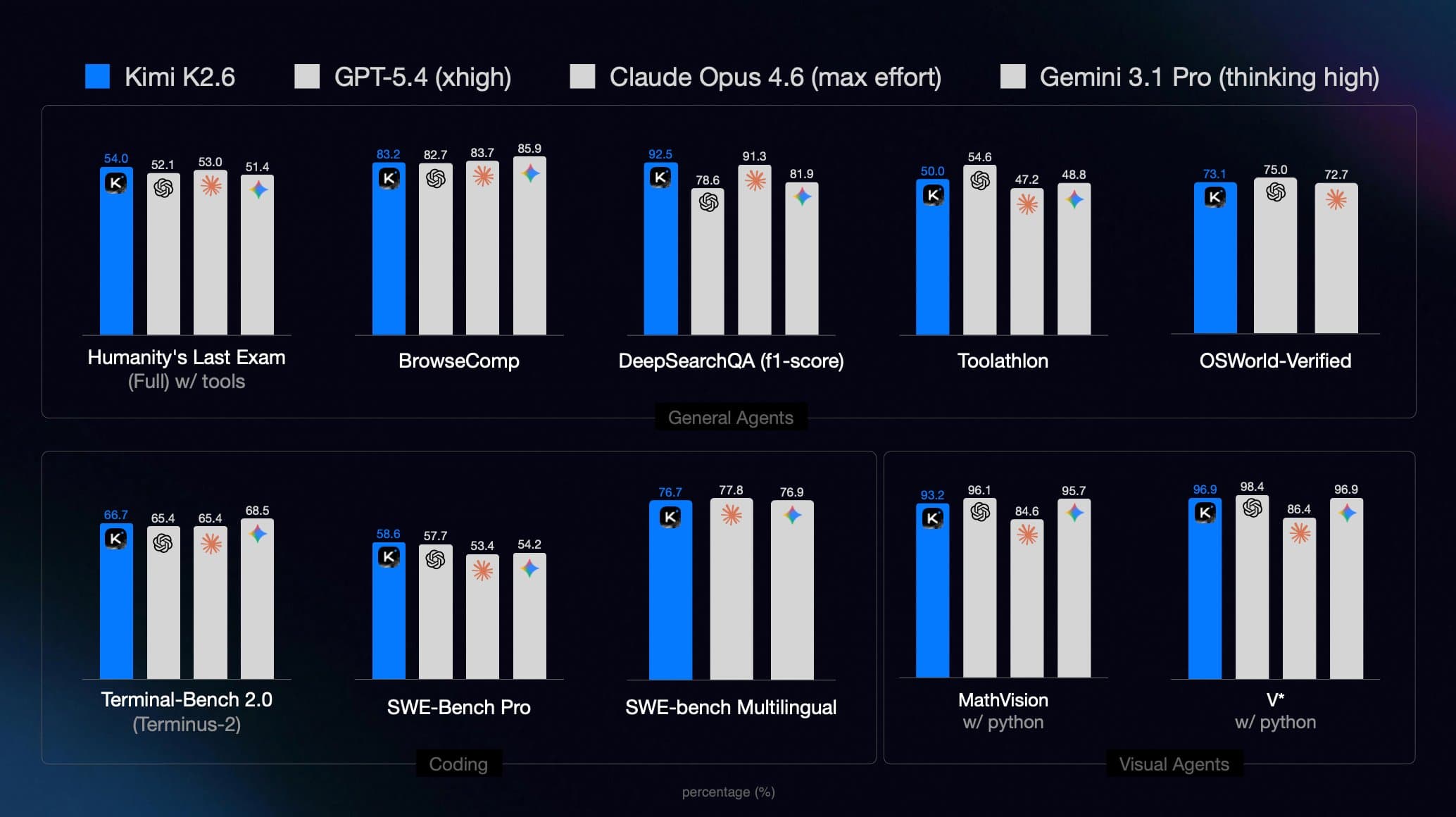
Overview
Kimi K2.6 is a one-trillion-parameter mixture-of-experts model with 32 billion parameters activated per token, a 256K-token context window, and native text, image, and video input. Moonshot emphasizes long-horizon software engineering, coding-driven interface generation, tool calling, self-correction, and autonomous agent work rather than simple chat alone.
The model remains available through Kimi's consumer products, Kimi Code, the official API, and downloadable weights, but it is no longer Moonshot's newest model. Kimi K3 is the newer general-purpose flagship and Kimi K2.7 Code is the newer coding-specific option. K2.6 can still be attractive for teams that want its documented architecture, 256K context, multimodal support, and modified-MIT deployment path.
Use cases
The strongest fit depends on the job you need the product to complete, not the size of its feature list.
Run multi-step software engineering tasks involving repository exploration, edits, tests, debugging, and repeated tool calls.
Combine text instructions with screenshots, design references, diagrams, images, or video inside an agent workflow.
Deploy downloadable weights when an organization has the GPU capacity and engineering expertise to operate a very large model.
Experiment with tool calling, long reasoning, autonomous execution, and parallel task decomposition.
Capabilities
Targets complex engineering work across languages and domains such as frontend, DevOps, systems optimization, and large-codebase changes.
Accepts text, images, and video, with Moonshot's official API currently providing the broadest documented video support.
Supports a reasoning mode for difficult tasks and a non-thinking mode for faster responses.
Includes tool calls, JSON mode, partial mode, context caching, and an OpenAI-compatible Chat Completions API.
Moonshot's hosted Agent Swarm can decompose work across up to 300 specialized sub-agents and 4,000 coordinated steps.
Weights and deployment guidance are available for vLLM, SGLang, KTransformers, Transformers, and compatible local or cloud infrastructure.
Process
Step 1
Use Kimi.com or the official API for convenience, or assess the substantial hardware and operations required for downloaded weights.
Step 2
Keep thinking enabled for complex reasoning and agent work or disable it when latency and lower output-token use matter more.
Step 3
Send text, supported media, repository context, and carefully defined tools through the compatible API or an agent harness.
Step 4
Run realistic tests, inspect tool calls and code changes, apply permission boundaries, and require human review before consequential actions.
Cost
The downloadable model has no per-token license fee, but self-hosting requires costly infrastructure. Moonshot's official API charges separately for cached input, uncached input, and output tokens; taxes may be added by jurisdiction.
No per-token license fee
Download and run Kimi K2.6 under its modified MIT license.
$0.16 per 1M tokens
Discounted input price when automatic context caching produces a cache hit.
$0.95 per 1M tokens
Input price for cache misses.
$4.00 per 1M tokens
Output-token price for generated answer and reasoning usage.
Pricing checked . Check current pricing at the source ↗
Assessment
Compare
The right alternative depends on the specific output, workflow, controls and budget your project requires.
Consulting
Choose Kimi K3 for Moonshot's newer general-purpose flagship and its larger one-million-token context window.
Explore Kimi K3 →Coding
Choose Kimi K2.7 Code for Moonshot's newer coding-specific model when software engineering is the primary workload.
Explore Kimi K2.7 Code →Consumer
Consider GLM 5.3 for another open-weight model aimed at advanced coding and agentic workloads.
Explore GLM-5.3 →Questions
Moonshot describes Kimi K2.6 as open source and publishes its weights and code under a modified MIT license. The modification requires very large commercial products or services—over 100 million monthly active users or $20 million in monthly revenue—to display the Kimi K2.6 name prominently.
It uses a mixture-of-experts architecture with one trillion total parameters and 32 billion activated per token. The Hugging Face repository is approximately 595GB.
The official model card and API documentation specify 262,144 tokens, commonly described as 256K.
Yes. It accepts text, image, and video input. Moonshot notes that some video behavior is experimental or limited to the official API rather than every third-party deployment.
No. Moonshot currently lists Kimi K3 as its flagship model and Kimi K2.7 Code as its newer dedicated coding model. K2.6 remains available through the API and open weights.
Bottom line
Kimi K2.6 remains a capable and unusually accessible multimodal agent model for teams that value open weights, a 256K context, tool use, and low official API input prices. It is now best viewed as a mature option to benchmark against Kimi K3 and K2.7 Code, not automatically the default for every new Moonshot deployment.
Visit Kimi K2.6 website ↗
Claude Opus 4.7 - Anthropic’s new top model with advanced agentic coding
Deep Research Max - Google DeepMind's Gemini 3.1 Pro-powered autonomous research agent with MCP and native charts
.png)
Gemini for Mac - Google's new native macOS app for Gemini
GPT-5.5 - OpenAI's new frontier flagship model for agentic coding and computer use

Get access to all our AI courses, hundreds of real-world AI use cases, live expert-led workshops, an exclusive network of AI early adopters, and more.
Get unlimited access to all of our current & upcoming industry-specific AI courses for the duration of your subscription.
To keep up with the rapid pace of AI, our team publishes AI implementation guides daily. Our library contains 300+ practical use cases to automate real-world work.
Join weekly, live, interactive sessions with industry leaders who are at the forefront of AI for hands-on implementation guidance and exclusive insights.
Network with an exclusive community of AI-first professionals who are working smarter with AI. Learn how early adopters are using AI in their work and businesses.