Cost-aware agent workflows
Applications that need repeated planning and tool use but must keep token prices well below premium frontier-model rates.
Independent tool overview
Gemini 3.8 Flash is Google’s fast, lower-cost reasoning model for software engineering, agentic workflows and multi-step work across the Gemini API and Google products.
Visit the official Gemini 3.8 Flash site ↗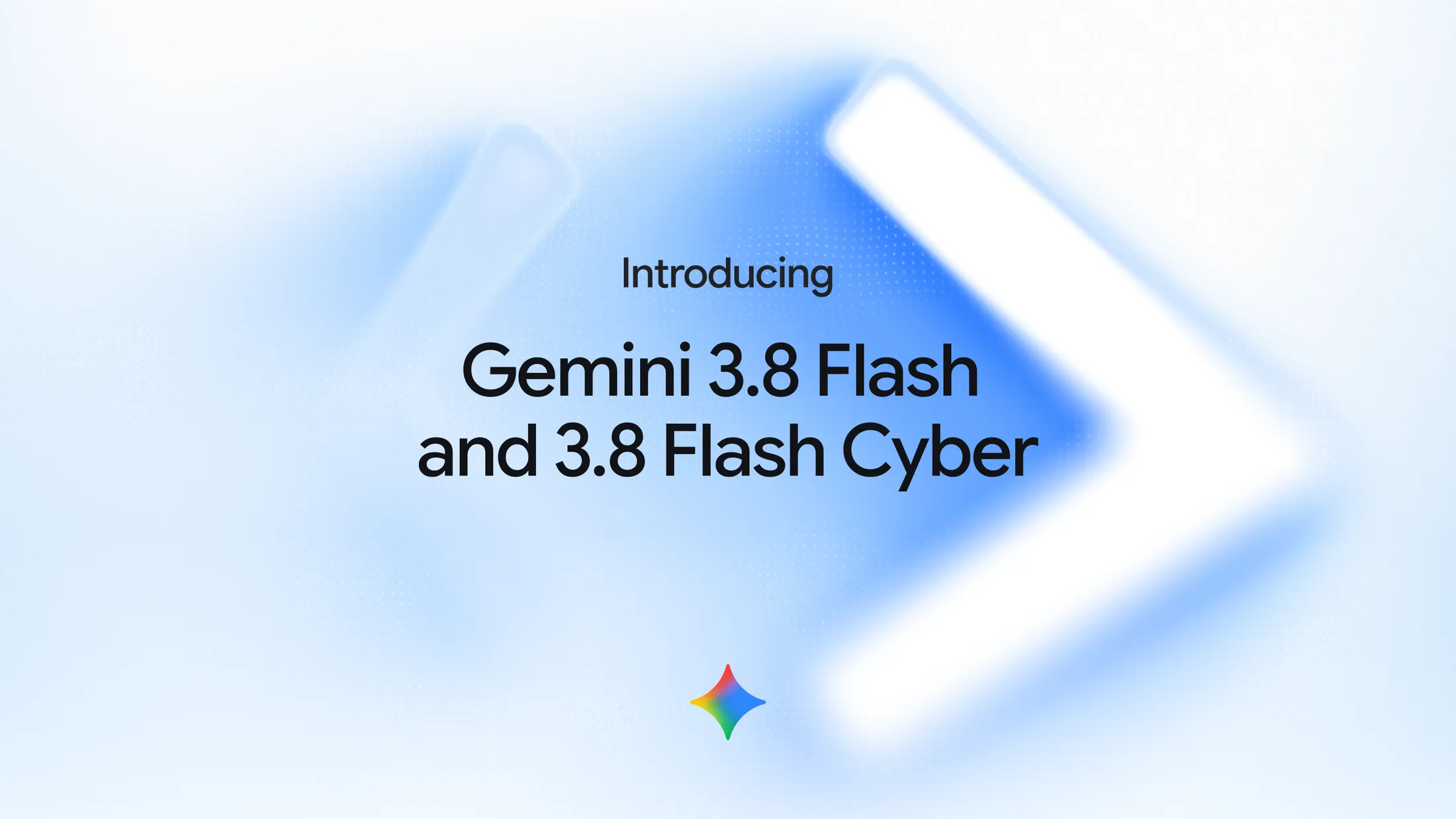
Overview
Google describes Gemini 3.8 Flash as its most intelligent Flash workhorse to date, with gains in software engineering, agentic tasks and specialized multi-step reasoning while retaining the Flash family’s emphasis on speed and cost.
The model is available to developers in Google AI Studio and the Gemini API, to enterprises through Gemini Enterprise, and to Google AI Pro and Ultra subscribers in selected Google experiences. A separate 3.8 Flash Cyber variant is restricted to trusted defenders through Google’s Fairwind Program.
Use cases
The strongest fit depends on the job you need the product to complete, not the size of its feature list.
Applications that need repeated planning and tool use but must keep token prices well below premium frontier-model rates.
Coding agents that need to work through larger engineering tasks, iterate with tools and preserve the objective across multiple steps.
Teams handling quantitative, legal or other specialized workflows that require structured multi-step reasoning and reporting.
Developers and businesses already using Google AI Studio, Gemini Enterprise, Android Studio or Gemini features in Google products.
Capabilities
Designed to carry longer objectives forward, call tools iteratively and refine an approach as new information appears.
Google highlights end-to-end performance on difficult engineering tasks as a central improvement over Gemini 3.7 Flash.
Developers can lower effort when compute efficiency matters or allow more reasoning steps for more difficult work.
Targets quantitative and professional domains where a task requires several connected analysis and reporting steps.
Available through the Gemini API and AI Studio, Gemini Enterprise, Android Studio and selected subscriber experiences in Google products.
Google says the model includes safeguards for high-risk domains and improved prompt-injection robustness, though application-level controls remain necessary.
Process
Step 1
Prototype in Google AI Studio, integrate the gemini-3.8-flash model through the API, or use the supported enterprise and consumer experiences.
Step 2
Give an agent the objective, allowed tools, stopping conditions and evidence requirements before it begins a longer task.
Step 3
Use lower effort for efficiency-first requests and increase it only where additional reasoning materially improves the output.
Step 4
Measure total tokens, tool calls, latency and accepted results on your own workload rather than relying on benchmark scores alone.
Cost
Google launched Gemini 3.8 Flash with introductory API pricing through December 31, 2026. Published rates double on January 1, 2027, so production forecasts should use the post-introductory price when workloads will continue into 2027.
$0.75 input · $3.75 output / 1M tokens
Launch pricing for Gemini 3.8 Flash API use through December 31, 2026.
$1.50 input · $7.50 output / 1M tokens
The standard rates Google says will apply after the launch-price period.
Google AI Pro or Ultra subscription
Consumer access in the Gemini app and selected Google experiences for eligible subscribers.
Pricing checked . Check current pricing at the source ↗
Assessment
Compare
The right alternative depends on the specific output, workflow, controls and budget your project requires.
Consumer
Choose Claude Fable 5.1 when Anthropic’s Claude Code and Cowork ecosystem or premium long-running work is the stronger fit.
Explore Claude Fable 5.1 →Consumer
Choose Muse Spark 1.3 when Meta’s Model API, Muse Code or contributor-priced prototyping is central to the workflow.
Explore Muse Spark 1.3 →Consumer
Choose GPT 5.5 when your team already depends on OpenAI’s API and product integrations.
Explore GPT 5.5 →Questions
Gemini 3.8 Flash is Google’s Flash-class model for agentic workflows, software engineering and multi-step reasoning, with an emphasis on speed and lower cost.
Google lists introductory API pricing of $0.75 per million input tokens and $3.75 per million output tokens through December 31, 2026.
Yes. Google says that starting January 1, 2027, API pricing will be $1.50 per million input tokens and $7.50 per million output tokens.
Developers can use it through Google AI Studio and the Gemini API. Google also announced access through Gemini Enterprise and selected Google experiences for AI Pro and Ultra subscribers.
No. They share foundational intelligence, but the Cyber variant has more permissive cybersecurity mitigations and is restricted to trusted defenders in Google’s Fairwind Program.
It can. Google says 3.8 Flash may execute more reasoning steps and tool calls on difficult tasks, particularly at higher effort settings. Lower effort or 3.7 Flash may suit efficiency-first workloads.
No. This independent overview is based on Google’s official launch and developer materials; The Rundown has not completed a controlled hands-on model comparison for this page.
Bottom line
Gemini 3.8 Flash is compelling for developers who need capable coding and agent behavior at a comparatively low launch price, especially inside Google’s ecosystem. The main planning caveats are its tendency to spend more tokens on harder tasks and the scheduled 2027 price increase. Teams should benchmark completed-task quality and cost against Claude Fable 5.1, Muse Spark 1.3 and their current OpenAI model before switching production traffic.
Visit Gemini 3.8 Flash website ↗
Get access to all our AI courses, hundreds of real-world AI use cases, live expert-led workshops, an exclusive network of AI early adopters, and more.
Get unlimited access to all of our current & upcoming industry-specific AI courses for the duration of your subscription.
To keep up with the rapid pace of AI, our team publishes AI implementation guides daily. Our library contains 300+ practical use cases to automate real-world work.
Join weekly, live, interactive sessions with industry leaders who are at the forefront of AI for hands-on implementation guidance and exclusive insights.
Network with an exclusive community of AI-first professionals who are working smarter with AI. Learn how early adopters are using AI in their work and businesses.