Voice-first writers
Founders, marketers, journalists, and creators who generate stronger raw ideas by speaking and want help turning several fragments into a draft.
Independent tool overview
Flipner is a voice-first writing workspace that stores spoken and typed snippets, then merges and rewrites them into articles, posts, notes, and other drafts. It is more structured than basic dictation, but users should verify every output and avoid recording confidential material until its older privacy documentation and third-party AI handling meet their needs.
Visit the official Flipner site ↗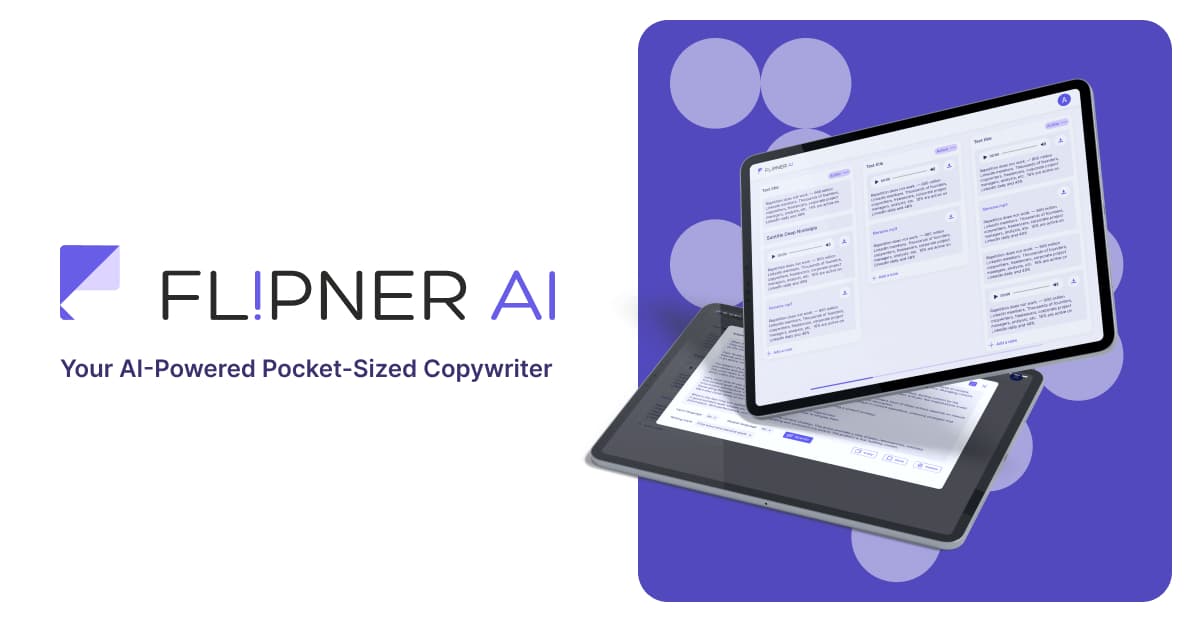
Overview
Flipner is designed for people who think more easily out loud than at a blank document. Users capture short voice recordings or typed fragments in a content hub, group the relevant snippets, select a tone and output language, and ask the system to turn those raw ideas into a more coherent draft.
The product is not merely a word-for-word transcription service. Its main value is editorial transformation: it can merge multiple notes, organize them, rewrite them in one of several tones, and preserve the user's source thoughts as a reusable idea library. A progressive web app supports recording from mobile and desktop browsers without a separate app-store download.
Flipner's own FAQ says it uses GPT-4, supports more than 30 languages, and measures usage by counting both the characters supplied to the system and the characters generated in response. That double-sided accounting matters when comparing its 40,000- and 400,000-character plans with tools that charge only for output or time.
The service should be treated as a drafting assistant. Transcription can miss names and jargon, and rewriting can invent transitions, claims, or emphasis the speaker never intended. Users should compare the result with the original snippets, fact-check publishable material, and obtain consent before recording other people.
Use cases
The strongest fit depends on the job you need the product to complete, not the size of its feature list.
Founders, marketers, journalists, and creators who generate stronger raw ideas by speaking and want help turning several fragments into a draft.
Users who want to capture in one supported language and produce a draft in another, with a human speaker checking idiom and meaning.
People building an archive of their own notes who do not need meeting-bot features, team approval workflows, or regulated-data controls.
Capabilities
Captures live audio, accepts typed notes, and on paid tiers supports uploaded audio files up to the listed duration and file-size limits.
Keeps raw fragments available so users can organize and reuse ideas rather than losing the source after one transcription.
Combines selected snippets into one structured text and can revise an existing draft without requiring a new recording.
Offers more than ten preset tones, custom voice prompts on the newer plan table, and the ability to ask for a different output language.
The public FAQ lists support for more than 30 languages spanning major European, Asian, Middle Eastern, and regional languages.
Can be installed from Safari, Chrome, or Edge on supported phones and computers while continuing to run as a browser-based service.
Process
Step 1
Decide whether the output is an outline, post, memo, article, script, or other draft and specify the audience, length, and facts that must remain unchanged.
Step 2
Record in a quiet place, state names and numbers carefully, and avoid including client, health, legal, financial, employment, or other confidential information without approval.
Step 3
Group only the snippets relevant to the current piece, remove duplicates, and choose the tone, structure, and output language before generation.
Step 4
Check names, quotations, numbers, causality, intent, and any new transition or assertion that appears in the rewrite.
Step 5
Apply a human editorial pass for fact-checking, permissions, originality, disclosures, brand voice, and accessibility, then export or copy the final version.
Cost
Flipner's public pricing page contains both annual-equivalent and monthly figures. Its FAQ says annual billing receives a 20% discount, which aligns with $12 versus $15 for Standard and $32 versus $40 for Pro. Separate lifetime offers retain monthly usage limits. Character usage counts both input and generated text.
$0
A continuing free tier for testing the capture and rewriting workflow.
$15 monthly or $12/month annually
For regular short-form voice capture and drafting.
$40 monthly or $32/month annually
For higher-volume writers and longer monthly audio use.
Custom quote
A negotiated plan for organizations needing support and tailored functionality.
$119 / $279 one-time
Limited-time one-time-payment offers with the corresponding Standard or Pro monthly allowances.
Pricing checked . Check current pricing at the source ↗
Assessment
Compare
The right alternative depends on the specific output, workflow, controls and budget your project requires.
Content Creator
Choose Voicenotes for a dedicated voice-note memory and transcription workflow with its own AI search and organization features.
Explore Voicenotes →Project Management
Choose Notion AI when captured ideas need to live inside a larger team knowledge base, project system, and collaborative editor.
Explore Notion AI →Content Creator
Choose Transistor Transcription when the source is a published podcast and speaker labeling or episode-level transcript editing matters more than short voice-note drafting.
Explore Transistor AI Transcription →Questions
Flipner stores spoken and typed snippets and uses AI to merge or rewrite selected ideas into a more structured draft. It is intended for articles, posts, notes, scripts, and similar writing rather than verbatim legal or evidentiary transcription.
Yes. The public pricing page lists a free tier with five text columns, 30 text or live-audio snippets, 4,000 processed characters, three-minute recordings, and ten total live-audio minutes. Limits and feature labels can change.
The page shows Standard at $15 month-to-month or a $12 monthly equivalent with annual billing, and Pro at $40 month-to-month or $32 with annual billing. The FAQ describes the annual discount as 20%. Confirm the currency, tax, and total commitment at checkout.
Its FAQ says both input and output count. Supplying 20,000 characters and receiving 21,000 generated characters consumes 41,000 characters, so long source notes and multiple rewrites can use a plan quickly.
It can capture audio snippets, but paid recordings are listed at a maximum of 15 minutes each and the product is oriented toward personal idea capture. Obtain participant consent and use a meeting or interview transcription tool when long recordings, speakers, permissions, or an authoritative record matter.
Flipner's FAQ says the user owns generated articles, and its terms say users retain rights in submitted content. Users remain responsible for having rights to the inputs and for ensuring the result does not infringe privacy, publicity, copyright, contractual, or other rights.
The service processes and stores recordings, text, and account data, and its public privacy policy is older and does not fully document the named AI provider's content handling. Avoid confidential or regulated material unless the company supplies current contractual, security, retention, subprocessors, and AI-training terms that satisfy your requirements.
Bottom line
Flipner is a useful bridge between unstructured voice notes and a workable first draft, especially for solo creators who want to preserve their source fragments. Start on Free, test it with non-sensitive material, and measure the double-sided character usage. For client or regulated work, the older privacy notice and unclear AI-provider treatment deserve resolution before any recording is uploaded.
Visit Flipner website ↗
Get access to all our AI courses, hundreds of real-world AI use cases, live expert-led workshops, an exclusive network of AI early adopters, and more.
Get unlimited access to all of our current & upcoming industry-specific AI courses for the duration of your subscription.
To keep up with the rapid pace of AI, our team publishes AI implementation guides daily. Our library contains 300+ practical use cases to automate real-world work.
Join weekly, live, interactive sessions with industry leaders who are at the forefront of AI for hands-on implementation guidance and exclusive insights.
Network with an exclusive community of AI-first professionals who are working smarter with AI. Learn how early adopters are using AI in their work and businesses.


