Security-log normalization
Map heterogeneous network, identity, endpoint and cloud events into OCSF, UDM or another canonical model.
Independent tool overview
Fleak is a managed data-pipeline platform that connects, normalizes, filters, governs and routes real-time data for AI, security, industrial and financial applications.
Visit the official fleakai site ↗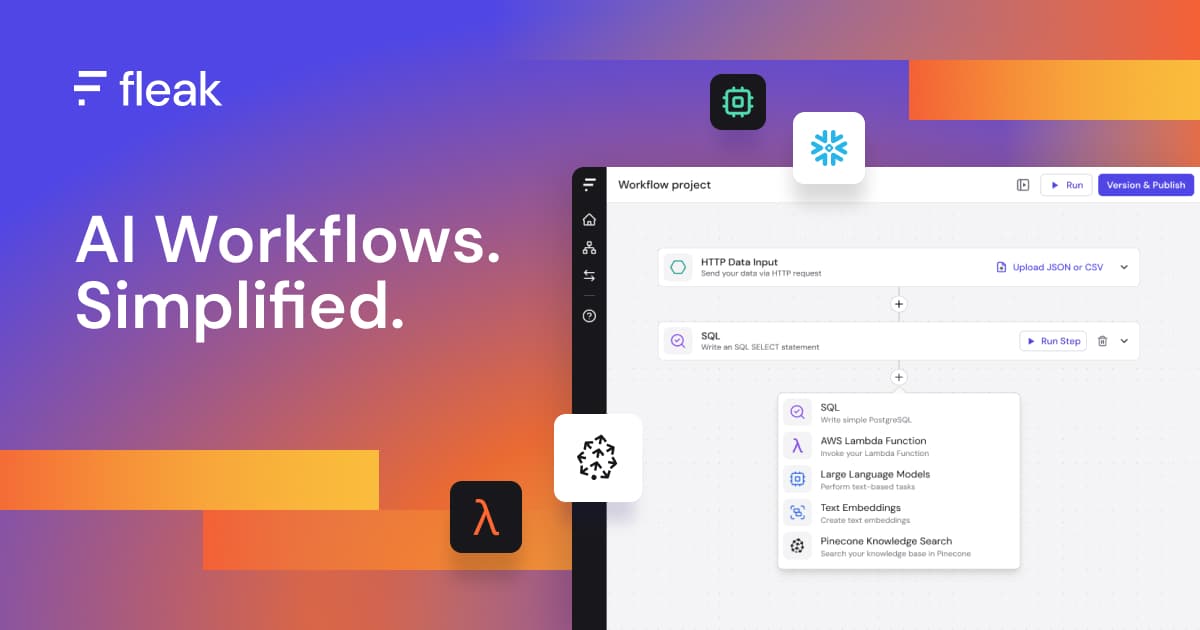
Overview
Fleak has moved upmarket from the general serverless AI-workflow builder in its older materials. The current product is positioned as an AI infrastructure and data-fabric layer between messy source systems and downstream AI applications, SIEMs, data lakes and analytics platforms. Its strongest emphasis is real-time normalization of security, industrial/IoT and financial data into governed canonical schemas such as OCSF and UDM.
Teams build distributed pipelines in a visual DAG, connect sources and destinations, transform and deduplicate events, publish a version, deploy it to compute and monitor execution. Fleak also advertises AI-generated configurations and self-healing when upstream schemas change. Those capabilities can reduce repetitive mapping work, but an automatically repaired pipeline can silently change data meaning, so schema tests, sample replay, human approval and downstream detection checks remain essential.
Use cases
The strongest fit depends on the job you need the product to complete, not the size of its feature list.
Map heterogeneous network, identity, endpoint and cloud events into OCSF, UDM or another canonical model.
Standardize vendor-specific tags and noisy sensor streams before analytics or predictive models consume them.
Filter, deduplicate and normalize events before they consume storage, retrieval or model tokens.
Detect source changes and generate proposed mapping updates instead of manually rewriting every parser.
Send different data to applications, long-term storage or discard paths according to value and access policy.
Capabilities
Ingests events from cloud services, operational systems, endpoints, APIs, databases and other emitting sources.
Models sources, processing steps and destinations as a versioned distributed-data workflow.
Uses natural-language intent to help create pipeline configuration and transformations.
Maps incompatible source fields into a canonical schema expected by downstream systems.
Reduces repetitive or low-value events before they increase storage and model-processing cost.
Directs events to real-time processing, retained storage or discard paths according to downstream need.
Detects schema drift and can generate, test and redeploy a revised mapping under configured review.
Advertises fine-grained access controls, transformation logging and audit trails at the data layer.
Processes and delivers data in real time without requiring Fleak to be the permanent system of record.
Centralizes reusable references to remote Delta tables, Databricks Unity Catalog tables and cloud-storage folders.
Process
Step 1
Choose a representative high-value feed and define its expected event types, volume, latency and required destination schema.
Step 2
Capture normal, rare, malformed and version-changed events plus the mappings analysts expect.
Step 3
Connect the source, generate or write transforms, add deduplication and define exact routing and access rules.
Step 4
Validate required fields, timestamps, identities, severity, units and null behavior against domain-owned examples.
Step 5
Run the new pipeline beside the existing path, compare counts and detections and measure drops, duplicates, latency and cost.
Step 6
Require approval and replay tests for schema-driven changes until the team has evidence that automated fixes preserve downstream behavior.
Cost
Fleak's current production site is sales-led and does not publish self-serve platform prices. The company invites prospects to bring a real source to a 30-minute demo and provides free schema-mapping tools for evaluation. Production cost should be quoted against event volume, throughput, connectors, retention, compute, support and deployment requirements.
$0 tools available
Free OCSF and related mapping experiences are offered for testing representative events.
Custom quote
Managed real-time pipelines, AI orchestration, governance and self-healing configured to the workload.
Contact sales
Higher-scale or regulated deployments with negotiated architecture and service commitments.
Pricing checked . Check current pricing at the source ↗
Assessment
Compare
The right alternative depends on the specific output, workflow, controls and budget your project requires.
Data Analysis
A broader lakehouse and AI platform when the organization already centralizes data engineering, governance and model workloads in Databricks.
Explore Databricks Mosaic AI →Business Operations
A self-hostable workflow-automation option for lower-volume application and API flows rather than high-throughput event normalization.
Explore n8n →Business Operations
A more approachable visual AI automation builder for business data tasks that do not require a specialized streaming fabric.
Explore Gumloop →Data Analysis
A downstream retrieval database when the main need is indexing and searching prepared data rather than transforming raw event streams.
Explore Pinecone →Questions
Fleak connects to data sources, normalizes and filters events, applies governance and routes the results in real time to AI applications, security systems, data lakes and other destinations.
Its documentation still describes a managed DAG workflow platform, but current marketing focuses more specifically on enterprise data infrastructure for security, industrial/IoT and financial systems.
Production pricing is not public. Fleak offers free schema-mapping tools and a sales-led demo, while platform pricing is custom to the deployment and data volume.
Fleak says it detects upstream schema changes and generates a revised configuration that can be approved and redeployed. Buyers should require sample replay, semantic tests and rollback before allowing automatic production changes.
The Open Cybersecurity Schema Framework is an open schema for representing security events consistently across vendors. Fleak uses it as one target for translating heterogeneous logs.
Filtering, deduplicating and normalizing data before it reaches a model can reduce unnecessary tokens and storage. The actual savings depend on source quality, retention and what the application truly needs.
Not necessarily. It is positioned as an upstream interpretation and routing layer that can deliver clean data to existing SIEMs, lakes and AI tools.
Measure field-level mapping accuracy, event loss and duplication, throughput, end-to-end latency, detection parity, schema-change recovery, operating effort and fully loaded cost against the current pipeline.
Bottom line
Fleak is most interesting where heterogeneous real-time data—not the AI model—is the bottleneck. Its security and industrial normalization focus is more concrete than the older generic workflow story. A credible purchase decision requires a source-by-source proof of concept that validates semantic accuracy and failure recovery, because the same automation that removes parser work can also propagate wrong mappings at scale.
Visit fleakai website ↗
Automated code reviews and bug-fixing for developers.

Mimrr automates codebase documentation and analysis.

With Postgres Sandbox, instantly spin up Postgres databases in your browser for easy data management and analysis.

Chat with AI to quickly build web apps.

Get access to all our AI courses, hundreds of real-world AI use cases, live expert-led workshops, an exclusive network of AI early adopters, and more.
Get unlimited access to all of our current & upcoming industry-specific AI courses for the duration of your subscription.
To keep up with the rapid pace of AI, our team publishes AI implementation guides daily. Our library contains 300+ practical use cases to automate real-world work.
Join weekly, live, interactive sessions with industry leaders who are at the forefront of AI for hands-on implementation guidance and exclusive insights.
Network with an exclusive community of AI-first professionals who are working smarter with AI. Learn how early adopters are using AI in their work and businesses.