Digital onboarding and account recovery
Organizations adding liveness and face-to-document checks to KYC, account opening, step-up authentication, or recovery flows.
Independent tool overview
Facia is an active biometric-verification platform offering passive and active liveness checks, deepfake detection, 1:1 face matching, 1:N search, age estimation, and document verification through APIs and mobile/web SDKs. Its public per-check pricing is unusually transparent, but any deployment needs independent accuracy testing, strict biometric-data governance, an accessible fallback, and human review before denial or adverse action.
Visit the official Facia site ↗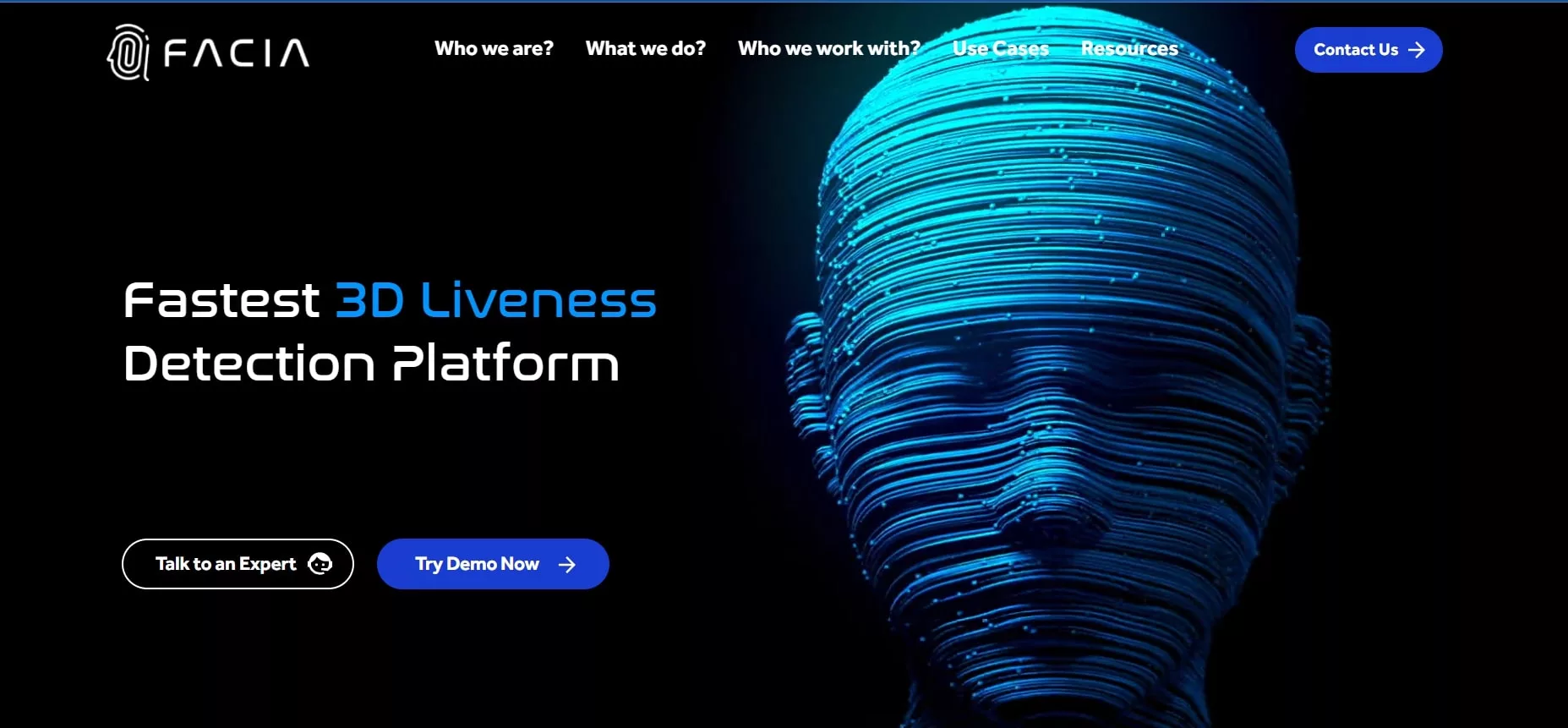
Overview
Facia's current product line spans identity and media-authenticity workflows: Quick and Detailed Liveness, DeepLiveness, face-to-ID matching, face search, age estimation, document checks, live-meeting deepfake detection, and AI-image or video detection. It offers REST APIs, roughly 5MB iOS and Android SDKs, web SDKs, and enterprise on-premises deployment.
The vendor markets sub-second checks and publishes several error claims, including a current algorithm FAR of 0.06% with FRR of 0.3% and an iBeta Level 2 result reporting 0% attack acceptance under a specific 2024 ISO/IEC 30107-3 presentation-attack test. These figures describe different tests and thresholds and cannot be combined into a general accuracy guarantee. The iBeta result covered named 2024 SDK versions, two devices, and 1,500 presentation attacks; buyers should request the full current report and test the exact SDK, threshold, camera, population, lighting, network, and attack mix they will deploy.
A liveness pass means the captured presentation appears live under the detector; it does not prove the person's legal identity, intent, eligibility, or authority. Likewise, a face-match or deepfake score is probabilistic evidence, not a verdict. Layer Facia with document and account signals, device and fraud controls, manual review, and an appeal or non-biometric recovery path.
Facia's privacy policy treats facial images used for verification as biometric data, permits authorized subprocessors and international transfers, and gives only a purpose-based retention standard rather than a fixed deletion period. Before production, the customer needs a signed data-processing agreement that defines controller and processor roles, lawful basis or consent, notice, storage location, encryption and key control, exact deletion deadlines, subprocessor changes, audit rights, breach duties, and treatment of templates, images, scores, logs, and backups.
Use cases
The strongest fit depends on the job you need the product to complete, not the size of its feature list.
Organizations adding liveness and face-to-document checks to KYC, account opening, step-up authentication, or recovery flows.
Teams screening synthetic selfies, replay attacks, face swaps, manipulated media, or live-video overlays as one signal in a broader fraud system.
Buyers that need API, mobile SDK, or on-premises options and have the legal, security, accessibility, and operations staff to govern biometrics responsibly.
Capabilities
Passive or active checks assess whether a face presentation is live, with higher-detail checks available at a higher per-call price.
Adds synthetic-face and deepfake signals for onboarding images, recorded media, and live-video scenarios.
Supports 1:1 similarity checks against an expected identity and 1:N search against an enrolled gallery; the latter carries substantially greater privacy and false-match risk.
Offers facial age estimation and document verification, which should be paired with policy-specific thresholds and a non-biometric fallback.
Provides REST APIs plus web and lightweight mobile SDKs for embedding capture and verification into customer applications.
Enterprise customers can request local deployment for tighter data-location and systems control, subject to contract and operational responsibilities.
Process
Step 1
Document why biometrics are proportionate, which jurisdictions and populations are affected, required notices or consent, retention, and the accessible alternative for people who decline or cannot pass.
Step 2
Choose liveness, 1:1 match, 1:N search, age, document, or deepfake services deliberately; do not collapse their scores into a single unexplained accept/deny rule.
Step 3
Measure false acceptance, false rejection, attack acceptance, failure to acquire, latency, and abandonment by device, lighting, age, skin tone, gender presentation, disability, and network conditions.
Step 4
Route uncertainty and failures to trained reviewers, prohibit automatic adverse action, provide a timely non-biometric path, and make appeals available without forcing repeated face scans.
Step 5
Collect only necessary frames, set automated deletion for images, templates, scores, logs, and backups, rotate credentials, monitor threshold drift, retest upgrades, and audit processor compliance.
Cost
Facia publishes pay-as-you-go prices for fewer than 1,000 checks per month and custom enterprise pricing above 1,000. The portal offers 10 starting credits without a card. Enterprise quotes can be up to ten times lower than individual rates according to Facia, but the discount varies by volume and requirements. Budget for failed captures, retries, manual review, document-vendor costs, storage, implementation, legal review, and support—not only successful checks.
$0.10–$0.70 per check
Public rates for fewer than 1,000 checks per month.
Custom quote
Bulk pricing and enterprise controls for more than 1,000 checks per month.
10 credits
Portal starter credits with no credit card required.
Pricing checked . Check current pricing at the source ↗
Assessment
Compare
The right alternative depends on the specific output, workflow, controls and budget your project requires.
Students
Human or Not is only a public deepfake-literacy exercise, not an enterprise identity-verification substitute; use it for awareness while comparing Facia against dedicated biometric vendors through a formal procurement and bake-off.
Explore Human or Not Game →Questions
Facia provides liveness and deepfake detection, 1:1 face matching, 1:N face search, age estimation, document verification, and related biometric APIs and SDKs.
Public pay-as-you-go rates range from $0.10 for Quick Liveness or Age Estimation to $0.70 for Document Verification. Detailed Liveness is $0.12, face match or search is $0.15, and deepfake detection is $0.40 per check. Enterprise pricing is custom.
Facia reports that specified Android and iOS SDK versions passed a March 2024 iBeta Level 2 presentation-attack test aligned with ISO/IEC 30107-3. Ask for the full report and confirm that the tested version, platform, configuration, and attack scope match the current product you will deploy.
No. It indicates that the captured presentation appears live under the detector. Identity still requires matching to a trusted enrollment or document plus account, device, and fraud checks.
The public privacy policy says data is kept as long as reasonably necessary for the purpose and legal obligations, but it does not publish a fixed biometric retention schedule. Contract an exact deletion timetable for each data type and backup.
It can return scores and decisions for workflow automation, but organizations should not let one biometric signal make consequential decisions. Use calibrated thresholds, human review, notice, an accessible alternative, and appeal rights.
Bottom line
Facia is a credible product to include in a liveness and deepfake-detection evaluation, especially because its unit pricing, integration options, and named iBeta test are public. It is not a plug-and-forget identity authority. The procurement decision should depend on an independent, population-specific bake-off and a contract that closes the public policy gaps around retention, subprocessors, data location, versioned accuracy evidence, fallback, and adverse-action review.
Visit Facia website ↗
Get access to all our AI courses, hundreds of real-world AI use cases, live expert-led workshops, an exclusive network of AI early adopters, and more.
Get unlimited access to all of our current & upcoming industry-specific AI courses for the duration of your subscription.
To keep up with the rapid pace of AI, our team publishes AI implementation guides daily. Our library contains 300+ practical use cases to automate real-world work.
Join weekly, live, interactive sessions with industry leaders who are at the forefront of AI for hands-on implementation guidance and exclusive insights.
Network with an exclusive community of AI-first professionals who are working smarter with AI. Learn how early adopters are using AI in their work and businesses.


