Chinese-language agents
Applications that need a Baidu model for multi-step planning, tool selection, search, and Chinese business workflows.
Independent tool overview
ERNIE 5.1 is Baidu's current flagship ERNIE chat model and a Qianfan text-generation endpoint focused on agent tasks, reasoning, deep search, knowledge, and creative writing. It is a more compact successor derived from ERNIE 5.0, with a 128K context window and lower published China API rates than 5.0, but its international Qianfan availability and USD pricing are not yet listed on the current English catalog.
Visit the official ERNIE 5.1 site ↗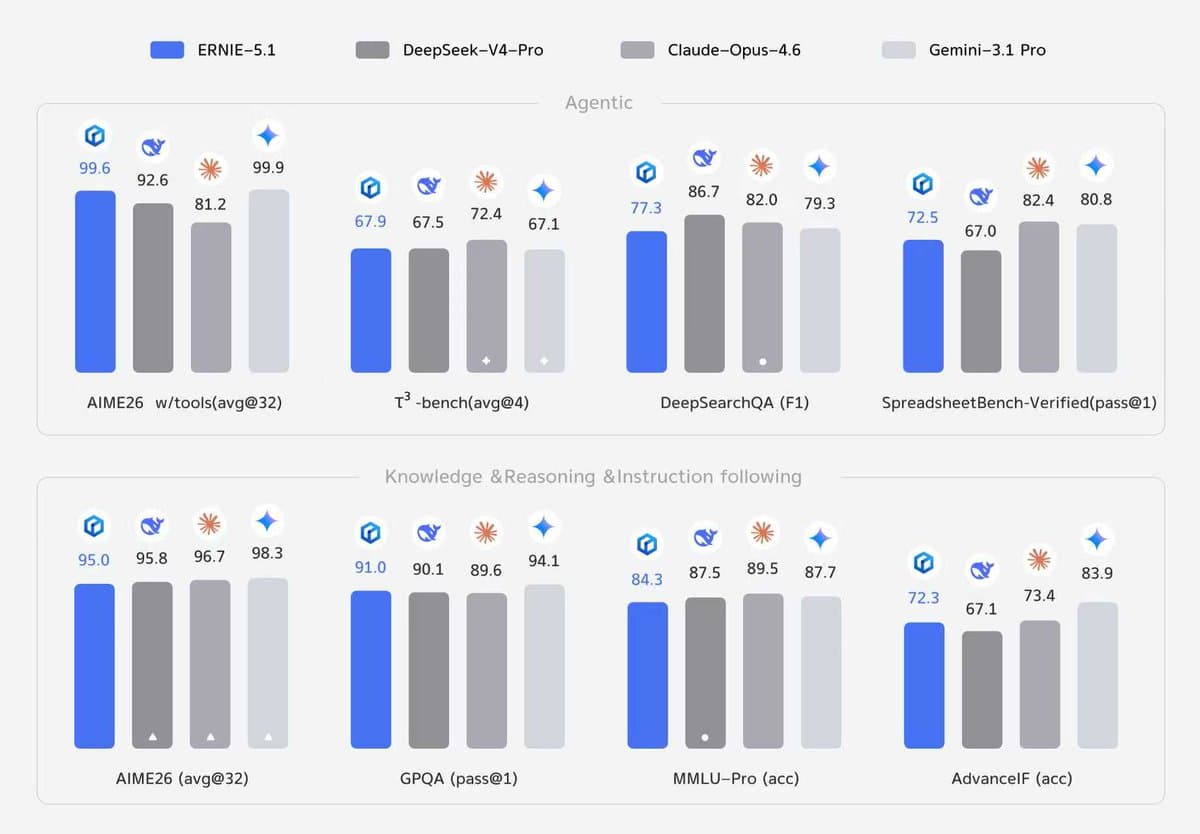
Overview
Baidu released ERNIE 5.1 in May 2026 as the latest model in its consumer chat experience. It extracts a smaller network from ERNIE 5.0's elastic training foundation: Baidu says total parameters are about one-third and active parameters about one-half of 5.0, while pre-training used roughly 6% of the compute of comparable models. That is a vendor training-efficiency claim, not a 94% reduction in the price customers pay.
The mainland China Qianfan catalog lists `ernie-5.1` with 128K context, up to 119K input tokens, up to 65,536 output tokens, and default limits of 60 requests and 150,000 tokens per minute. Its current placement is under flagship text generation; developers should not assume it exposes the native image, audio, and video capabilities associated with ERNIE 5.0's research architecture.
Baidu emphasizes tool use, multi-step agent behavior, reasoning, deep search, world knowledge, and creative writing. The Qianfan API supports function-calling responses, but the model does not execute functions itself: the application must validate the requested function and arguments, enforce authorization, execute the tool, and safely return the result.
Baidu's leaderboard and internal benchmark comparisons should guide testing rather than decide procurement. Teams should evaluate 5.1 on private Chinese and multilingual tasks, long-context retrieval, tool-call accuracy, factuality, latency, and total cost. Consequential medical, legal, financial, employment, or safety decisions require authoritative sources and accountable human review.
Use cases
The strongest fit depends on the job you need the product to complete, not the size of its feature list.
Applications that need a Baidu model for multi-step planning, tool selection, search, and Chinese business workflows.
Teams evaluating a current Chinese flagship for research synthesis, long-form writing, document questions, and instruction following.
Developers who can use Baidu's domestic cloud service and benefit from its published yuan pricing and OpenAI-compatible access patterns.
Capabilities
Baidu trained 5.1 for long-horizon tasks, tool use, autonomous planning, and stability on complex edge cases.
The release emphasizes search, broad knowledge, reasoning, and synthesis, which should be tested with source-quality and citation checks.
Baidu tuned the model for intent, narrative control, style adaptation, and longer creative outputs.
The Qianfan API can return a requested function name and arguments; the host application remains responsible for safe execution.
The documented endpoint supports 128K context, 119K maximum input, and up to 65,536 output tokens.
The model inherits ERNIE 5.0 knowledge from an elastically trained sub-network while using materially fewer total and active parameters.
Process
Step 1
Check whether the workload can use mainland Qianfan, which identity and payment requirements apply, and whether data location and contract terms meet policy.
Step 2
Test representative Chinese and multilingual prompts, long documents, search questions, tool calls, refusals, and known failure cases against expected answers.
Step 3
Keep keys server-side, cap tokens and spend, validate structured output, allowlist functions, constrain arguments, and require authorization before side effects.
Step 4
Track answer quality, retrieval and citation accuracy, tool-call success, latency, cost, refusal behavior, and human correction—not just model benchmark scores.
Step 5
Start with low-impact traffic, log model versions and tool actions, add human escalation, and preserve the ability to fall back to ERNIE 5.0 or another provider.
Cost
Baidu's mainland China Qianfan price sheet lists ERNIE 5.1 by input length. For requests up to 32K input tokens, rates are ¥0.004 per thousand input tokens and ¥0.018 per thousand output tokens—equivalent to ¥4 and ¥18 per million. For inputs above 32K and up to 128K, rates rise to ¥0.006 and ¥0.022 per thousand—¥6 and ¥22 per million. The current international Qianfan catalog lists ERNIE 5.0 but not 5.1, so do not assume these yuan rates or availability apply to an international account.
¥4 input / ¥18 output per 1M tokens
Mainland China online-inference pricing for ERNIE 5.1 with shorter inputs.
¥6 input / ¥22 output per 1M tokens
Higher mainland China rate for long-context ERNIE 5.1 requests.
No clear English plan price published
Baidu directs users to its ERNIE chat experience but the English release does not publish a dedicated 5.1 subscription price.
Pricing checked . Check current pricing at the source ↗
Assessment
Compare
The right alternative depends on the specific output, workflow, controls and budget your project requires.
Consumer
Choose ERNIE 5.0 when international Qianfan availability, multimodal visual understanding, or compatibility with an existing endpoint matters more than using Baidu's newest model.
Explore ERNIE 5.0 →Consumer
Consider Qwen3-Max-Thinking for another Chinese flagship focused on reasoning and agentic work in Alibaba's ecosystem.
Explore Qwen3-Max-Thinking →Business Operations
Consider DeepSeek for alternative Chinese reasoning models, broader open-model options, or different API economics.
Explore DeepSeek →Questions
ERNIE 5.1 is Baidu's current flagship ERNIE model for chat and Qianfan text generation, emphasizing agent tasks, reasoning, deep search, knowledge, and creative writing.
Baidu positions it as the newer, more compact, and more efficient successor with stronger agent and reasoning behavior. The right choice still depends on regional availability, required modalities, latency, compatibility, and results on the application's own evaluation set.
On mainland China Qianfan, inputs up to 32K cost ¥4 per million input tokens and outputs cost ¥18 per million. For inputs above 32K to 128K, rates are ¥6 and ¥22 per million. International 5.1 pricing was not published on the current English price page during this review.
The Qianfan model list gives it a 128K-token context window, up to 119K input tokens, and up to 65,536 output tokens, with default limits of 60 requests and 150,000 tokens per minute.
It can propose function calls, but the API does not execute them. Your application must validate the model's function name and arguments, check user authorization, run the tool, and handle the result safely.
It should not be the final decision-maker. Require authoritative sources, domain-expert review, privacy controls, and explicit accountability for any consequential use.
Bottom line
ERNIE 5.1 is the Baidu model new China-focused projects should benchmark first: it is current, cheaper than 5.0 on the published domestic API, and designed for agent, search, reasoning, and writing workloads. Its main caveat is distribution rather than inactivity—the model is clearly live in China, while current English Qianfan documentation has not caught up with international access or USD pricing. Confirm region, contract, and exact endpoint capabilities before committing.
Visit ERNIE 5.1 website ↗.jpeg)
Grok 4.3 - xAI’s latest model release with strong cost efficiency, instruction following, and domain-specific performance

Incognito Chat - Meta’s new way to have private conversations with Meta AI via WhatsApp

MiMo-V2.5-Pro - Xiaomi's powerful open-source model that excels in agentic and long-horizon tasks
Alexa for Shopping - Amazon's new shopping agent for Q&A, price tracking, and Auto-Buy across devices

Get access to all our AI courses, hundreds of real-world AI use cases, live expert-led workshops, an exclusive network of AI early adopters, and more.
Get unlimited access to all of our current & upcoming industry-specific AI courses for the duration of your subscription.
To keep up with the rapid pace of AI, our team publishes AI implementation guides daily. Our library contains 300+ practical use cases to automate real-world work.
Join weekly, live, interactive sessions with industry leaders who are at the forefront of AI for hands-on implementation guidance and exclusive insights.
Network with an exclusive community of AI-first professionals who are working smarter with AI. Learn how early adopters are using AI in their work and businesses.