AI's next frontier is the human cell
PLUS: Give Claude’s routine work to Haiku 5.5


Good morning, AI enthusiasts, and welcome to our 4,318 new readers. Math is currently in the thick of its AI moment. Mark Zuckerberg wants biology to be next.
In April, Zuck's Biohub put $500M into the idea that AI could eventually mimic a living cell. Months later, the pot is up to $1.8B, with the U.S. government, Meta, and Google all hoping that data on billions of cells can give biology a similar moment of its own.
In today’s AI rundown:
AI's next frontier is the human cell
Nate's Notebook: Slop grenades trickle down
Give Claude’s routine work to Haiku 5.5
Grok Bot opens up routing to Claude, other models
LATEST DEVELOPMENTS
BIOHUB
Image source: Biohub
The Rundown: Mark Zuckerberg and Priscilla Chan's science nonprofit, Biohub, just expanded its $500M Virtual Biology Initiative into a $1.8B effort with the U.S., DeepMind, and Meta, pushing to collect enough data to train AI that can simulate cells.
The details:
Biohub's end goal is a “universal virtual cell,” AI software that predicts how cells will respond to a drug or other change before a lab test.
The National Institutes of Health is sharing datasets paid for by $500M+ in past federal spending, while the Energy Dept. commits $500M+ over five years.
Google DeepMind and Meta are chipping in $300M with drug startup Isomorphic Labs, and all three keep the resulting data private for a year before release.
Biohub science head Alex Rives says accurate models will need data on trillions of cells, versus the hundreds of millions currently in today's biggest sets.
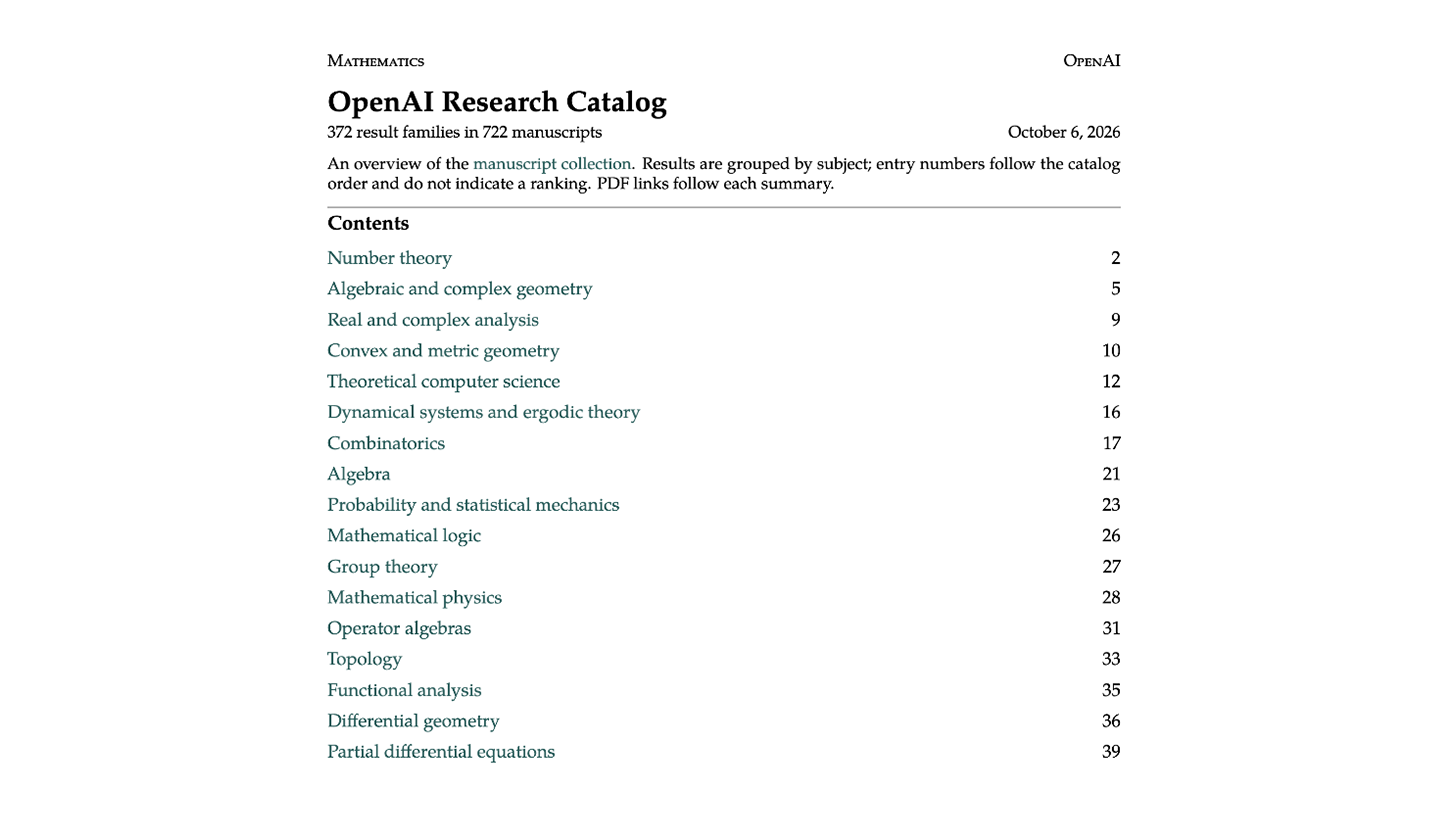
Why it matters: Fresh off math being solved internally by OpenAI, you might be wondering what field AI comes for next. Zuck and co. are making biology the target, throwing funding, datasets, and talent at Biohub's moonshot mission to “cure or prevent all disease” — an AI megaproject that's a lot easier for the public to root for than most.
TOGETHER WITH VANTA

The Rundown: This live session with Alex Kantrowitz, founder of Big Technology, and Vanta's SVP of Engineering is where startup builders learn what still matters when AI lets tiny teams build almost anything.
You'll learn:
How teams turn AI demos into production tools
How to build an edge before capital catches up
Which fundamentals still hold as everything moves
NATE’S NOTEBOOK

The Rundown: Each week, Rundown AI educator Nate Grahek breaks down what he's seeing while teaching real teams to use AI. This week, he kicks off a two-part series on slop grenades.
Nate: A friend told me about a colleague whose work she's always trusted. Then he started tinkering with Copilot, and she got a 15-page report that looked polished and said almost nothing. Decoding it became her job.
Shopify CEO Tobi Lütke says his team has a name for this: slop grenades. Someone pulls the pin, AI writes 15 pages, and the receivers absorb the damage. Lütke's sharpest question: “Why did we invent decompression and recompression?” BetterUp and Stanford found 40% of U.S. desk workers got one in a single month, costing them about two hours each.
Here's my hypothesis: the worst slop grenades are made by leaders. Too many blind AI mandates track who logged in and never show anyone what good AI work looks like. When the only standard is "use it," you get more output.
So leaders need to go first, transparently. Before you ask your team for anything, share one piece of your own AI-assisted work: your process, how you checked it, why it's useful, and what you'd still question. Label drafts as drafts and ask for critique; Atlassian found that simple step helps reviewers catch the flaws AI polish hides.
When I run this with leadership teams, I start with one rule: it's never okay to send AI work that takes longer to read and understand than you spent making it. Work worth handing off comes from running the AI operator playbook across multiple chats: gather, brainstorm, draft, critique. Don't skip the last one. Make AI argue with you before your team has to.
Who on your team is lobbing the most slop grenades, and are you sure it isn't you?
AI TRAINING

The Rundown: In this guide, you’ll use Haiku 5.5 on a routine Claude task like sorting customer messages, then ask Sonnet to review the exceptions. You’ll check the sources and compare the full workflow’s cost before using it on real work.
Step-by-step:
Open a clean practice folder in Claude Code and add the guide’s sample messages. Define the categories and the requests that need a person’s review
Keep Sonnet as your main model. Ask it to create a Haiku helper that can read the sample file and suggest routes, without editing files or contacting anyone
Have the helper sort one small batch. Check the task details to confirm Haiku ran, then make sure every message appears once with a quote from its source
Give Sonnet the flagged messages and their original text. Ask for review notes and missing information. Leave refunds, replies, and account changes to a person
Compare the result with a Sonnet-only run. Count errors, editing time, and usage across both stages before choosing which approach to keep
Pro tip: Start with one helper for a small batch rather than one agent per message. Our Pro members get the prepared helper, practice messages, prompts, and checks.
PRESENTED BY BOSTON CONSULTING GROUP

The Rundown: BCG’s 2026 Applied AI Index, based on a survey of more than 1,300 CxOs and senior leaders across 20+ sectors, found that almost 50% of companies now generate value from AI. As agentic AI spreads, these companies have critical lessons for others.
Here’s what survey respondents are saying:
AI spend has doubled year on year
90% expect AI to generate new work
Only 5% have all agent controls enterprise-wide
SPACEXAI

Image source: xAI / Anthropic
The Rundown: Elon Musk announced that SpaceXAI’s Grok Bot agent platform will send tasks to rival models like Anthropic’s Claude and image maker Midjourney, with Musk saying it will route to “whatever is most likely to give you the best outcome.”
The details:
Musk said lower-lift queries will still use a “lightning-fast” version of Grok 4.8 when it releases, but route to third-party models and “leading APIs” when relevant.
The move effectively now makes xAI an Anthropic customer, while Anthropic already rents computing power via the company’s Colossus 1 since spring.
Rival agents like OpenAI's dots and Meta's Muse now compete with Grok Bot, which arrived in August as a 24/7 assistant with a computer of its own.
Why it matters: Musk has spent heavily to make Grok a frontier contender, so letting Claude into Grok Bot is about as close to a concession as he gets. A big draw for OAI's dots was the GPT-6 Astra model powering them, so adding a top-ranked Opus 5.5 should help Grok Bot siphon usage away from its personal agent rivals.
QUICK HITS
COMMUNITY AI WORKFLOW OF THE DAY
▸ Gil built an AI archaeologist that runs on spare ChatGPT tokens
Today’s workflow comes from reader Gil:
“I had a ChatGPT subscription that I knew I would not use during the coming month, so I wanted to find a productive use for the tokens I would otherwise pay for without using.
I created a team of specialized agents on Raft that works persistently in the background. They continue working until all my allotted tokens are used, wait for the tokens to reset, and then continue.
I assigned them a project: searching a stretch of LiDAR-mapped dense forest in Slovenia for archaeological discoveries. The agents scan the dataset for meaningful anomalies that could point to potential findings. Anything they identify will be handed over to the Slovenian authorities for further investigation. Even if they find nothing, that result is valuable in its own right.
I encourage anyone with an idle AI subscription to use it for something beneficial. There are many publicly available datasets containing potential discoveries that no human would ever have time to examine manually.”
See Gil’s full workflow Visit The Rundown University. How do you use AI? Tell us for a chance to be featured.
🐠 TinyFish - One profile for ChatGPT, Claude, and every AI agent you use. Sign up once, use it everywhere*
🤖 Grok Bot - xAI's always-on agent teammates, now leveraging external models
🔎 SynthID Detector - Google's tool to spot AI-made images, video, and audio
📞 Architect - ElevenLabs' assistant for building and fixing AI support agents
*Sponsored Listing
Google rolled out its SynthID Detector worldwide, letting anyone scan images, video, and audio for watermarks left by its AI and partners including OpenAI, Nvidia, and Kakao.
Anthropic launched Claude Haiku 5.5, a budget model starting at the same $0.10 per million input tokens as OpenAI's GPT-6 Luna while passing it on multiple benchmarks.
OpenAI debuted “intelligent UI,” a new GPT-6-powered feature within ChatGPT that lets the assistant answer using interactive charts, maps, tools, and more.
Nous Research announced a new $90M funding round at a $1.5B valuation, revealing that its open-source Hermes agent now handles roughly 2.5% of global token usage.
SemiAnalysis published research finding that Claude subscriptions give about 5x more value per dollar than ChatGPT plans on each lab's everyday model, coming after OpenAI halved its $200 tier's limits last week.
Google Labs introduced Playground for U.S. adults, a new experimental tool letting users describe a game in chat and play it minutes later.
Read our last AI newsletter: OpenAI’s math avalanche continues
Read our last Tech newsletter: A breakout moment for AI medicine
Read our last Robotics newsletter: California crashes robot fight club
Today’s AI tool guide: Give Claude’s routine work to Haiku 5.5
RSVP to next workshop on Oct. 21: Getting real work out of Microsoft Copilot
That's it for today!Before you go we’d love to know what you thought of today's newsletter to help us improve The Rundown experience for you. |
|
See you soon,
Rowan, Zach, Shubham, Jennifer, and Nate — the humans behind The Rundown