Creative software products
Add image, video, audio, editing, and upscaling features without operating separate model infrastructure.
Independent tool overview
Runway Dev is an API platform for adding generative video, images, audio, media workflows, and real-time interactive characters to products through one developer account and billing layer.
Visit the official Runway Dev site ↗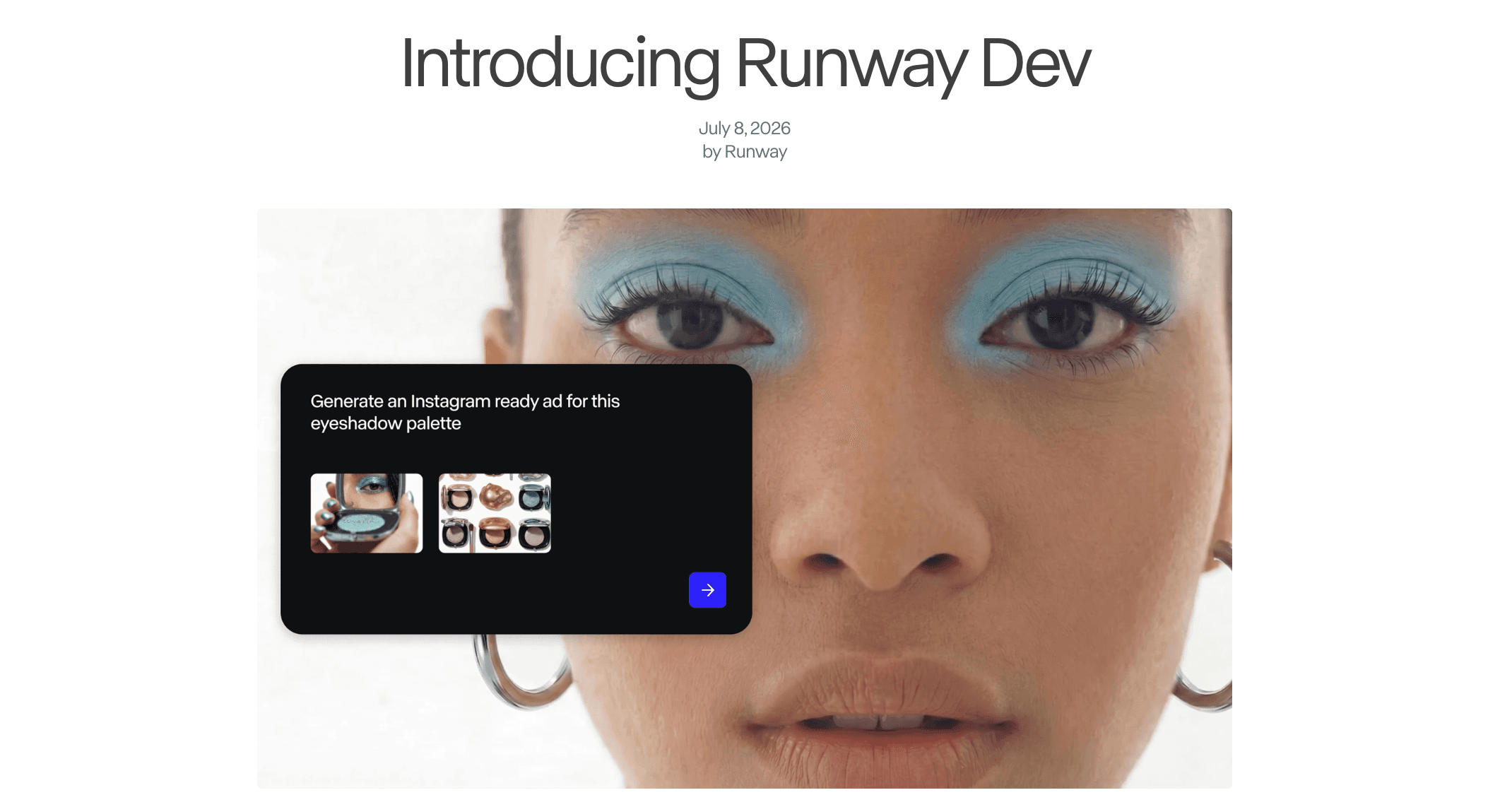
Overview
Runway Dev is Runway's production API platform for developers and enterprise teams. It combines Runway models such as Gen-4.5, Gen-4 Turbo, Aleph 2.0, and Act-Two with selected third-party image, video, and audio models behind one integration, organization, credit balance, and usage dashboard.
The platform is broader than a list of generation endpoints. A Model Router can choose an eligible model by cost, latency, or quality within allow lists, deny lists, and hard credit ceilings. Recipes package common commercial outputs such as product ads and localization into single calls, while Workflows expose custom multi-model pipelines through private endpoints.
Runway Dev also includes Characters, its real-time avatar layer with voice, tool calling, and a knowledge base. This makes the platform relevant to creative applications, ecommerce automation, advertising systems, games, training, and customer-facing agents—not just standalone text-to-video demos.
Use cases
The strongest fit depends on the job you need the product to complete, not the size of its feature list.
Add image, video, audio, editing, and upscaling features without operating separate model infrastructure.
Generate product images, ads, localized variants, and multi-shot video through outcome-oriented Recipe endpoints.
Trigger controlled, repeatable multi-model Workflows and track spend across teams and models.
Build real-time avatars with a face, voice, tools, and a knowledge base for support, training, games, or entertainment.
Use the Media Router or a single SDK to switch among Runway and third-party providers as quality, cost, and availability change.
Capabilities
Accesses Runway video and image models plus selected third-party models for video, images, speech, sound, and upscaling.
Filters models by capability and policy, then selects by cost, latency, or quality while respecting price caps and provider rules.
Single-call endpoints handle outcomes such as product ads, product swaps, UGC videos, multi-shot video, ad localization, and campaign images.
Combines multiple models, modalities, and processing steps into a reusable pipeline exposed through a private API endpoint.
Creates real-time interactive avatars with voice, tool calling, and connected knowledge for embedded agent experiences.
Selected models can output ProRes, PNG sequences, 10-bit, HDR10, HLG, EXR, and other professional or HDR formats for an additional fee.
Provides scoped API keys, roles, credit tracking, usage tiers, spend limits, autobilling, and enterprise workspace reporting.
Eligible organizations can route API usage to an AWS account while keeping the Runway Dev organization and API keys.
Process
Step 1
Register in the developer portal, create a project organization, and assign appropriate admin, developer, and billing roles.
Step 2
Purchase at least $10 in credits, create an API key, store it in a secret manager, and configure separate keys for environments.
Step 3
Call a specific model for predictable behavior, a Recipe for a packaged outcome, a Workflow for a custom pipeline, or a Router for dynamic selection.
Step 4
Create asynchronous generation jobs, handle queued or throttled states, poll or use supported callbacks, and validate outputs.
Step 5
Moderate inputs and outputs, disclose synthetic media where appropriate, protect user uploads, and define retry and fallback behavior.
Step 6
Record the realized model and credits, compare output quality, watch concurrency and daily-generation caps, and adjust routing or usage tiers.
Cost
Runway Dev is pay-as-you-go at $0.01 per credit with a $10 minimum initial purchase. Costs vary widely by model, resolution, duration, references, and output format. For example, Gen-4.5 video is $0.12 per output second, Gen-4 Turbo is $0.05 per second, and Gen-4 Image Turbo is $0.02 per image. Model Router calls use the selected model's standard rate.
$0.01 per credit
Shared pay-as-you-go unit across Runway Dev models and endpoints.
$0.05–$0.28 per second
Representative first-party video rates before format surcharges.
$0.01–$0.40 per image
Rates depend on model, quality, and resolution.
$0.02 upfront + $0.02 per 6 seconds
Current GWM-1 avatar session billing.
From $0.21 to several dollars per call
Outcome-based endpoints bundle prompt and workflow steps.
Custom agreement
Higher limits, guaranteed capacity, advanced reporting, and contractual controls are negotiated.
Pricing checked . Check current pricing at the source ↗
Assessment
Compare
The right alternative depends on the specific output, workflow, controls and budget your project requires.
Coding
A broader model-hosting marketplace for developers who value open-model variety and per-model deployment options beyond media production.
Explore Replicate →Content Creator
Runway Creative is the better fit for human creators who want a visual workspace instead of embedding models through code.
Explore Runway Creative →Content Creator
Use the dedicated model page when the decision is specifically about Runway's high-quality video model rather than the full multi-model platform.
Explore Runway Gen-4.5 →Content Creator
A creator-oriented AI video and image platform with social and cinematic workflows, useful when an API-first enterprise stack is unnecessary.
Explore Higgsfield AI →Questions
Runway Dev is Runway's API platform for image, video, audio, upscaling, professional media formats, packaged Recipes, custom Workflows, model routing, and real-time Characters.
Credits cost $0.01 each, and the minimum initial purchase is $10. Each model or Recipe has its own credit rate; Gen-4.5 currently costs 12 credits, or $0.12, per output second.
No. Runway Dev has separate organization, API-key, credit, and usage billing designed for software integrations. A Runway Creative plan is the visual application for creators.
The catalog includes Runway models such as Gen-4.5, Gen-4 Turbo, Aleph 2.0, Act-Two, and Gen-4 Image, plus selected third-party video, image, audio, speech, and upscaling models. Check the live model list before building.
It filters models using capability, allow and deny lists, and credit ceilings, then chooses an eligible model based on a cost, latency, or quality preference. Response metadata identifies the model and realized cost.
Recipes are Runway-maintained, outcome-specific endpoints such as Product Ad or Ad Localization. Workflows are custom multi-step pipelines that a team builds once and invokes through a private API.
Yes. Runway Characters supports real-time avatars with voice, tool calling, and a knowledge base. Current GWM-1 avatar billing is two credits upfront and two credits per six seconds.
Runway says Runway Dev includes contractual commitments not to train on customer data and support for zero-data retention. Buyers should verify scope, third-party-model coverage, exceptions, and retention terms in their agreement.
Tier 1 begins with model-dependent concurrency, daily-generation caps, and a $100 maximum spend over 30 days. Purchasing thresholds automatically unlock higher tiers, while enterprise teams can request exceptions.
Bottom line
Runway Dev is compelling for teams that need production media generation across multiple providers without building separate integrations and orchestration from scratch. Its strongest differentiators are media-specific routing, packaged Recipes, private Workflows, and real-time Characters. The tradeoff is operational: teams still need strict cost ceilings, model regression tests, safety review, and contract-level privacy checks because media workloads are expensive, stochastic, and provider-dependent.
Visit Runway Dev website ↗
Seed Audio 1.0 - ByteDance's model for generating speech, music, and SFX in one pass
Lucy 2.5 - Decart's AI that edits and restyles video mid-stream

Seedance 2.0 - ByteDance's frontier AI video model
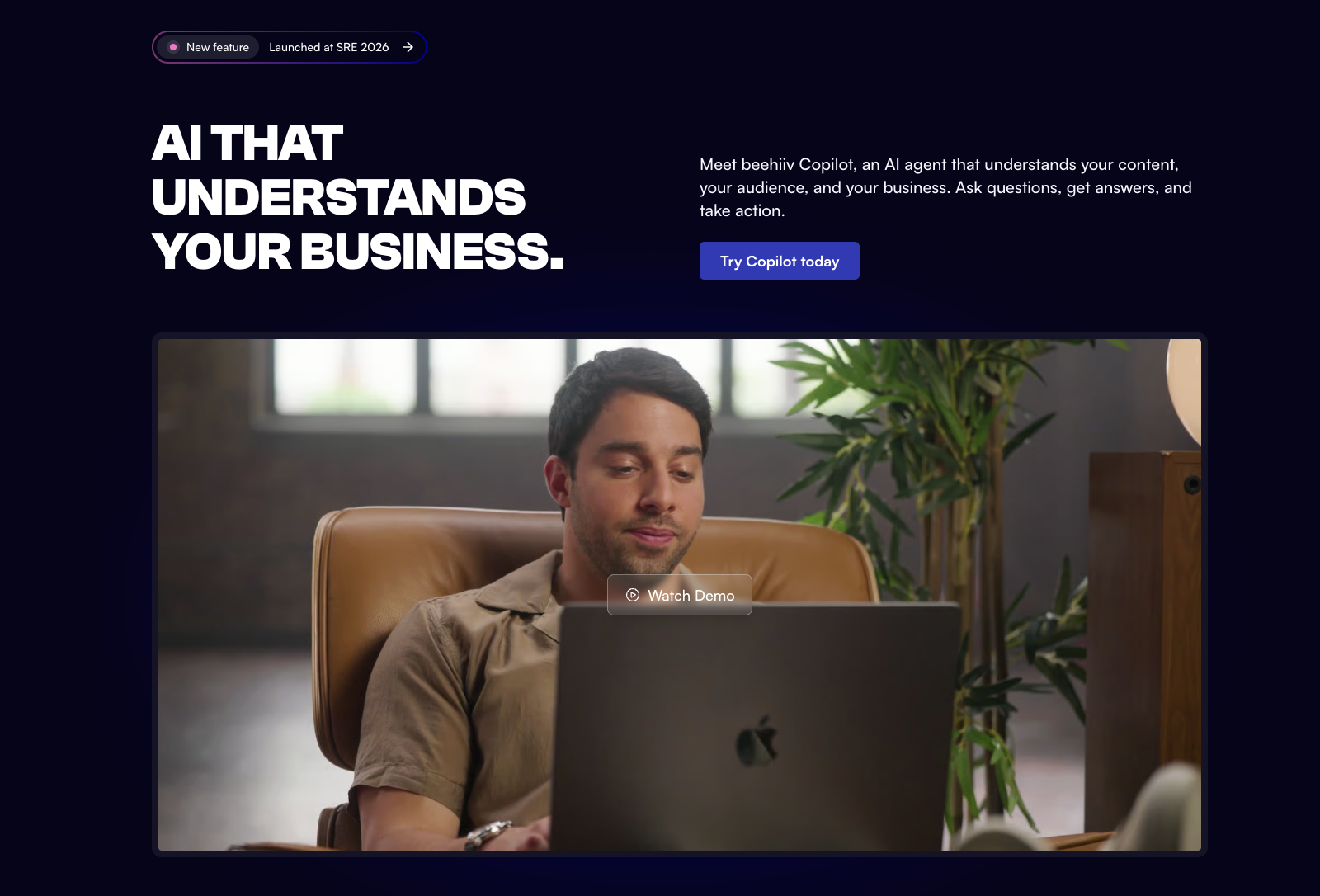
Beehiiv Copilot - Beehiiv's built-in agent for newsletter analytics, segments, and campaigns

Get access to all our AI courses, hundreds of real-world AI use cases, live expert-led workshops, an exclusive network of AI early adopters, and more.
Get unlimited access to all of our current & upcoming industry-specific AI courses for the duration of your subscription.
To keep up with the rapid pace of AI, our team publishes AI implementation guides daily. Our library contains 300+ practical use cases to automate real-world work.
Join weekly, live, interactive sessions with industry leaders who are at the forefront of AI for hands-on implementation guidance and exclusive insights.
Network with an exclusive community of AI-first professionals who are working smarter with AI. Learn how early adopters are using AI in their work and businesses.