Large customer-service operations
Automate a bounded support job that requires authentication, system access, policy adherence and dependable human transfer.
Independent tool overview
OpenAI Presence is a managed enterprise product for deploying governed voice and chat agents into high-volume customer and internal workflows. OpenAI Forward Deployed Engineers and select systems integrators help scope a specific job, connect approved systems, define policies and permissions, run simulations and evaluations, establish human escalation, launch gradually and improve the agent from production evidence. It is limited-GA, quote-based and not self-serve; the product is suitable only when an organization can own the operational, security, compliance and human-service system around the model.
Visit the official Presence site ↗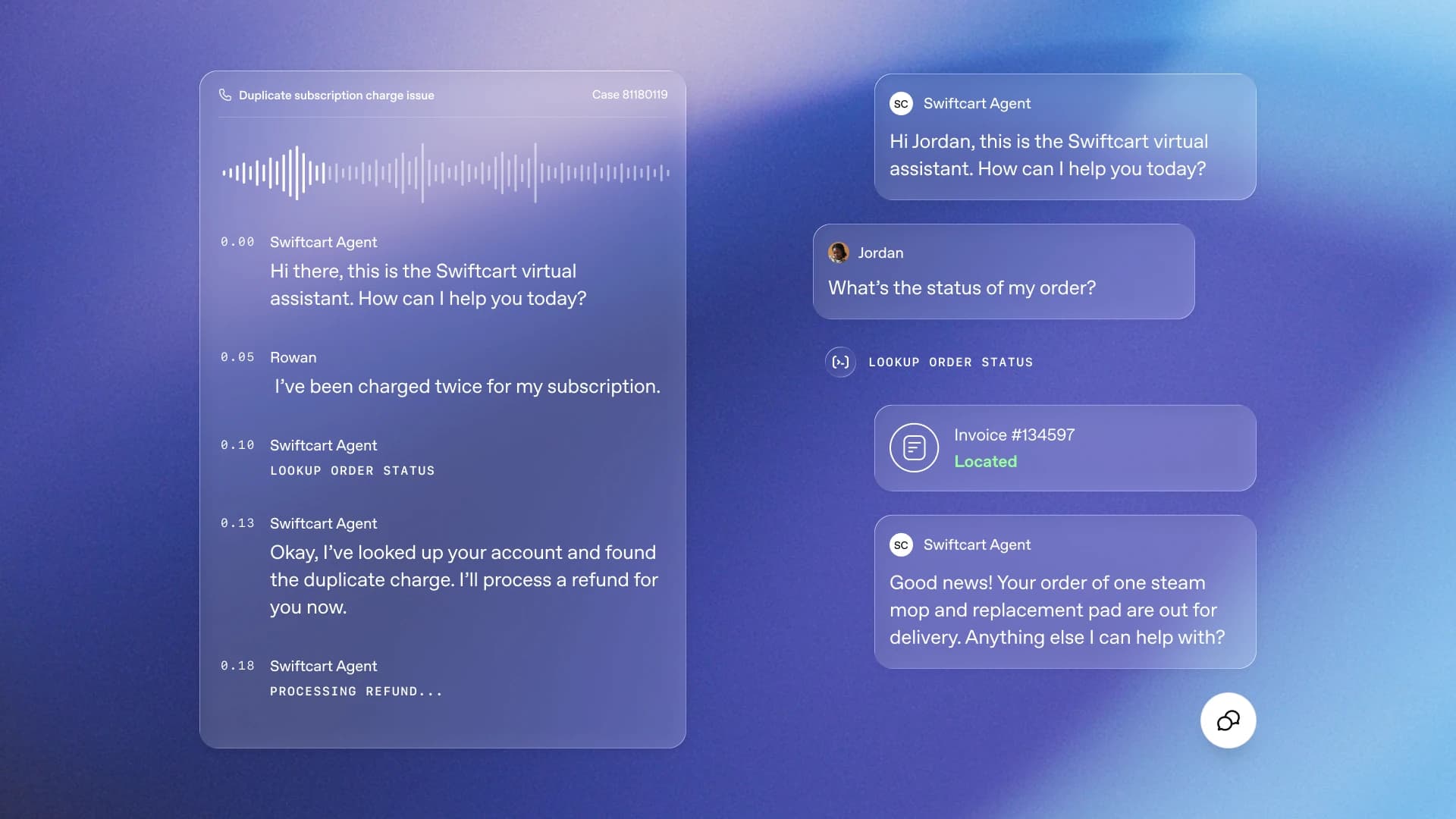
Overview
Presence is designed for repeatable production jobs such as customer support, billing resolution, insurance claims, outbound sales and internal IT service. An agent receives only the knowledge and system access needed for that job and can retrieve information, update systems or take approved actions through voice or chat.
The managed deployment includes standard operating procedures, policies, guardrails, scoped actions, simulations, graders, acceptance tests, monitoring and escalation rules. After launch, production sessions and handoffs reveal gaps; a Codex-powered process can propose changes that customer teams test, approve and roll out under control.
Presence is separate from ChatGPT workspace agents and from simply calling a realtime model through the API. Exact models, channels, integrations, capacity, data handling, retention, service commitments, implementation scope and pricing are defined for each eligible enterprise deployment.
Use cases
The strongest fit depends on the job you need the product to complete, not the size of its feature list.
Automate a bounded support job that requires authentication, system access, policy adherence and dependable human transfer.
Deploy agents where permissioning, evaluation, monitoring, audit evidence and escalation must be designed before production.
Work with forward-deployed engineers and integrators when a self-serve agent builder is insufficient for the workflow or operating environment.
Capabilities
Starts from one defined workflow and grants only the knowledge, tools and permissions required to perform it.
Supports realtime conversational channels, with contact-center routing, authentication and human handoff scoped per deployment.
Encodes company procedures, boundaries, approval requirements and the actions an agent may take in connected systems.
Tests common requests, edge cases and higher-risk scenarios with graders for outcome, policy, tool use and escalation behavior.
Intervenes when an interaction exceeds a defined boundary and transfers work when policy or judgment requires a person.
Uses sessions, escalations and quality signals to identify failure patterns after launch rather than treating deployment as finished.
Investigates production evidence and proposes agent changes that teams can compare with the live version, test and approve before rollout.
Process
Step 1
Define the user population, allowed intents, systems, baseline cost and quality, exclusion cases, service target and required human outcome.
Step 2
Specify authentication, least-privilege access, prohibited actions, approval thresholds, recording and disclosure rules, data classes, retention and escalation ownership.
Step 3
Connect current policies, knowledge and APIs; resolve contradictory documentation and design safe outcomes for unavailable tools or incomplete identity verification.
Step 4
Run representative, adversarial and high-risk simulations across accents, languages, accessibility needs, noisy channels, fraud attempts, policy changes and backend failures.
Step 5
Use a limited cohort, live monitoring, reversible permissions, staffed human handoff, incident response and pre-release regression tests for every proposed update.
Cost
OpenAI does not publish a standard Presence price. It is a managed, limited-GA product for eligible enterprises, and pricing is specific to the customer, workflow and deployment. Buyers should model implementation, systems integration, telephony or channel costs, model usage, monitoring, evaluation, human escalation, ongoing change management and support—not just a per-conversation amount.
Custom
Scoped voice or chat agent deployment led by OpenAI and approved partners.
Pricing checked . Check current pricing at the source ↗
Assessment
Compare
The right alternative depends on the specific output, workflow, controls and budget your project requires.
Sales
Consider Vapi when an engineering team wants a self-serve, composable voice-agent stack and is prepared to own providers, testing, compliance and operations.
Explore Vapi →Agents
Consider OpenAI Frontier when the objective is a broader enterprise platform for many AI coworkers and agent workflows rather than a managed voice-or-chat deployment.
Explore OpenAI Frontier →Questions
Presence is a managed enterprise product for building, deploying, governing and improving voice and chat agents that can use approved knowledge and systems, take permitted actions and escalate to people.
It is available through a limited general availability program for eligible enterprise customers. It is not a self-serve product, and access depends on workflow fit, readiness and delivery capacity.
OpenAI does not publish a standard price. Implementation, models, channels, capacity, data handling, support and service commitments are scoped and priced for each deployment.
During limited GA, Presence supports conversational voice and chat workflows. The exact contact-center integration, routing, authentication and handoff design is confirmed during technical scoping.
Presence is a separate managed deployment for high-volume production workflows with connected systems, testing, guardrails, monitoring and deployment support. Workspace agents are created and managed inside supported ChatGPT and Slack experiences.
No. Human judgment, escalation, incident response, policy ownership, quality review and support capacity remain essential. A safe deployment defines when and how a person takes over.
No. OpenAI reports that its own English phone-support agent resolved 75% of inbound issues and reduced handoffs by 15 percentage points over ten days. Those internal results are not a forecast or service commitment for another company.
Bottom line
Presence is aimed at the hard part of enterprise agents: not a convincing demo, but a governed service that can touch real systems and survive changing policy and user behavior. The managed model is attractive for organizations with scale, a bounded high-value workflow and mature operational owners. It is a poor fit for a small experiment that lacks clean procedures, reliable APIs, human escalation or a measurable acceptance bar. Buy the deployment and governance system—not a generic promise of automation.
Visit Presence website ↗
🗣️ Mercury 2 - Inception's diffusion reasoning model built for realtime voice agents

Grok Voice Think Fast 2.0 - xAI's new voice model that thinks while it speaks

Claude Tag - Tag @Claude as a shared Slack teammate to delegate tasks

Low-cost model converting complex documents into machine-readable data

Get access to all our AI courses, hundreds of real-world AI use cases, live expert-led workshops, an exclusive network of AI early adopters, and more.
Get unlimited access to all of our current & upcoming industry-specific AI courses for the duration of your subscription.
To keep up with the rapid pace of AI, our team publishes AI implementation guides daily. Our library contains 300+ practical use cases to automate real-world work.
Join weekly, live, interactive sessions with industry leaders who are at the forefront of AI for hands-on implementation guidance and exclusive insights.
Network with an exclusive community of AI-first professionals who are working smarter with AI. Learn how early adopters are using AI in their work and businesses.