World-model research
Explore how causal video generation accumulates state, responds to actions, and approximates physical dynamics over time.
Independent tool overview
Odyssey-2 is an experimental world model that begins streaming an AI-imagined video world immediately and lets the user change what happens next with prompts.
Visit the official Odyssey-2 site ↗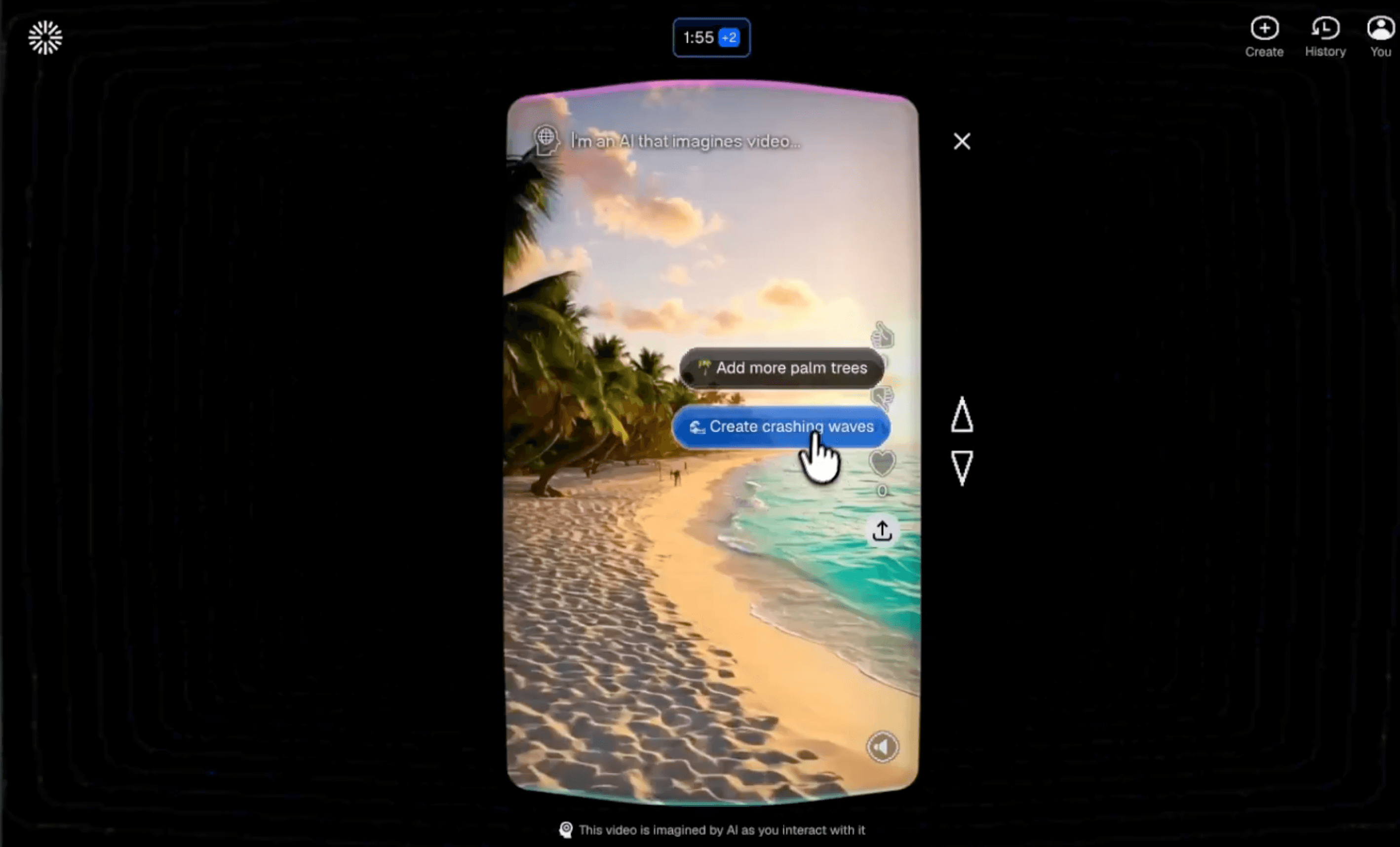
Overview
Odyssey-2 is not a conventional text-to-video generator. Instead of rendering a fixed clip with a predetermined ending, it generates the next frame from what has happened so far and continues the simulation while the user interacts with it.
Odyssey says the model starts streaming immediately, produces a frame in under 50 milliseconds, runs at 20 frames per second, and can continue for minutes. Users can begin with text or an image and shape the evolving video with new prompts.
The original Odyssey-2 research experience remains available, but the model family has advanced. Odyssey-2 Pro launched with developer endpoints for simulations, interactive streams, and one-to-many viewable streams, followed by the larger Odyssey-2 Max. The current developer portal says Max access is rolling out to existing API users and asks new developers to request priority access.
The experience is a useful preview of real-time world simulation, interactive storytelling, training, games, and embodied-AI research. It is still early technology, with private pricing, limited production assurances, and legal terms that require careful review before commercial use.
Use cases
The strongest fit depends on the job you need the product to complete, not the size of its feature list.
Explore how causal video generation accumulates state, responds to actions, and approximates physical dynamics over time.
Test experiences where a viewer can redirect a visual world while it is being generated.
Prototype open-ended environments without first building every scene and transition by hand.
Explore adaptive visual scenarios that change in response to a learner's questions or decisions.
Use the API access process to assess interactive, viewable, or offline simulation endpoints for a product concept.
Capabilities
Begins generating the visual stream immediately instead of waiting for a complete clip to render.
Odyssey reports one new frame in under 50 milliseconds, corresponding to a 20-frame-per-second stream.
Continues a simulation for minutes rather than stopping at a short fixed clip.
Accepts new prompts while the video is running so the user can alter what the model generates next.
Starts a simulated world from a written prompt or an image according to Odyssey's current product overview.
Predicts each frame from prior frames and actions rather than relying on a known future ending.
Aims to model many kinds of scenes, motion, lighting, contact, and behavior instead of one narrow environment.
Odyssey-2 Pro introduced an endpoint for embedding a stream that can be changed programmatically in real time.
Supports distributing one generated stream to multiple viewers for shared viewing experiences.
Generates an offline video from a prompt, specified actions at precise time steps, quality settings, and a target duration.
Odyssey announced JavaScript and Python SDKs with the Pro API, while current access is managed through its developer portal.
Pro expanded the original experience into an API, and Max increases model scale and physical-simulation ambition.
Process
Step 1
Use the public Odyssey-2 experience for exploration; request API access when building an application or conducting structured evaluation.
Step 2
Confirm allowed commercial use, data licensing, output handling, access limits, and any signed order before uploading sensitive material.
Step 3
Describe the setting, subjects, visual style, camera viewpoint, and initial action, or provide an image you are authorized to use.
Step 4
Observe the first moments before adding instructions so later prompts respond to a stable visual context.
Step 5
Use short, unambiguous prompts that change a subject, action, environment, or direction without overloading the model.
Step 6
Look for drift in identity, geometry, physics, lighting, camera position, and cause-and-effect as the simulation continues.
Step 7
Use interactive streams for live control, viewable streams for an audience, or simulations for action-timed offline output.
Step 8
Moderate prompts and outputs, constrain user actions, protect API credentials, disclose generated content, and provide failure recovery.
Step 9
Benchmark response time, stream stability, quality, safety, cost, and the percentage of sessions that produce a useful experience.
Cost
Odyssey does not publish a standard consumer subscription or per-second API rate. The current developer portal asks new users to request priority access, and API fees are set through the applicable order. Treat any trial or promotional access as temporary and obtain a written quote before budgeting.
Price not published
The public-facing experience for trying the original interactive model.
Request access
The developer portal is currently onboarding new users through a priority-access request.
Custom quote
Fees and permitted use are defined by an API order and governing agreements.
Pricing checked . Check current pricing at the source ↗
Assessment
Compare
The right alternative depends on the specific output, workflow, controls and budget your project requires.
Content Creator
A stronger fit for creating persistent, navigable 3D worlds from text, images, or video rather than a continuously generated 2D video stream.
Explore World Labs Marble →Content Creator
A conventional high-quality video model for directed, fixed clips with production-oriented controls and native audio.
Explore Veo 3.1 →Content Creator
A creator-focused video model and editing ecosystem when cinematic clip quality and repeatable production tools matter more than live world interaction.
Explore Runway Gen-4.5 →Questions
Odyssey-2 is a causal world model that generates a continuous video stream frame by frame and lets the user change what happens next with prompts.
Most video models render a fixed clip. Odyssey-2 starts streaming immediately, predicts the next frame from prior context, and can respond to new instructions while the simulation continues.
Odyssey reports that it generates a frame in under 50 milliseconds and streams at 20 frames per second.
Odyssey describes multi-minute interactive streams and simulations rather than the short fixed clips common in video generators.
Yes. Odyssey's current product overview says Odyssey-2 can begin from an image or a text prompt.
Pro extended the original Odyssey-2 into a developer API with interactive and offline endpoints. Max is the newer, larger model now rolling out to existing API users.
Yes, but current access is managed. Existing API users are receiving Max access, while new developers are directed to request priority access.
Odyssey announced interactive streams for live control, viewable streams for one-to-many distribution, and simulations for offline videos with actions scheduled at specific times.
Odyssey does not publish a standard self-serve price. API fees are defined in an applicable order, so developers need access approval and a current quote.
The current consumer terms restrict the app and service to personal, non-commercial use. Commercial or product work should use an appropriately authorized API agreement and written order.
The terms say users retain their rights in output subject to law, but they also grant Odyssey a broad perpetual license to use user content and output, including for service operation and model improvement.
It is promising for prototypes and research, but production teams should first secure the correct license, pricing, support terms, safety controls, reliability evidence, and a fallback for unstable streams.
Bottom line
Odyssey-2 is one of the clearest demonstrations of how AI video can become an interactive medium rather than a rendered asset. Immediate, multi-minute generation is genuinely distinctive, and the Pro and Max roadmap makes it relevant to developers as well as researchers. It remains an early platform: use it to test new interaction ideas, but do not treat the public experience as a production-ready commercial video tool.
Visit Odyssey-2 website ↗
Sesame - Conversational voice agent capable of holding natural conversations

Hailuo 2.3 - MiniMax's new AI video model with upgraded movement, realism, and expression

Spiral - An AI writing partner with taste
Sonic 3 - Cartesia's realistic text-to-speech model for voice agents

Get access to all our AI courses, hundreds of real-world AI use cases, live expert-led workshops, an exclusive network of AI early adopters, and more.
Get unlimited access to all of our current & upcoming industry-specific AI courses for the duration of your subscription.
To keep up with the rapid pace of AI, our team publishes AI implementation guides daily. Our library contains 300+ practical use cases to automate real-world work.
Join weekly, live, interactive sessions with industry leaders who are at the forefront of AI for hands-on implementation guidance and exclusive insights.
Network with an exclusive community of AI-first professionals who are working smarter with AI. Learn how early adopters are using AI in their work and businesses.