Mercury business customers
Keep bank and accounting data in one workspace with fewer manual transaction imports.
Independent tool overview
Double-entry accounting built into Mercury business banking, with AI-assisted categorization.
Visit the official Mercury Books site ↗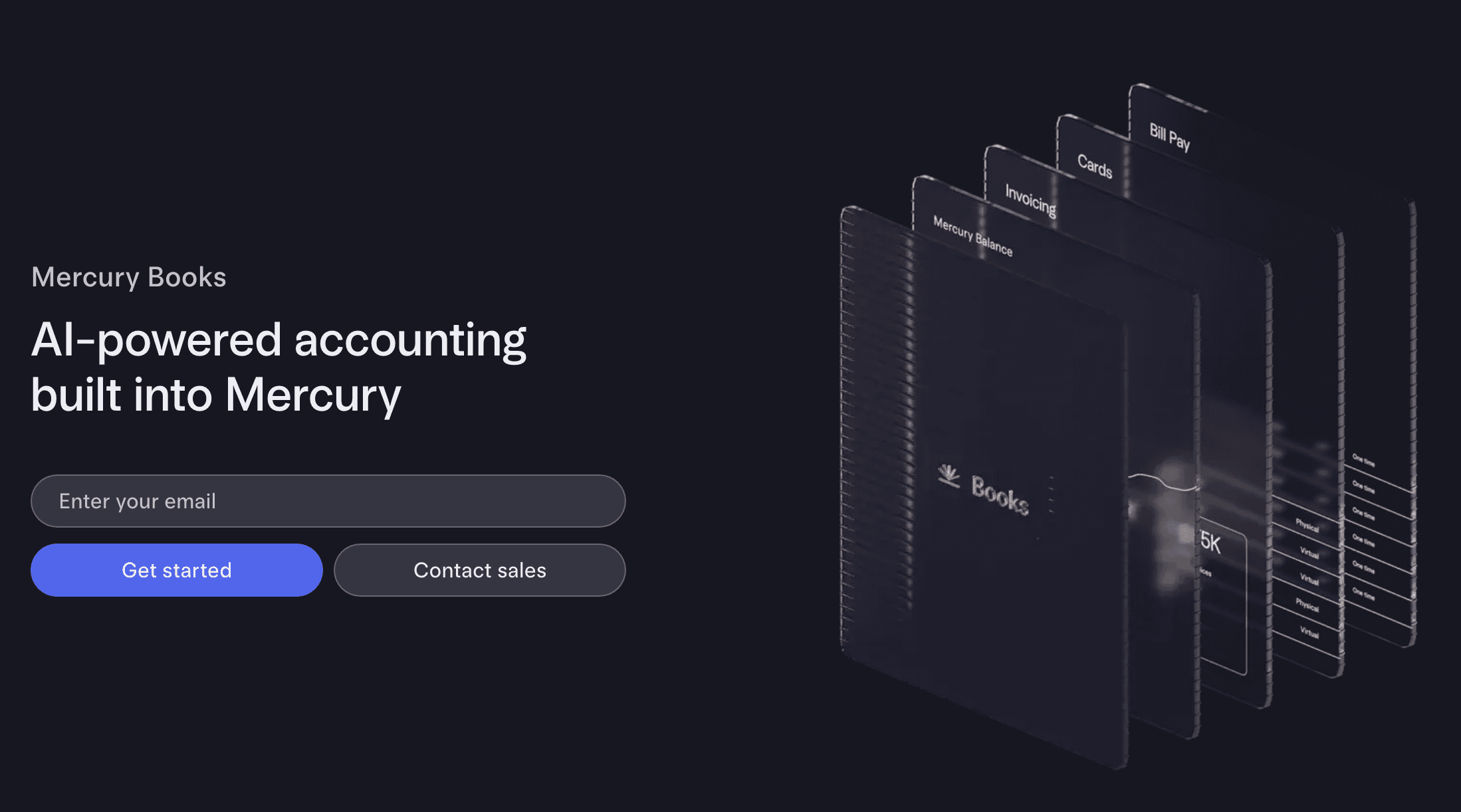
Overview
Mercury Books puts a double-entry ledger beside a company's Mercury banking, cards, invoicing, and bill pay. It supports cash or accrual accounting and produces profit-and-loss, balance-sheet, cash-flow, and general-ledger reports. Mercury account activity syncs into the books; external banks and cards can connect through Plaid, while Stripe, PayPal, and Gusto integrations help bring in sales and payroll data.
AI contributes transaction categorization and the Command assistant for questions and bookkeeping tasks such as journal entries or chart-of-accounts organization. This is accounting software, not an autonomous substitute for financial judgment: unusual transactions, tax treatment, and the opening-balance cutover still need a responsible reviewer. Books requires a Mercury business account, works in USD, and is designed as a replacement ledger rather than a QuickBooks sync. It is free through December 31, 2026, then listed at $35 per month.
Use cases
The strongest fit depends on the job you need the product to complete, not the size of its feature list.
Keep bank and accounting data in one workspace with fewer manual transaction imports.
Track basic books and financial reports while retaining an accountant for judgment calls.
Join a client’s Mercury account with tailored access and work from shared current transaction context.
Learn by doing
Explore the latest step-by-step AI guides from The Rundown University.
Capabilities
Supports cash or accrual basis, journals, reconciliations, and standard financial statements.
Mercury banking and card accounts, including history, feed Books directly.
Plaid and integrations with Stripe, PayPal, and Gusto extend the record.
Books uses AI, similarity matching, and user-defined rules for transactions.
The product page describes asking about financial trends and delegating some bookkeeping tasks.
Process
Step 1
Choose cash or accrual and a chart-of-accounts template or imported CSV.
Step 2
Close the last period in the old system, set the Books start date, and record opening balances.
Step 3
Add outside banks, cards, and sales or payroll platforms that matter to the ledger.
Step 4
Inspect categorization, reconciliations, and monthly statements with an accountant when needed.
Cost
Mercury Books is free for all of 2026 for eligible Mercury account holders. Mercury lists a separate $35/month Books subscription starting January 1, 2027; it is not included in Mercury Plus or Pro. External bookkeeping partners set their own fees.
$0 through December 31, 2026
Available to eligible Mercury business customers.
$35/month from January 1, 2027
Published ongoing Books price.
Pricing checked . Check current pricing at the source ↗
Assessment
Compare
The right alternative depends on the specific output, workflow, controls and budget your project requires.
Finance
Consider Ramp Stack for a broader finance workflow centered on spending and accounting operations.
Explore Ramp Stack →Finance
Consider Intuit’s assistant within its finance products when that ecosystem is already in use.
Explore Intuit Assist →Questions
Mercury says Books is a full accounting system designed to replace rather than sync with another ledger.
Yes. The product is available to Mercury business account holders.
Yes. Mercury documents Plaid-linked accounts and CSV import for unsupported sources.
The support article says Books currently works in USD and non-USD invoices do not sync.
Bottom line
Mercury Books is a credible low-friction choice for companies already banking with Mercury and willing to move their ledger there. The strongest benefits are automatic source data and current reports; the decision hinges on cutover effort, USD-only limits, accountant fit, and the $35 monthly fee after 2026.
Visit Mercury Books website ↗
Get access to all our AI courses, hundreds of real-world AI use cases, live expert-led workshops, an exclusive network of AI early adopters, and more.
Get unlimited access to all of our current & upcoming industry-specific AI courses for the duration of your subscription.
To keep up with the rapid pace of AI, our team publishes AI implementation guides daily. Our library contains 300+ practical use cases to automate real-world work.
Join weekly, live, interactive sessions with industry leaders who are at the forefront of AI for hands-on implementation guidance and exclusive insights.
Network with an exclusive community of AI-first professionals who are working smarter with AI. Learn how early adopters are using AI in their work and businesses.