Visual learners
Explore how changing one value alters a graph, shape, physical relationship, or outcome instead of reading a formula in isolation.
Independent tool overview
Interactive Learning is a built-in ChatGPT feature that can turn supported math and science explanations into manipulable visual modules. Learners can change variables or formulas and see graphs and outcomes update in real time, making relationships such as slope, energy, pressure, geometry, and decay easier to explore. OpenAI launched it with more than 70 topics for logged-in users on every ChatGPT plan worldwide. It is useful for conceptual exploration, but it is not a separate app, a complete curriculum, a symbolic proof system, or a guarantee that every explanation and calculation is correct.
Visit the official Interactive Learning site ↗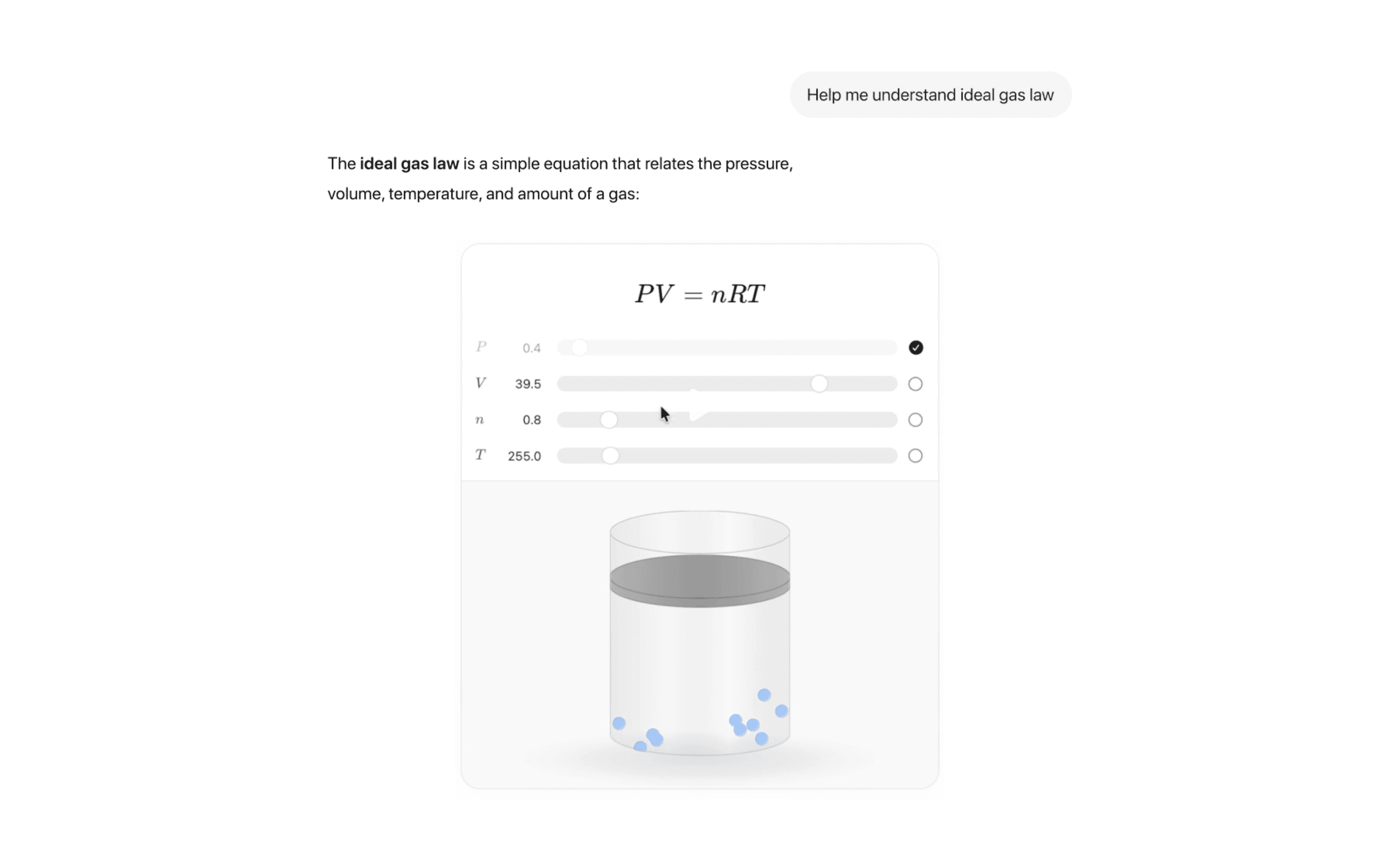
Overview
OpenAI introduced ChatGPT's interactive math and science explanations on March 10, 2026. When a request matches a supported concept, ChatGPT can present a dynamic visual module alongside its explanation rather than relying only on prose or a static chart.
The modules let a learner manipulate variables and formulas and immediately see how the graph, geometry, or numerical outcome changes. Initial coverage spans more than 70 concepts most relevant to high-school and college-age learners, including linear equations, the Pythagorean theorem, circle area, trigonometric identities, exponential decay, compound interest, kinetic and potential energy, Hooke's law, Ohm's law, Coulomb's law, lens equations, and gas laws.
Interactive Learning is part of ChatGPT, not a separate tool or paid add-on. OpenAI says it is available globally to all logged-in users across all plans. A learner can trigger it with a direct concept request, but a visual may not appear for every wording, topic, device state, model response, or account configuration.
The feature complements Study Mode rather than replacing it. Interactive Learning focuses on visual manipulation of supported concepts; Study Mode adds Socratic questions, staged explanations, knowledge checks, uploaded materials, and step-by-step guidance across a much wider range of subjects.
Use the output as an exploratory aid, then verify formulas, units, assumptions, graphs, and final answers against course materials or an authoritative source. Generative explanations can be confidently wrong, and a plausible visualization can reinforce a misconception if its inputs or model-generated interpretation are incorrect.
Use cases
The strongest fit depends on the job you need the product to complete, not the size of its feature list.
Explore how changing one value alters a graph, shape, physical relationship, or outcome instead of reading a formula in isolation.
Refresh the relationship behind a familiar equation before returning to practice problems or course materials.
Manipulate a supported concept together and discuss why the visual changes, without treating ChatGPT as the answer key.
Use a quick visualization as a supplementary explanation after checking its accuracy and alignment with the lesson.
Test a prediction, alter one variable at a time, and explain the observed result in their own words.
Experiment with a supported high-school or introductory college topic outside a formal class, then verify the result independently.
Capabilities
Pairs conversational instruction with an interactive representation of a supported mathematical or scientific relationship.
Lets learners adjust quantities and immediately observe how the displayed graph or outcome responds.
Supports experimentation with equations so relationships are explored rather than only stated.
Learners can ask why a change occurred, request a simpler explanation, or connect the visual to a concrete example.
Launched with more than 70 concepts across algebra, geometry, trigonometry, mechanics, electricity, optics, and thermodynamics.
OpenAI says the modules are available to logged-in ChatGPT users worldwide across Free and paid plans.
Can be paired with ChatGPT's guided-learning behavior for questions, hints, practice, reflection, and knowledge checks.
The surrounding ChatGPT learning experience is available on web, iOS, and Android, although the exact rendering can vary by client.
Process
Step 1
Start with a precise request such as 'Help me understand the Pythagorean theorem' or 'Show how PV = nRT changes when volume decreases.'
Step 2
Tell ChatGPT your course level, what you already know, and whether you want intuition, a derivation, practice, or exam review.
Step 3
If the module does not appear automatically, request a dynamic visualization and note that not every topic is supported.
Step 4
Write down what you think will happen to the graph or result before moving a variable; this makes the interaction an active-learning exercise.
Step 5
Hold other assumptions steady, move one control, and describe the direction and size of the observed change.
Step 6
State why the result changed in your own words and ask ChatGPT to challenge gaps rather than simply confirm you.
Step 7
Test zero, negative, very large, or physically impossible values where relevant and verify that units, domains, and constraints are handled correctly.
Step 8
Compare the formula, assumptions, worked result, and graph with a textbook, instructor materials, calculator, or authoritative reference.
Step 9
Solve a fresh problem unaided to determine whether you learned the concept rather than only recognizing the animation.
Step 10
Use ChatGPT only as permitted by the course, disclose assistance when required, and never submit generated work as your own when prohibited.
Cost
Interactive Learning has no standalone price. OpenAI says it is included for logged-in ChatGPT users globally across all plans, including Free. Paid individual, business, and education subscriptions may change model access, limits, administration, privacy defaults, or surrounding features, but do not represent a separate Interactive Learning purchase.
$0
Interactive learning is included for logged-in Free users, subject to ChatGPT's current usage limits and availability.
Included with plan
The feature is included rather than sold as an add-on; consult the live ChatGPT pricing page for current plan prices and limits.
Institutional pricing
Education organizations can deploy ChatGPT through managed offerings with administrative and business-data protections.
Pricing checked . Check current pricing at the source ↗
Assessment
Compare
The right alternative depends on the specific output, workflow, controls and budget your project requires.
Educators
Another built-in ChatGPT experience focused on guided questions, step-by-step explanations, practice, and knowledge checks across broader subjects.
Explore ChatGPT Study Mode →Educators
A tutoring and teaching assistant built around Khan Academy's educational content and classroom workflows.
Explore Khanmigo →Educators
A narrower custom GPT aimed at helping parents guide children through math problems.
Explore Math Mentor →Educators
A separate AI tutoring experience for learners who want an alternative to the ChatGPT ecosystem.
Explore Llama Tutor →Questions
It is a built-in ChatGPT feature that can display dynamic visual explanations for supported math and science concepts. Users can change variables or formulas and see graphs and outcomes update in real time.
No. It is part of ChatGPT. The original Rundown listing points to OpenAI's product announcement, and users access the experience by asking ChatGPT about a supported concept.
Yes for logged-in Free users. OpenAI says the feature is available globally across all ChatGPT plans and does not list a separate add-on price.
OpenAI launched with more than 70 concepts, including algebra, geometry, trigonometry, compound interest, exponential decay, mechanics, electricity, optics, and gas-law relationships. The published list is illustrative rather than a complete curriculum.
Ask directly for help understanding a supported concept and request an interactive visualization. Examples from OpenAI include the Pythagorean theorem, PV = nRT, and the area of a circle. Availability can still vary by topic and response.
Interactive Learning visualizes and lets you manipulate supported math and science relationships. Study Mode is a broader guided-learning behavior that asks questions, scaffolds explanations, works with uploaded materials, and checks understanding.
Do not treat it as an answer key. Verify formulas, units, assumptions, graphs, and final results against class materials or an authoritative source, and follow your instructor's AI-use rules.
Yes as a supplementary demonstration after checking the module for accuracy, accessibility, curriculum alignment, privacy, and device availability. It should not be the sole source of instruction or assessment evidence.
For individual consumer services, OpenAI may use content to improve models unless the user opts out. Temporary Chats are not used for training. OpenAI says business and education workspace data is not used to train models by default.
Apply OpenAI's current age requirements and local school or parental rules. OpenAI advises that, in education contexts involving children under 13, an adult must conduct the actual interaction with ChatGPT.
Predict what will happen, change one variable at a time, explain the result in your own words, test boundary cases, verify the model, and then solve a new problem without the visual.
Bottom line
ChatGPT Interactive Learning is a useful free visual aid for turning selected math and science formulas into experiments. Its best use is not watching an animation or copying an answer, but predicting, manipulating, explaining, checking, and then practicing independently. The feature is easy to recommend as a supplement because it is included across ChatGPT plans; it is not sufficient as a curriculum, authoritative calculator, or unsupervised classroom policy.
Visit Interactive Learning website ↗.avif)
CheatSheet AI: Create Cheat Sheets Instantly
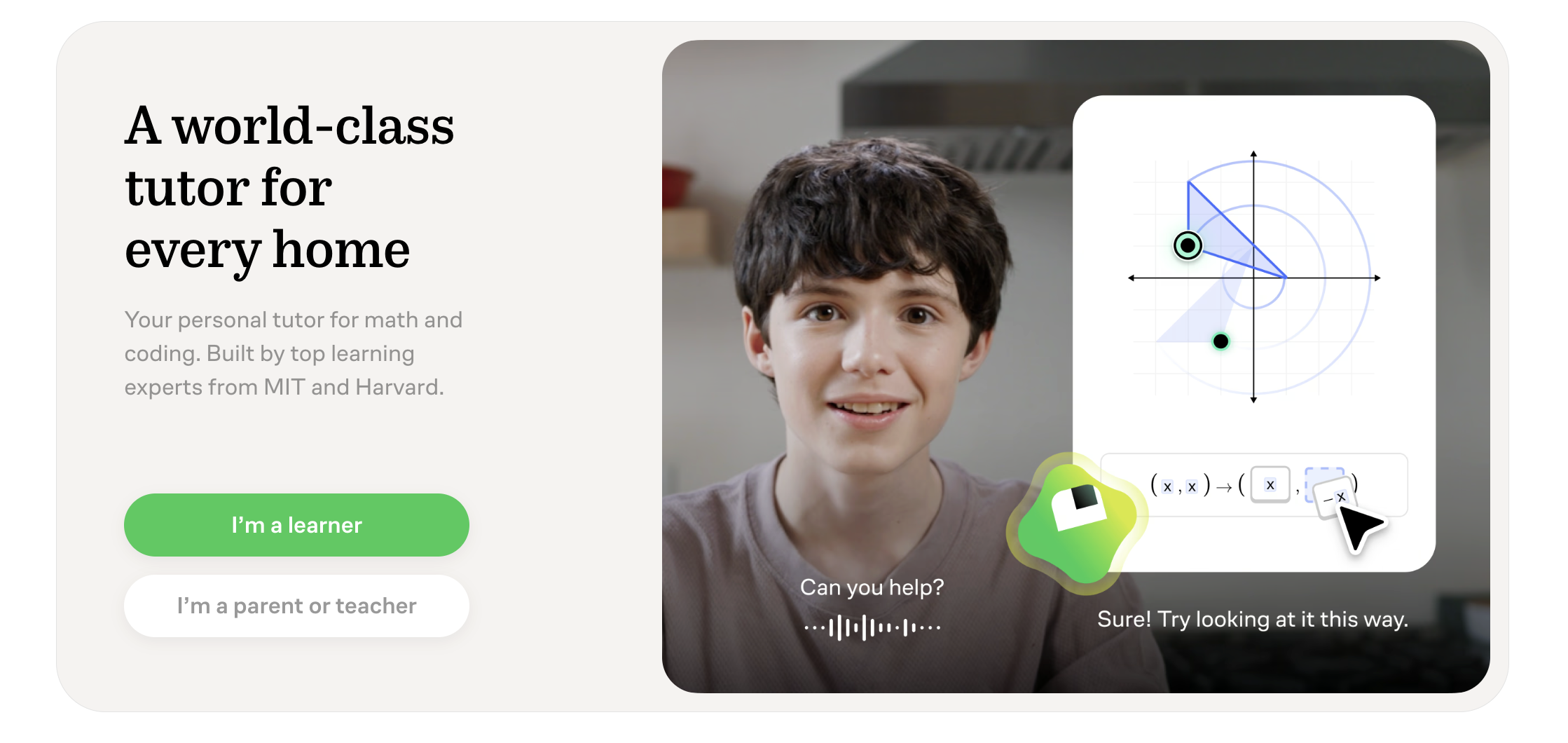
Koji by Brilliant - A personal AI tutor for math and coding

Child's read-along companion for enthusiastic reading.

Claude for Teachers - Free Claude access with teaching and lesson-planning skills for verified K-12 teachers

Get access to all our AI courses, hundreds of real-world AI use cases, live expert-led workshops, an exclusive network of AI early adopters, and more.
Get unlimited access to all of our current & upcoming industry-specific AI courses for the duration of your subscription.
To keep up with the rapid pace of AI, our team publishes AI implementation guides daily. Our library contains 300+ practical use cases to automate real-world work.
Join weekly, live, interactive sessions with industry leaders who are at the forefront of AI for hands-on implementation guidance and exclusive insights.
Network with an exclusive community of AI-first professionals who are working smarter with AI. Learn how early adopters are using AI in their work and businesses.