Audio publishers
Produce narrated long-form work with continuity and expressive delivery.
Independent tool overview
Eleven v4 is ElevenLabs’ expressive text-to-speech model for produced audio. It supports multi-speaker scripts, audio direction tags, professional voice clones and more than 90 languages. Eleven v4 Turbo is a related low-latency option for real-time voice agents, with vendor-reported median inference latency near 100 milliseconds.
Visit the official Eleven v4 site ↗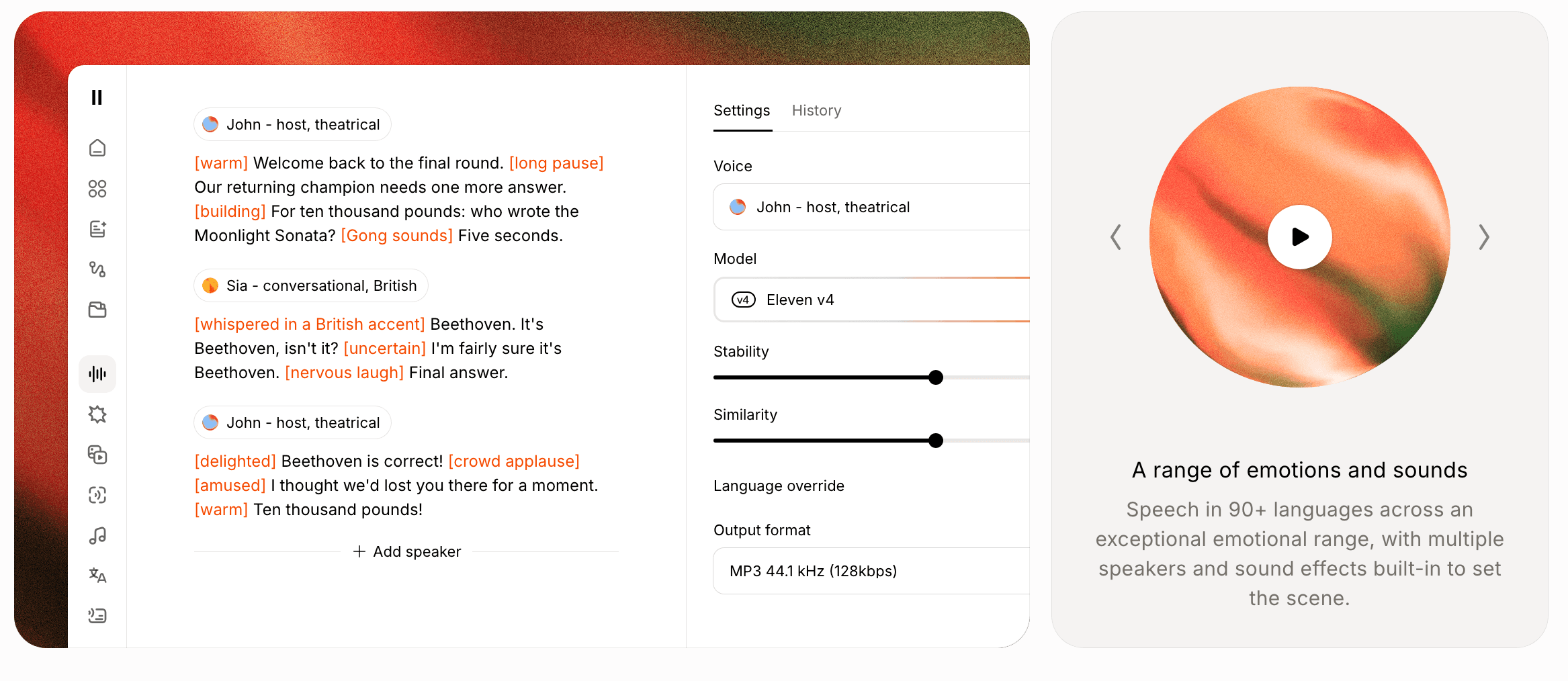
Overview
Eleven v4 is aimed at audio that needs performance, not merely intelligible words. ElevenLabs says its new architecture reads a script with awareness of who is speaking and how a line should land. Writers can put directions such as whispers, pauses, laughter and sound events into the text, then cast more than one speaker. The release also emphasizes speaker stability when a line is regenerated, a practical concern for long projects where one changed sentence should not sound like a different person.
Long-form creators can use context stitching to keep delivery consistent across successive generations, while professional voice clones return as a supported option in v4. The product page says one generation accepts up to 10,000 characters and lists MP3, WAV/PCM and telephony-oriented formats. These details make the model plausible for narration, multilingual education, character dialogue and ads. All generated audio still needs editorial listening: pronunciation, pacing, emotional fit and possible sound-tag artifacts can vary, especially in specialized vocabulary or longer sequences.
The related v4 Turbo model is built for live conversations and agent loops. ElevenLabs reports roughly 100 ms median inference and about 150 ms to first speech, plus bidirectional streaming and voice continuity. Those numbers are vendor measurements, not a guarantee for a particular network, voice or application. Choosing the production v4 model versus Turbo should depend on the use case: a finished audiobook can tolerate extra processing for quality, whereas an interactive agent must avoid unnatural pauses. Voice cloning has a separate consent obligation; ElevenLabs says every clone requires verified consent from its owner. Commercial output rights also depend on plan terms, so free-plan testing should not be treated as a commercial license.
Use cases
The strongest fit depends on the job you need the product to complete, not the size of its feature list.
Produce narrated long-form work with continuity and expressive delivery.
Direct multiple voices and sound cues in scripted media.
Evaluate v4 Turbo for responsive dialogue and brand-consistent voices.
Capabilities
Use audio tags for pauses, emotion, whispered delivery and events.
Produce dialogue with distinct voices in one scripted workflow.
Use professional clones with owner consent across supported languages.
Stream speech for interactive agents where response delay matters.
Process
Step 1
Choose v4 for produced quality or Turbo for live conversational latency.
Step 2
Mark speakers, pronunciation and emotion; keep passages within length limits.
Step 3
Listen for pronunciation, stable identity, rights and final-mix quality before release.
Cost
Eleven v4 uses ElevenLabs credits and is available on the free tier; paid plans add more monthly credits and commercial rights under current terms. Turbo API usage also consumes credits.
$0/month
Entry access with 10,000 monthly credits for personal testing.
From $6/month
More credits and paid-plan features, including higher limits.
Custom
Higher-volume and contract-based deployment.
Pricing checked . Check current pricing at the source ↗
Assessment
Compare
The right alternative depends on the specific output, workflow, controls and budget your project requires.
Marketing
Review the broader ElevenLabs platform rather than only the v4 release.
Explore ElevenLabs →Content Creator
Compare another speech model for expressive or long-form audio.
Explore VibeVoice →Coding
Consider speech recognition when transcription, not synthesis, is the core need.
Explore Deepgram →Questions
Eleven v4 is positioned for produced expressive audio; v4 Turbo targets low-latency real-time conversations and voice agents.
ElevenLabs says every voice clone requires verified consent from the voice owner. Review rights before generation.
ElevenLabs’ documentation says commercial usage rights are available with paid plans; confirm the current terms for your output.
Bottom line
Eleven v4 is a credible shortlist choice when the voice needs acting-like expression, multi-speaker structure and repeatable edits. The more interesting buying decision is which variant and rights package fits the workflow. Test a real script with difficult names and multiple regenerations, calculate credit consumption to a final approved minute, and verify voice consent and commercial-use terms before publishing.
Visit Eleven v4 website ↗
Get access to all our AI courses, hundreds of real-world AI use cases, live expert-led workshops, an exclusive network of AI early adopters, and more.
Get unlimited access to all of our current & upcoming industry-specific AI courses for the duration of your subscription.
To keep up with the rapid pace of AI, our team publishes AI implementation guides daily. Our library contains 300+ practical use cases to automate real-world work.
Join weekly, live, interactive sessions with industry leaders who are at the forefront of AI for hands-on implementation guidance and exclusive insights.
Network with an exclusive community of AI-first professionals who are working smarter with AI. Learn how early adopters are using AI in their work and businesses.