Agent builders
Evaluate long-context tool workflows with token and cache accounting.
Independent tool overview
DeepSeek V4.1 Flash is a multimodal mixture-of-experts model with image and text input, text output, and a context window of up to one million tokens. Its 552B-parameter backbone activates fewer parameters during input and output than its total size suggests. Open weights are MIT-licensed, while the hosted API uses the model ID `deepseek-flash`.
Visit the official DeepSeek V4.1 Flash site ↗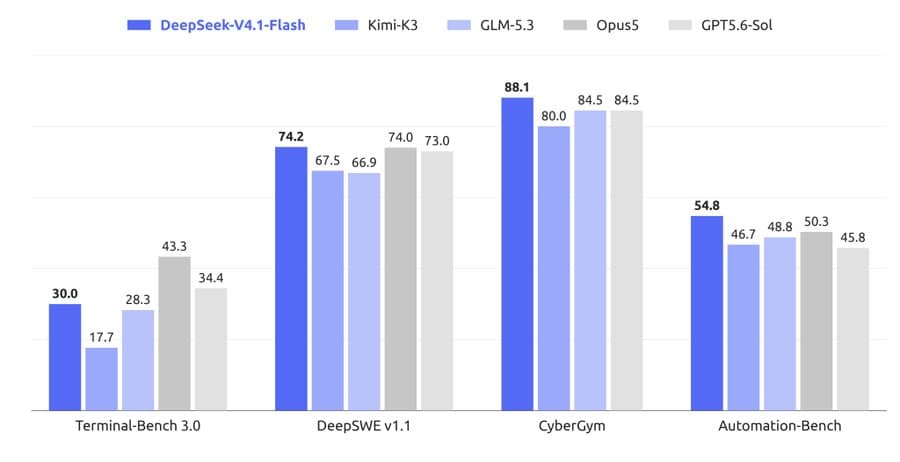
Overview
The word Flash refers to an efficiency goal, not a tiny downloaded model. DeepSeek’s model card describes a 552B-parameter mixture-of-experts backbone with a causal encoder-decoder architecture and about 8B parameters active during input processing and 16B during decoding. It also documents a compressed attention and cache design intended to reduce memory pressure in long, input-heavy agent workloads. Those mechanisms can matter for processing large contexts, but self-hosting the full weights still calls for substantial accelerators, storage and serving expertise.
The release supports native image understanding alongside text and publishes a one-million-token context limit. DeepSeek positions it for reasoning, coding, tool use and extended agent sessions, with controllable reasoning effort. The model card contains large benchmark tables under specific harnesses and temperature settings. These are useful to understand intended strengths, but a team should not transfer any single score to its own codebase or visual task without a representative evaluation. Long context especially invites attention to retrieval quality, state management and the cost of repeatedly sending history.
The official hosted API currently maps `deepseek-flash` to V4.1 Flash; legacy V4 Flash IDs are temporarily routed to it. The API pricing page lists separate rates for cache hits, cache misses and output, with off-peak rates half of peak rates. At the time checked, peak cache-miss input was $0.30 and peak output $1.20 per million tokens, with lower off-peak prices. Actual bills depend on the token mix and timing. The MIT model license means the weights can be deployed under those terms, but it does not make hosting free or establish any independent security guarantee.
Use cases
The strongest fit depends on the job you need the product to complete, not the size of its feature list.
Evaluate long-context tool workflows with token and cache accounting.
Test coding and repository tasks under a reproducible harness.
Assess whether open weights justify the substantial serving footprint.
Capabilities
Accept image and text material for text responses.
Reduce cache footprint relative to earlier DeepSeek Flash models according to the model card.
Adjust reasoning effort for an accuracy-versus-cost tradeoff.
Choose MIT-licensed weights or the metered DeepSeek API.
Process
Step 1
Use `deepseek-flash` for the hosted API or plan hardware for open-weight serving.
Step 2
Send relevant material, define permissions and cap output for the task.
Step 3
Measure correctness, latency and billable tokens on real workload samples.
Cost
DeepSeek publishes peak and off-peak hosted rates per million tokens; model weights are MIT-licensed but require self-hosting resources. Rates may change.
Input $0.30 / output $1.20 per 1M tokens
Listed cache-miss input and output rates for peak hours.
Input $0.15 / output $0.60 per 1M tokens
Half-price cache-miss input and output outside peak windows.
MIT license
Download and self-host subject to the model license.
Pricing checked . Check current pricing at the source ↗
Assessment
Compare
The right alternative depends on the specific output, workflow, controls and budget your project requires.
Business Operations
Compare the broader DeepSeek product and model ecosystem.
Explore DeepSeek →Miscellaneous
Evaluate another open-weight agentic model with a smaller published context window.
Explore Atria Dawn Preview →Business Operations
Consider a separate open-model ecosystem and deployment options.
Explore Qwen →Questions
No. It is a 552B-backbone MoE model; 8B and 16B refer to active parameters during different inference phases, not total download size.
DeepSeek documents `deepseek-flash` as the current hosted ID for V4.1 Flash.
No. Large inputs increase cost and can make verification harder; select relevant context and test performance on your task.
Bottom line
V4.1 Flash is attractive for teams that need a powerful hosted model with clear token economics or want open weights for a controlled deployment. Its architecture appears aimed at a real agent cost problem: long inputs and cache growth. The practical decision rests on accepted-task quality, serving feasibility and token patterns. Reproduce your own evaluations and budget peak, off-peak and cache cases rather than using release benchmarks as a purchase decision.
Visit DeepSeek V4.1 Flash website ↗
Get access to all our AI courses, hundreds of real-world AI use cases, live expert-led workshops, an exclusive network of AI early adopters, and more.
Get unlimited access to all of our current & upcoming industry-specific AI courses for the duration of your subscription.
To keep up with the rapid pace of AI, our team publishes AI implementation guides daily. Our library contains 300+ practical use cases to automate real-world work.
Join weekly, live, interactive sessions with industry leaders who are at the forefront of AI for hands-on implementation guidance and exclusive insights.
Network with an exclusive community of AI-first professionals who are working smarter with AI. Learn how early adopters are using AI in their work and businesses.