Training and onboarding
Create presenter-led lessons, process explainers, and localized updates without rerecording a person for every version.
Independent tool overview
D-ID is an AI video and digital-human platform for creating scripted avatar videos, translating video, and building real-time visual agents through its Studio and APIs.
Visit the official D-ID site ↗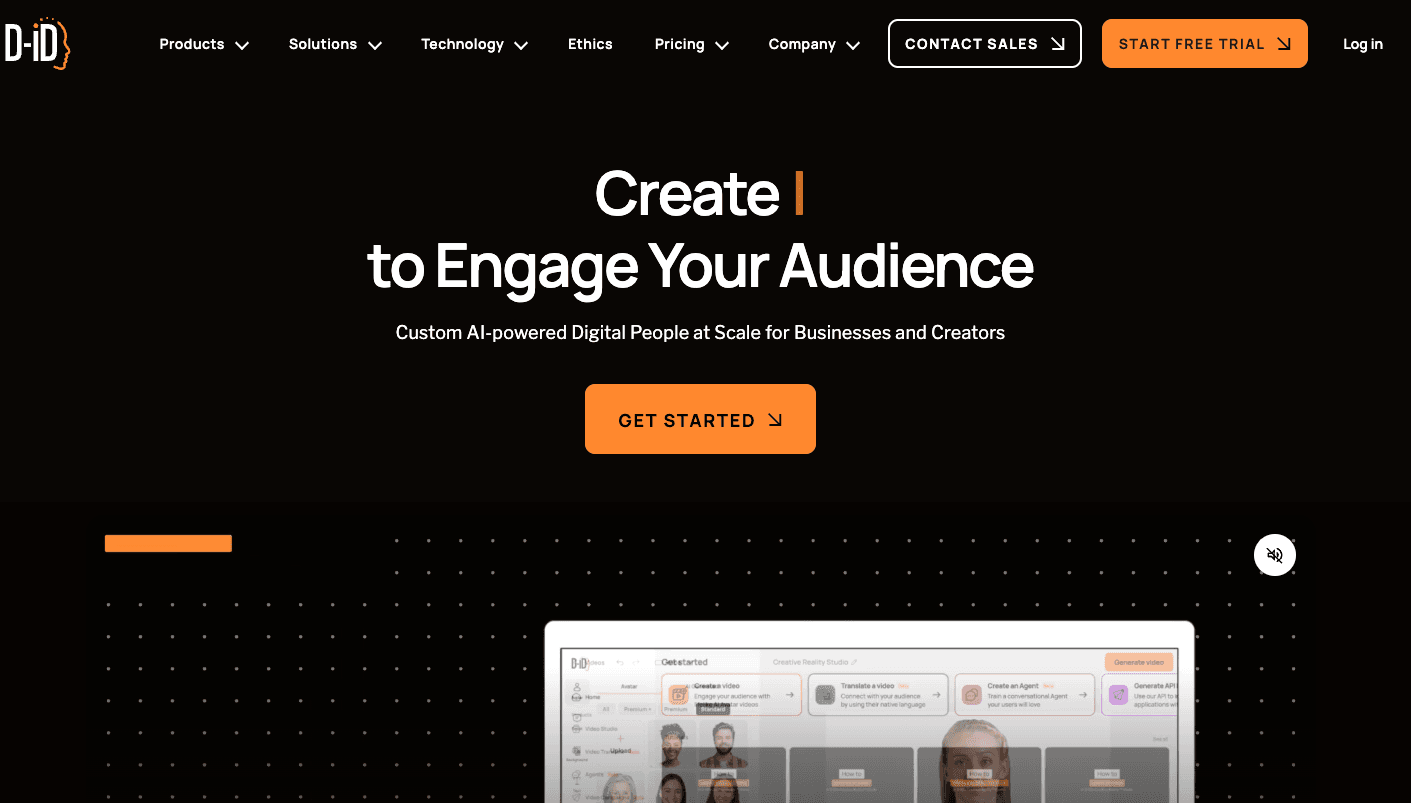
Overview
D-ID turns text, audio, photos, or recorded footage into speaking-avatar videos. Teams can work in the browser-based Studio, embed D-ID through integrations, or use APIs for asynchronous video generation and live WebRTC conversations.
The platform now spans two related jobs. Its video tools produce presenters, localized clips, campaigns, and agentic videos, while Visual AI Agents combine an avatar with instructions, an LLM, a knowledge base, and a real-time conversational interface.
Avatar quality and setup vary by generation. V2 animates a single photo, V3 Instant uses personal video footage, V3 Pro is designed for higher-quality custom presenters, and V4 Expressive Avatars add selectable sentiments, listening states, and more nuanced facial behavior.
D-ID is most useful when a human presenter would improve clarity or engagement but recording every language, variation, or response is impractical. It is not a substitute for editorial approval, consent, native-language quality assurance, or a secure agent architecture.
The product supports more than 120 languages across its broader workflow, but exact voice, translation, avatar, duration, resolution, and licensing options depend on the feature and plan. Confirm those details for the intended output before committing to production.
Use cases
The strongest fit depends on the job you need the product to complete, not the size of its feature list.
Create presenter-led lessons, process explainers, and localized updates without rerecording a person for every version.
Add a speaking interface to support, product guidance, sales qualification, or internal knowledge workflows.
Translate and lip-sync existing clips or generate new avatar-led content for multiple markets.
Generate videos asynchronously or stream interactive avatars through APIs, SDKs, and embedded interfaces.
Produce many approved message variants when the campaign benefits from a visible presenter.
Capabilities
Provides a browser workflow for selecting an avatar, adding a script or audio, choosing a voice, arranging scenes, and generating a video.
Supports stock presenters, photo avatars, personal avatars, higher-fidelity V3 presenters, and V4 expressive avatars with different capture requirements.
Adds richer facial nuance, selectable sentiments, improved listening and speaking states, and support for scripted or real-time experiences.
Combines an avatar with instructions, a language model, knowledge sources, conversation memory, and real-time streaming.
Lets viewers ask questions from within a video experience instead of following only a fixed linear script.
Translates speech into supported languages while applying voice cloning and lip synchronization to the source video.
Supports asynchronous talking-head generation and low-latency conversational sessions, with keys managed through the D-ID account.
Developers can connect knowledge bases, configure supported model providers, or bring their own model for agent responses.
D-ID lists integrations for Canva, PowerPoint, Google Slides, mobile workflows, and website embedding.
Process
Step 1
Use scripted generation for repeatable content and a visual agent only when the audience needs an interactive conversation.
Step 2
Obtain explicit permission for every face, recording, voice clone, and source asset, including the intended commercial channels and duration of use.
Step 3
Match V2, V3 Instant, V3 Pro, or V4 to the required realism, expressiveness, capture effort, latency, and plan.
Step 4
Write a concise script or define agent instructions, knowledge boundaries, prohibited topics, escalation rules, and synthetic-media disclosure.
Step 5
Test facial motion, pronunciation, lip sync, sentiment, pacing, captions, framing, and brand treatment before generating a full batch.
Step 6
For interactive deployments, authenticate users, restrict tools and data, validate actions server-side, and require human approval for consequential steps.
Step 7
Have subject-matter experts and native speakers check factual accuracy, pronunciation, tone, translations, disclosures, and accessibility.
Step 8
Track generation cost, completion, viewer questions, agent accuracy, escalation, latency, misuse, and deletion or retention obligations.
Cost
D-ID sells Studio subscriptions and separate API-oriented packages, with credit or minute allowances that vary by plan. Studio currently lists Trial, Lite, Pro, Advanced, and Enterprise; API pricing lists Build, Launch, Scale, and Enterprise. Monthly usage is rounded up to 15-second intervals and unused minutes do not roll over. Check the live selector because credit packages and annual discounts change the effective price.
$0 for 14 days
A limited personal-use trial for evaluating videos, agents, translation, and API access.
From $5.90/month
Entry paid Studio plan with selectable credit packages; the lowest public monthly configuration starts at 40 credits.
From $29/month
Commercial-use Studio tier with selectable credit packages and broader avatar, voice, agent, and API features.
From $196/month
Higher-volume commercial tier with selectable packages beginning at 400 credits.
From $18/month
Build starts at $18 monthly; Launch starts at $50 and Scale at $198, with lower monthly equivalents on annual billing.
Pricing checked . Check current pricing at the source ↗
Assessment
Compare
The right alternative depends on the specific output, workflow, controls and budget your project requires.
Marketing
Choose Synthesia when a structured business-video editor, template library, team review workflow, and corporate training focus matter most.
Explore Synthesia →Content Creator
Choose Tavus when the core requirement is developer-led real-time video conversation or personalized video generation.
Explore tavus →Content Creator
Choose Hedra for character-led creative video and expressive content workflows rather than an enterprise visual-agent platform.
Explore Hedra →Marketing
Choose LiveAvatar by HeyGen when comparing managed real-time avatars and conversational-agent experiences.
Explore LiveAvatar by HeyGen →Questions
D-ID is used to generate talking-avatar videos, translate and lip-sync video, create personal or branded digital presenters, and build real-time visual agents for websites and applications.
D-ID offers a 14-day trial with three generation minutes across included products. Trial output has a full-screen watermark and a personal-use license.
Studio currently starts with a free trial, Lite from $5.90 per month, Pro from $29, and Advanced from $196. API packages start at $18 per month. Credit selection and annual billing change the effective price, and Enterprise is custom.
The trial uses a full-screen watermark and Lite retains D-ID branding. Higher commercial Studio plans offer different branding controls, including an AI watermark or custom-logo options. Confirm the selected plan before publishing.
V2 animates a photo, V3 Instant creates a personal presenter from short footage, V3 Pro targets higher-fidelity professional output, and V4 Expressive uses multiple recordings to capture a wider emotional and behavioral range.
Yes. D-ID's Video Translate workflow can translate speech, clone the voice, and adjust lip movement for supported languages. Limits and language availability vary by plan and workflow.
Yes. D-ID documents APIs for asynchronous video generation, translation, avatar management, real-time visual-agent sessions, knowledge bases, chat exports, and embedded agents.
They require the same controls as any production AI agent: curated knowledge, testing, authentication, minimal tool permissions, server-side validation, human escalation, audit logs, privacy controls, and clear disclosure that the presenter is synthetic.
No. D-ID says allowances renew monthly, unused minutes expire, and generated duration is rounded up to the nearest 15-second interval.
Bottom line
D-ID is a strong shortlist option for organizations that want one vendor for avatar-led videos, localization, and real-time digital humans. Its range is the advantage, but it also makes plan comparison and production governance more important. Test the exact avatar type and language on a short sample, confirm commercial rights and branding in the selected package, and treat every interactive agent as a secured application rather than a talking video widget.
Visit D-ID website ↗
Get access to all our AI courses, hundreds of real-world AI use cases, live expert-led workshops, an exclusive network of AI early adopters, and more.
Get unlimited access to all of our current & upcoming industry-specific AI courses for the duration of your subscription.
To keep up with the rapid pace of AI, our team publishes AI implementation guides daily. Our library contains 300+ practical use cases to automate real-world work.
Join weekly, live, interactive sessions with industry leaders who are at the forefront of AI for hands-on implementation guidance and exclusive insights.
Network with an exclusive community of AI-first professionals who are working smarter with AI. Learn how early adopters are using AI in their work and businesses.