Voice-agent developers
Use low-latency transcription, turn detection, contextual prompting, and a bundled agent stack for phone or in-app conversations.
Independent tool overview
AssemblyAI is a developer platform for transcribing pre-recorded, live, and short-form audio, then extracting structured information through diarization, speaker identification, summaries, sentiment, topics, entities, guardrails, and LLM workflows.
Visit the official AssemblyAI site ↗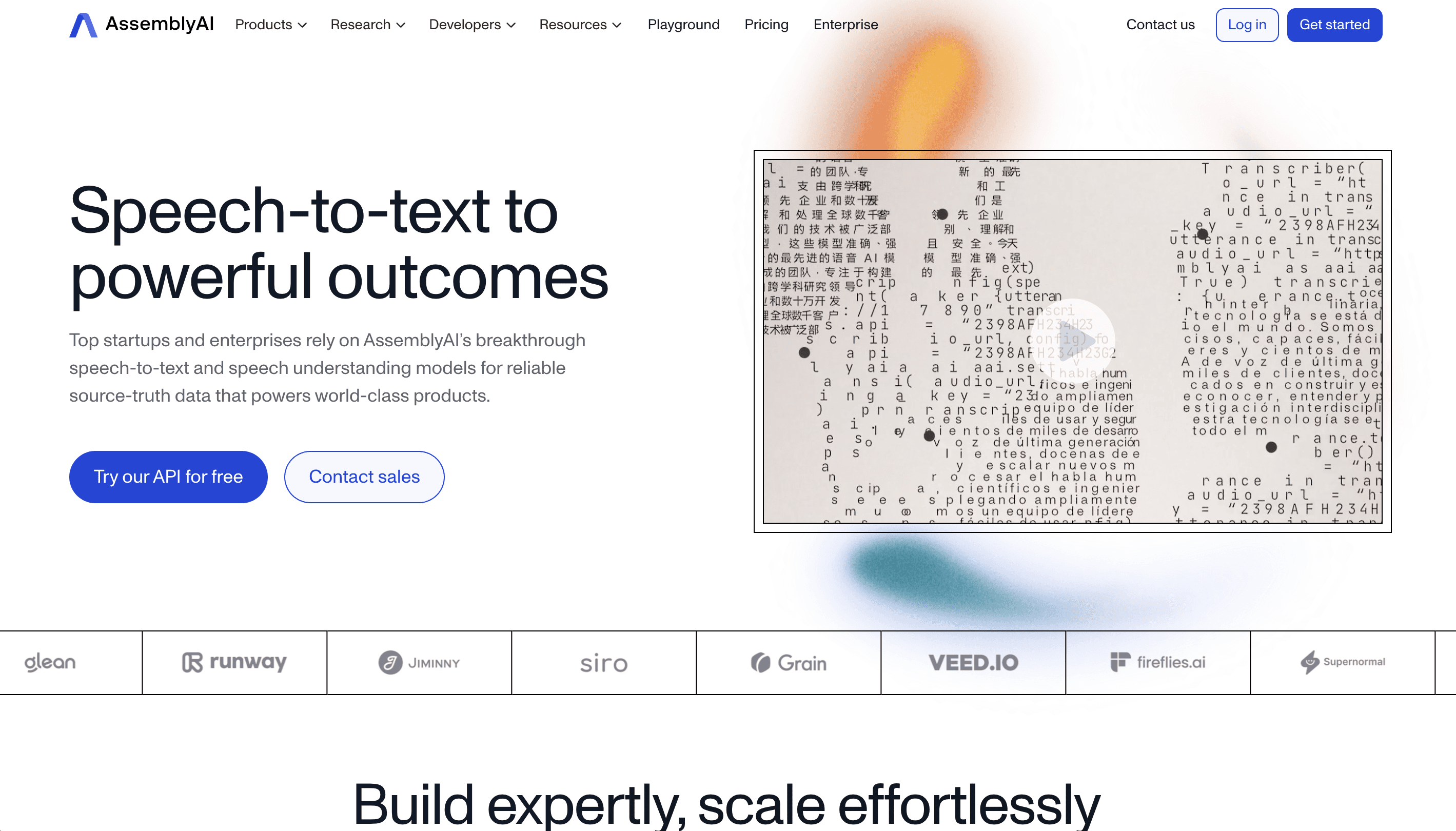
Overview
AssemblyAI is primarily an API platform rather than a finished meeting-notes app. Developers can submit audio or video for asynchronous transcription, stream live speech over WebSocket, transcribe clips of up to two minutes in a synchronous request, or use a managed Voice Agent API that bundles speech recognition, a conversational model, text-to-speech, and session infrastructure.
The platform offers a broad path from audio to structured data, but model choice, add-ons, retention settings, region, and human review matter. Speech recognition errors can alter names, numbers, negation, technical terms, speaker attribution, and meaning, while downstream summaries and classifications can add a second layer of uncertainty.
Use cases
The strongest fit depends on the job you need the product to complete, not the size of its feature list.
Use low-latency transcription, turn detection, contextual prompting, and a bundled agent stack for phone or in-app conversations.
Create transcripts with timestamps, speaker segmentation, summaries, chapters, entities, sentiment, and other structured outputs.
Generate searchable transcripts, captions, chapters, topics, and post-production metadata from recorded audio or video.
Choose a broad 99-language value model or newer 18-language and six-language models based on quality, latency, and cost.
Evaluate EU processing, BAA, retention, deletion, opt-out, redaction, and self-hosted arrangements against formal requirements.
Capabilities
Submit an audio or video source, poll or receive a webhook, and retrieve a completed transcript with formatting and timing data.
The current high-accuracy async model supports 18 languages, code switching, and updated speaker diarization.
A lower-cost pre-recorded model supporting 99 languages.
Streams live audio over WebSocket with punctuation, casing, end-of-turn detection, and model-specific context controls.
A lower-cost realtime option for English or a six-language multilingual model, priced by connected session duration.
Returns a Universal-3.5 Pro transcript in one response for clips up to two minutes, with timing and confidence data.
Segments a conversation by speaker and can map speakers to names or roles through separate capabilities.
Model-specific keyterms, prompting, custom spelling, conversation context, and medical terminology options help adapt recognition.
Offers translation, custom formatting, entities, sentiment, chapters, key phrases, topics, and summarization.
Can mask configured sensitive categories in transcript text and generate audio with detected PII replaced by a beep or silence.
Optional profanity filtering and content moderation can label or transform selected outputs.
Applies supported language models to audio-derived content without the customer separately hosting those models.
Bundles realtime speech-to-text, a voice-oriented LLM, text-to-speech, turn and interruption handling, recordings, transcripts, and hosting.
Projects isolate keys, uploads, transcripts, and other project data across environments or applications.
Custom rate limits, concurrency, volume pricing, support, security arrangements, and self-hosted deployment are available through sales.
Process
Step 1
Document languages, audio sources, latency target, speakers, accuracy thresholds, required outputs, consent, and the decisions the transcript will support.
Step 2
Choose US or EU processing, execute any required BAA or contract, configure TTL and deletion, and confirm model-training opt-out before sending sensitive audio.
Step 3
Create human-verified reference transcripts across accents, noise, channels, devices, languages, names, numbers, and difficult domain vocabulary.
Step 4
Select async, realtime, sync, or the bundled agent API, then enable only the add-ons that improve the measured use case.
Step 5
Keep keys server-side, isolate projects, validate URLs and webhooks, close streaming sessions, handle retries idempotently, and avoid logging raw sensitive content.
Step 6
Require human verification for names, numbers, quotations, commitments, diagnoses, legal statements, speaker identity, summaries, and automated actions.
Step 7
Track error rates and cost by model and feature, test regressions after model updates, audit access, and verify deletion against the intended retention policy.
Cost
AssemblyAI starts with free credit and then uses pay-as-you-go pricing. Pre-recorded media is charged from audio duration; streaming and Voice Agent sessions are charged from connected session duration. Rates are displayed per hour but prorated to the second, and optional understanding or guardrail features are usually additive.
$0.15–$0.21/hour
Universal-2 costs $0.15 per audio hour; Universal-3.5 Pro costs $0.21 per audio hour.
$0.15–$0.45/session hour
Universal-Streaming costs $0.15 per connected hour; Universal-3.5 Pro Realtime costs $0.45 per connected hour.
$0.45/audio hour
Single-request transcription for clips up to two minutes using Universal-3.5 Pro accuracy.
$4.50/connected hour
Bundled speech-to-text, voice LLM, text-to-speech, hosting, orchestration, recording, and turn handling.
$0.01–$0.15/audio hour per feature
Optional features are priced separately and can stack on the transcription rate.
Contact sales
For volume discounts, custom concurrency and limits, enterprise controls, specialized support, or self-hosted arrangements.
Pricing checked . Check current pricing at the source ↗
Assessment
Compare
The right alternative depends on the specific output, workflow, controls and budget your project requires.
Content Creator
A current Google speech-to-text model option for teams already building on the Gemini API.
Explore Gemini 3.5 Transcribe →Miscellaneous
A Mistral transcription family with a live model and an open-weight realtime option for more deployment control.
Explore Voxtral Transcribe 2 →Consumer
An open-source speech-recognition model for teams that prioritize self-hosting and model access over a managed API suite.
Explore Cohere Transcribe →Questions
AssemblyAI is a developer platform for speech-to-text, speech understanding, content guardrails, LLM analysis, and managed voice agents. It is an API service rather than a standalone consumer transcription editor.
Current public rates start at $0.15 per hour for Universal-2 async or Universal-Streaming realtime. Universal-3.5 Pro async is $0.21 per hour, its realtime model is $0.45 per connected hour, and the bundled Voice Agent API is $4.50 per connected hour. Add-ons cost extra.
Benchmark the application. Universal-3.5 Pro is the current higher-accuracy option for supported languages, Universal-2 offers 99-language coverage at lower cost, Universal-Streaming is the lower-cost realtime option, and Sync is for clips up to two minutes.
It offers speaker diarization to segment speakers and a separate Speaker Identification feature to map them to names or roles. Both are probabilistic and require verification for consequential use.
Yes. It can replace selected PII categories in transcript text and generate audio with detected PII beeped or silenced. Redaction may miss data, and other outputs such as entities or summaries can still contain PII.
Its current policy says certain files may be used when the contract permits, after a PII-redaction process. It says files are not used when covered by a BAA, processed on EU servers, or after an applicable paid-plan opt-out. Free users cannot currently opt out.
It depends on product and account configuration. Streaming can have zero audio and transcript retention after opt-out, while async final transcripts may be indefinite without TTL, BAA, or deletion. Configure and verify retention before production.
It offers Medical Mode, BAAs, retention controls, redaction, and documented security features, but an organization must confirm eligibility and configure the service correctly. Transcripts and clinical content still require qualified review.
Yes, through the Playground and supported no-code integrations. AssemblyAI describes the Playground as a public demo with limited functionality and advises users not to upload sensitive data.
Bottom line
AssemblyAI offers one of the broadest current developer surfaces for turning speech into transcripts, structured signals, and live voice experiences. Its strongest fit is a team prepared to benchmark real audio, design privacy and retention deliberately, and keep humans responsible for consequential words, speakers, summaries, and actions.
Visit AssemblyAI website ↗
Get access to all our AI courses, hundreds of real-world AI use cases, live expert-led workshops, an exclusive network of AI early adopters, and more.
Get unlimited access to all of our current & upcoming industry-specific AI courses for the duration of your subscription.
To keep up with the rapid pace of AI, our team publishes AI implementation guides daily. Our library contains 300+ practical use cases to automate real-world work.
Join weekly, live, interactive sessions with industry leaders who are at the forefront of AI for hands-on implementation guidance and exclusive insights.
Network with an exclusive community of AI-first professionals who are working smarter with AI. Learn how early adopters are using AI in their work and businesses.


