OpenAI study finds scientists lean on ChatGPT for reading, writing and code
OpenAI’s study of 1,819 scientists highlights reading, writing and coding, with reported time savings and limits on what that means for discovery.
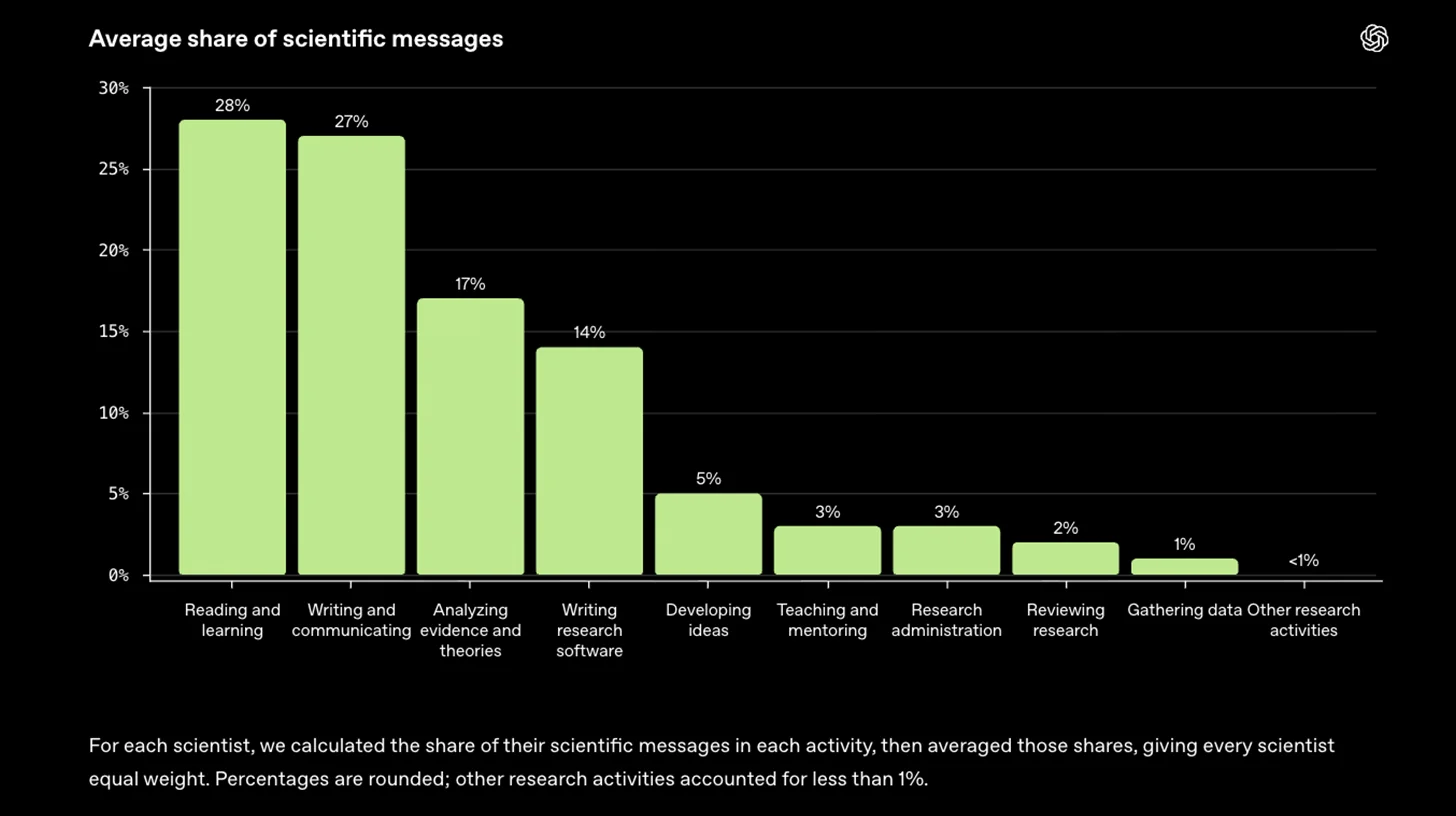
OpenAI published a study on Nov. 16 tracking how 1,819 scientists worked with AI through its free academic pilot. As The Rundown reported, the company also announced plans to expand the program to reach up to 200,000 researchers.
The company’s analysis covered 580,186 scientific messages from Aug. 20 through Sept. 22, 2026. Reading and writing accounted for more than half of the average participant’s messages about science. Surveyed researchers also estimated that equivalent work would take nearly twice as long without AI.
Where AI fits into research
Reading and knowledge acquisition accounted for 27.7% of the average participant’s scientific messages. Writing and communication followed at 26.9%, scientific analysis at 16.7%, and research software and code development at 13.8%, according to OpenAI’s breakdown.
The separate survey ran from Sept. 30 through Oct. 7 and included 251 respondents in the analysis. Their overall estimate, averaged equally across eight activities, was that work of the same quality would take 1.9 times as long without AI. Coding led at 2.83 times, with research ideation at roughly twice as long. Equal quality was an assumption in the question. The study provided no independent assessment of that quality.
Within messages about research ideas, requests for ChatGPT to suggest a research question accounted for 23% of the average participant’s messages in that category.
The pattern varied by age. Coding accounted for 17.9% of scientific messages among researchers ages 18 to 29, compared with 9.8% among those 40 and older. Older participants devoted larger shares to teaching, mentorship and administration, according to the paper.
A larger academic program
OpenAI says applications for 50,000 grants will open Nov. 23, with grants available in order of application. Each covers a recipient and up to two collaborators, allowing this round to reach up to 150,000 researchers. The company aims to reach up to 200,000 across the program.
The new grants provide ChatGPT Plus, compared with Pro in the pilot. OpenAI says most pilot participants’ activity would have fit within Plus limits. How the two plans compare on research results remains uncertain.
Why it matters
AI science often draws attention through claims of autonomous research. In September reporting on Anthropic’s claimed discovery involving multiple AI agents, WIRED highlighted scientists’ calls for human involvement and experimental validation.
OpenAI’s data shows a more ordinary pattern among its pilot participants. Fully autonomous research accounted for 0.4% of the average participant’s scientific messages, though around 15% tried at least one such request, according to the paper.
Less time spent reading a paper, drafting a manuscript or writing research code could leave scientists more time to refine ideas and plan experiments. For universities considering wider access, those tasks offer a practical starting point for measuring speed and quality.
Any measure of time saved needs to account for checking sources, calculations and code. About a third of requests prompted clarification, checking or revision within a week, according to OpenAI’s findings. A conversation ending after one answer leaves open whether the researcher checked it elsewhere or whether the answer was correct.
OpenAI studied participants in its own program, and survey respondents chose to answer. The findings therefore offer a limited view of scientists’ broader AI habits. Automated tools grouped messages from ChatGPT and Codex by activity, while the research team did not inspect their underlying content, according to the paper.
Survey respondents also cited limited time or staffing (51.8%) and funding (43.8%) as constraints, OpenAI reported. Faster drafting and coding could ease some pressure, while experiments still depend on people and resources. The study leaves open how much of the reported time saved leads to better experiments or more reliable scientific results.
Sources & further reading
This story builds on reporting from The Rundown newsletter on November 17, 2026.