Python agent applications
Build autonomous or structured agents with model, tool, memory, knowledge, and response-schema control.
Independent tool overview
GCA, originally the GPT Computer Assistant for customizable product intelligence and computer-use agents, evolved and rebranded into the actively maintained Upsonic Python agent framework.
Visit the official GCA site ↗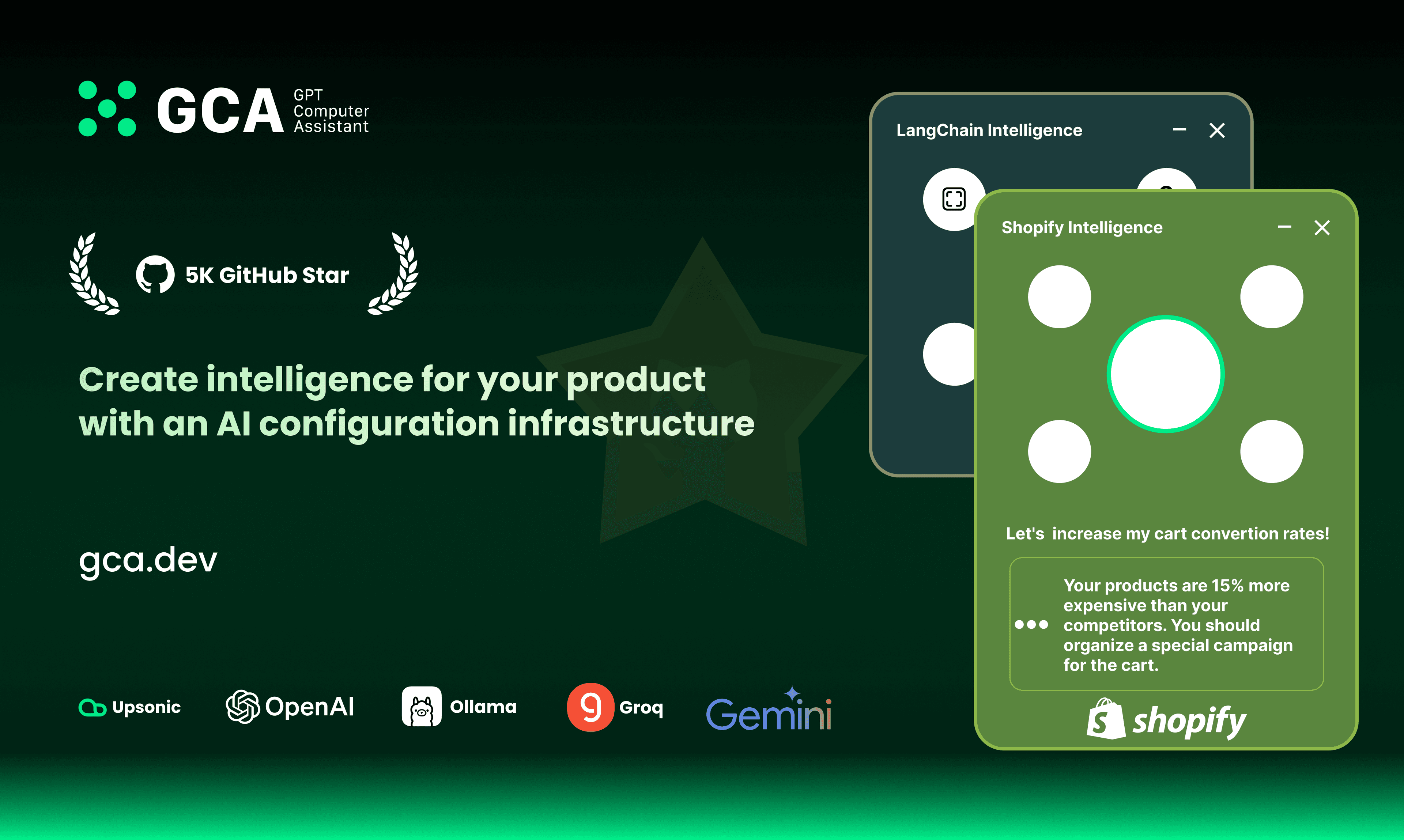
Overview
GCA began as GPT Computer Assistant, an open-source project for creating customizable assistants and computer-use agents across Windows, macOS, and Linux. The original gca.dev product name and package are no longer the maintained destination. The team later announced that it had transformed GCA into a broader framework and continued the project under the Upsonic name.
Upsonic is now an MIT-licensed Python framework for autonomous agents, traditional tool-driven agents, and multi-agent teams. Its current documentation covers tools, MCP, memory, knowledge bases and RAG, structured tasks, skills, human-in-the-loop pauses, tracing, guardrails, OCR, evaluations, sandboxed workspaces, and FastAPI or Django deployment.
The successor is best evaluated as developer infrastructure, not an off-the-shelf assistant. Teams supply model-provider credentials, tools, permissions, storage, deployment, observability, and application-specific safeguards. Upsonic also operates a separate commercial fintech automation platform, but that is distinct from the open-source framework that most directly continues GCA's developer lineage.
Use cases
The strongest fit depends on the job you need the product to complete, not the size of its feature list.
Build autonomous or structured agents with model, tool, memory, knowledge, and response-schema control.
Coordinate specialized agents through sequential, routing, or coordinated execution patterns.
Use an open-source framework when the team wants to own model selection, deployment, integrations, storage, and safeguards.
Capabilities
Supports open-ended agents that plan and iterate as well as bounded, task-oriented agents with defined tools and output contracts.
Connects Python functions, supported integrations, and Model Context Protocol tools to agent workflows.
Provides pluggable conversation memory plus document loading, embeddings, and vector-store integrations for RAG.
Coordinates multiple agents, packages reusable capabilities, and supports durable pauses for confirmation or user input.
Includes deployment patterns, tracing integrations, evaluations, usage tracking, and optional safety policies for production-oriented development.
Process
Step 1
Use the maintained upsonic package and documentation rather than building a new project around the older GCA package or domain.
Step 2
Specify inputs, permitted tools, expected structured output, model choice, and the conditions that require human confirmation.
Step 3
Keep file and shell access inside an approved workspace or external sandbox, and test tool failures, prompt injection, excessive loops, and unsafe actions.
Step 4
Add secret management, least-privilege credentials, budgets, timeouts, tracing, evaluations, logs, approval gates, and rollback before expanding autonomy.
Cost
The Upsonic framework that succeeds GCA is free under the MIT License. Operating an agent is not free: users pay their chosen model, search, sandbox, vector-database, storage, and hosting providers. Upsonic's separate managed fintech product uses custom sales-led pricing.
$0
Open-source Python framework under the MIT License.
Usage-based external costs
Infrastructure selected and paid for by the developer or organization.
Custom quote
A separate managed product for fintech merchant operations.
Pricing checked . Check current pricing at the source ↗
Assessment
Compare
The right alternative depends on the specific output, workflow, controls and budget your project requires.
Coding
A larger ecosystem for composing LLM applications, retrieval, tools, agents, and durable graph workflows across Python and JavaScript.
Explore LangChain →Questions
The original GCA name and gca.dev product path are no longer maintained as the current offering. The creators transformed and rebranded the project into Upsonic, which remains actively developed as an open-source Python agent framework.
GPT Computer Assistant expanded from a customizable computer assistant into a broader agent framework. The team announced that it was continuing that work under the Upsonic rebrand.
Upsonic is an MIT-licensed Python framework for autonomous and traditional agents, with tools, MCP, memory, RAG, teams, skills, human-in-the-loop controls, tracing, guardrails, and deployment support.
The maintained Upsonic framework is free and open source. Developers still pay for the model APIs, search or other tools, sandboxes, databases, storage, monitoring, and hosting used by their application.
No. Upsonic's public company site now markets a managed fintech operations platform, while docs.upsonic.ai and the GitHub repository document the open-source developer framework that most directly continues GCA.
No. For a new project, use the maintained upsonic package and current documentation, then validate its APIs and security model against your requirements.
Bottom line
GCA should be understood as the earlier identity of the project now maintained as Upsonic. The successor is a capable, broad Python framework for teams that want to build and operate their own agents, but it is not a turnkey product. The real evaluation is whether its primitives and maintenance fit your architecture—and whether your team can safely own the surrounding model, tool, data, deployment, and governance stack.
Visit GCA website ↗
Get access to all our AI courses, hundreds of real-world AI use cases, live expert-led workshops, an exclusive network of AI early adopters, and more.
Get unlimited access to all of our current & upcoming industry-specific AI courses for the duration of your subscription.
To keep up with the rapid pace of AI, our team publishes AI implementation guides daily. Our library contains 300+ practical use cases to automate real-world work.
Join weekly, live, interactive sessions with industry leaders who are at the forefront of AI for hands-on implementation guidance and exclusive insights.
Network with an exclusive community of AI-first professionals who are working smarter with AI. Learn how early adopters are using AI in their work and businesses.


