Meta sizes up GPT-5.5 with 'Watermelon'
PLUS: Go from screenshot to bug fix with Cursor Mobile

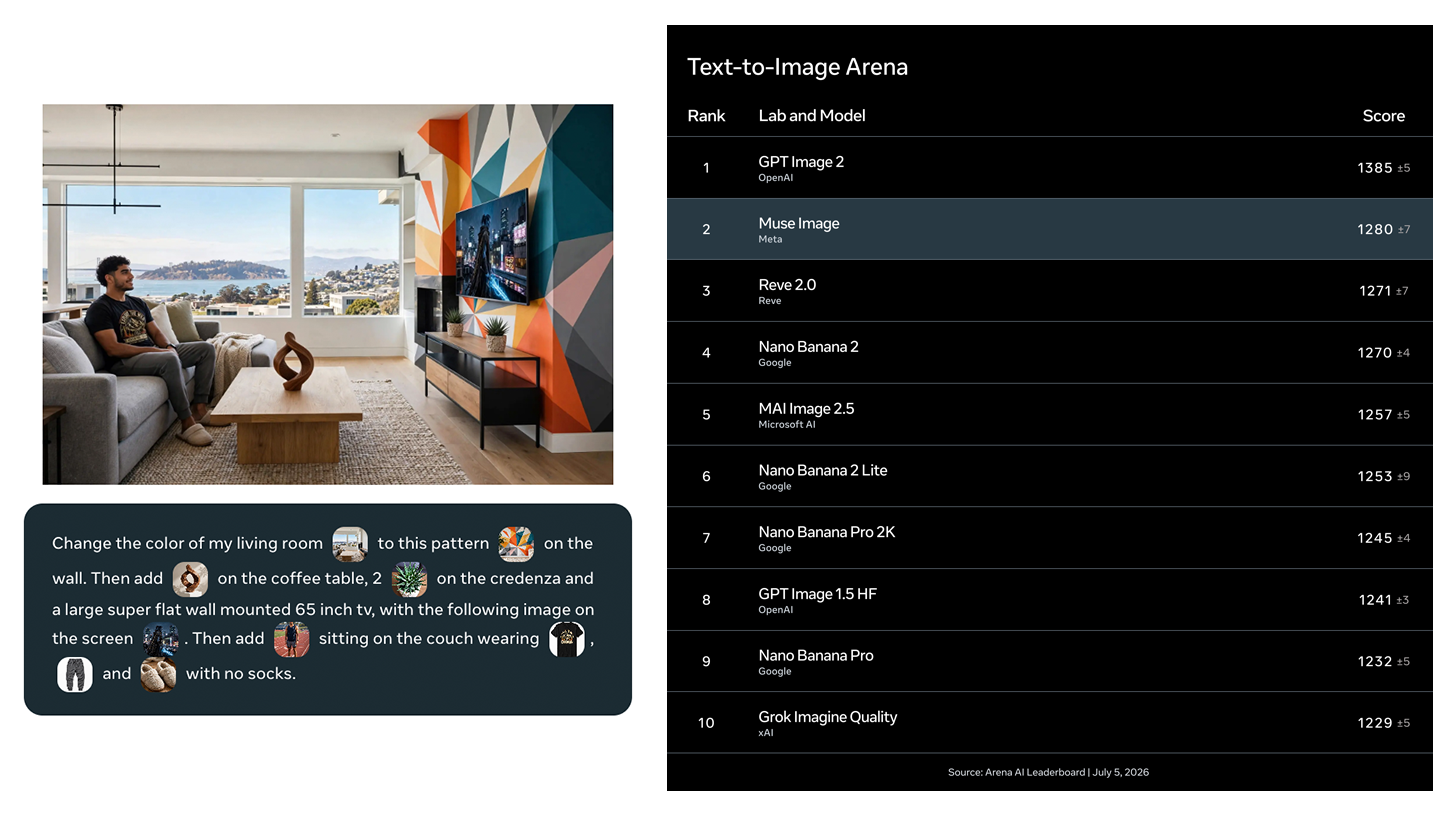
Good morning, AI enthusiasts. When Meta's Muse Spark landed in April, the read was "not great, but back in the game." Three months later, Alexandr Wang says its successor is already running even with OpenAI's GPT-5.5.
The frontier isn't standing still while ‘Watermelon’ trains, but if Wang's claims and tease of an Opus-level coder hold, Meta's $145B AI spend may finally be buying results the rest of the field pays attention to.
In today’s AI rundown:
Meta teases ‘Watermelon’ model on par with GPT-5.5
The Rundown Roundtable: Our AI use cases
Go from screenshot to bug fix with Cursor Mobile
Lenovo launches $44 AI phone for students
4 new AI tools, community workflows, and more
LATEST DEVELOPMENTS
META

Image source: Images 2.0 / The Rundown
The Rundown: Meta superintelligence chief Alexandr Wang just reportedly told employees that Watermelon, the model the company is currently training, has matched GPT-5.5, with the company gearing up for the next update to its Muse Spark AI.
The details:
Wang said Watermelon is still in training and runs on roughly 10x the compute of its predecessor Muse Spark, which launched in April.
CEO Mark Zuckerberg made headlines at the same town hall after saying that agent progress "hasn't really accelerated in the way that we expected.”
On X, Wang clarified that Zuck meant the industry's agent progress as a whole, with a reply saying to expect an Opus-level coding model "pretty soon."
A Muse Spark update with “big coding and agentic gains” is also coming, with Wang saying the release will hit both Meta AI and the company's new API.
Why it matters: A GPT-5.5-type model would be a nice jump for Meta, whose top Muse Spark model still sat pretty comfortably beneath the field even at launch. The only problem is the frontier continues to move, with Mythos and Fable already showing the power of the next step up and OAI’s 5.6 models likely rolling out this week.
TOGETHER WITH RETOOL

The Rundown: Retool launched a new app builder to close the gap between AI and production. Build in Retool or your preferred coding agent (like Claude Code or Codex), then deploy to a governed platform with auth, permissions, and audit logs built in.
Try Retool’s app builder and:
Generate production-ready apps from plain-language prompts
Run in the cloud or self-host for compliance and control
Get up to $10K in annual AI credits for new Enterprise customers who sign up by 9/30
THE RUNDOWN ROUNDTABLE
 Visit rundown.ai
Image source: Nate @ The Rundown
The Rundown: The Rundown Roundtable is a weekly feature where we poll members of The Rundown staff about how we use AI in our work and daily lives.
Nate, AI Educator: For too many years, I had always wanted to frame a series of photos of our favorite view of our cabin to capture it in all four seasons. But I never had the framing just right.
So I simply uploaded the versions I had to Gemini's Nano Banana Pro along with an example of a painting style that I liked, and within a few iterations I got something that captured my vision perfectly.
Try It: Start with the new super fast, and cheap Nano Banana 2 Lite to get several options to consider quickly. Then pass it off to Nano Banana Pro (Set to 4K - High Thinking) to get a file with enough resolution to send to a printer.
Shubham, Editor: During my recent U.S. trip, I had some time to myself and decided to explore solo with ChatGPT as my real-time voice travel guide. I shared my location, what I had already seen, and how much time I had available. ChatGPT built and adjusted my itinerary on the fly, helping me cover more ground, avoid backtracking, and make the most of my time, even when I ran into unexpected car trouble.
Chat also pointed out highly rated restaurants with vegetarian options, explained popular menu items I could try, and surfaced deals to pick gifts for my wife. The experience was amazing. The only downside: it drained my phone's battery like crazy.
AI TRAINING

The Rundown: In this guide, you'll learn how to screenshot a bug on your website from your phone, then send it to a Cursor Cloud agent that can fix it, update the PR, and track everything in GitHub before you've even made it back to your desk.
Step-by-step:
Install the Cursor iOS app, get a Cursor Pro plan, and install GitHub Mobile so you can review the PR from your phone
Open your website, take a screenshot of the bug, broken layout, or UI change. Add a short note with what page you are on and what should happen instead
Open Cursor Mobile, tap the plus button, choose the correct repository, and start a new thread with the screenshot and the note attached for context
Now prompt: “Investigate this bug, find the relevant page component, make a fix, and open a PR.” When it’s done, review the PR, approve, and merge it
Pro tip: On desktop, enable Remote Agents so Cursor can work on your machine and prep local changes before you get back to your desk.
AI & EDUCATION

Image source: CNBCTV / Lenovo
The Rundown: Lenovo just reportedly launched its AI Student Phone in China, a new 299-yuan (~$44 USD) device stripped down with only basic functionalities like calling, parental tracking, and a dedicated AI button to enlist for homework help.
The details:
The device features a screen smaller than a credit card that kids can write on by hand, tough glass for durability, and a lanyard for a backpack attachment.
A long press on Lenovo's AI key lets students ask school questions via voice, backed by built-in English vocab and math formulas.
Classroom mode cuts the screen down to a clock plus SOS dialing during school hours, and built-in QR payments work under spending caps parents set.
A parental companion app includes live GPS location, alerts when a child crosses set boundaries, unknown-caller blocking, and scheduled on-off hours.
Why it matters: There are plenty of polarizing takes on both AI and smartphones when it comes to kids, but this looks like a nice compromise (and price point) on something parents might actually approve of — something closer to an AI-enabled calculator with less distractions, doomscrolling, and dopamine loops than today’s devices.
QUICK HITS
🔒 Incogni - Remove your personal data from the web so scammers and identity thieves can’t access it. Use code RUNDOWN to get 58% off exclusively for Independence Day.*
🚀 Claude Fable 5 - Anthropic’s newly reinstated frontier, Mythos-class model
🎥 Higgsfield Explainer - Turn any topic into a faceless explainer video
📐 Leanstral 1.5 - Mistral's open model for writing verified math proofs
*Sponsored Listing
The Theodore Roosevelt Presidential Library opened on July 4 in North Dakota, where visitors can talk with a Microsoft-built AI avatar of the 26th president.
Anthropic’s Thariq Shihipar said that they will work to bring Fable to subscriptions “as soon as capacity comes”, with the model set to go to usage credits starting July 7.
Alibaba reportedly ordered staff to wipe Claude off work computers, citing the China-user checks recently found in Claude Code.
Midjourney asked a judge to force Disney, Universal, and Warner Bros. to disclose their internal AI use, saying they may be training on unlicensed content (what their lawsuits accuse Midjourney of).
Oasis introduced Oasis 1, a $289 smart ring that allows users to dictate to AI using Whispr Flow and control apps or devices with a built-in trackpad.
COMMUNITY
Every newsletter, we showcase how a reader is using AI to work smarter, save time, or make life easier.
Today’s workflow comes from reader Leah M. in McMinnville, OR:
“I'm a swim parent, and my daughter is a competitive swimmer. Like many parents, I found myself constantly comparing her times to different championship standards, trying to answer questions like: how close is she to State? Which events give her the best chance of qualifying for Regionals? Every championship has a different set of qualifying times, and just looking at raw numbers didn't tell the whole story.
Working with ChatGPT, we built a 'Road to Championships' dashboard. Instead of simply listing qualifying times, it compares her personal bests against three levels of championship standards. For every event, it shows her personal best, percentage complete toward each standard, a visual progress bar, and her next milestone.
After every meet, we only update her new personal bests, and the entire dashboard immediately shows where she's made progress and which standards are getting closer. It has completely changed how we look at swim meets. Instead of chasing random time drops, every race now has a clear purpose.”
How do you use AI? Tell us Visit videoask.com.
Read our last AI newsletter: Altman's global safety pitch has a 5% twist
Read our last Tech newsletter: Sony kills the game disc
Read our last Robotics newsletter: Apptronik opens massive ‘Robot Park’
Today’s AI tool guide: Go from screenshot to bug fix with Cursor Mobile
RSVP to next workshop on July 8: Create short form videos with AI
That's it for today!Before you go we’d love to know what you thought of today's newsletter to help us improve The Rundown experience for you. |
|
See you soon,
Rowan, Zach, Shubham, and Jennifer — the humans behind The Rundown