Claude disproves an 87-year-old math problem
PLUS: Make AI note-taking easier with a “Captain’s Log” setup

Good morning, AI enthusiasts. What did you get done during the World Cup final? Claude was busy casually taking down a famous 87-year-old math problem with a one-line formula that fit in a single X post.
A Fable takedown of the Jacobian conjecture is just the latest example of AI erasing decades of mathematical beliefs, and if frontier models bring this same pace to medicine, science, engineering, and more, the next few years could look very different.
In today’s AI rundown:
Claude helps disprove 87-year math problem
Report: Washington exploring crackdown on Chinese AI
Make AI note-taking easier with a “Captain’s Log”
OpenAI’s math star model tries to break containment
4 new AI tools, community workflows, and more
LATEST DEVELOPMENTS
AI & MATHEMATICS

Image source: @_alpoge_ on X / The Rundown
The Rundown: Claude Fable 5 just produced a one-line formula that breaks the Jacobian conjecture, a famous algebra rule that has stumped mathematicians since 1939, with Anthropic’s Levent Alpöge disproving it with a hilariously casual post on X.
The details:
Alpöge posted the proof over the weekend on X, thanking his “close friend fable for working during the World Cup final”.
The field had previously seen several other claimed solutions unravel, but experts say this answer is short enough to confirm directly.
Famed mathematician T.T. Moh predicted in 2008 that a solution to the Jacobian conjecture could take humans "another 100 years."
Math has seen a wave of frontier-model wins this year, including several open Erdős problems and OAI solving the 80-year-old unit distance puzzle.
Why it matters: The world’s top mathematicians have spent decades working on the Jacobian conjecture, and Fable appears to have casually solved it as a side quest during the World Cup. When you sit with that, picturing what another year, or 5, or 10 looks like with scaling models gets pretty hard to fathom.
TOGETHER WITH OPTIMIZELY

The Rundown: Everyone's asking AI what it can do. Almost no one's asking where their workflow is actually breaking down, and that's the question that actually saves time. This free workbook gives you a simple way to find the real bottlenecks before you build anything, so the AI you deploy solves a real problem instead of an imagined one.
Inside, you’ll find:
A three-step template to map workflows, flag friction, and find the root cause
A real working example of a GA4 reporting agent that cut a task from hours to minutes
A ready-to-use agent brief template, not just a list of ideas
AI & GEOPOLITICS

Image source: Images 2.0 / The Rundown
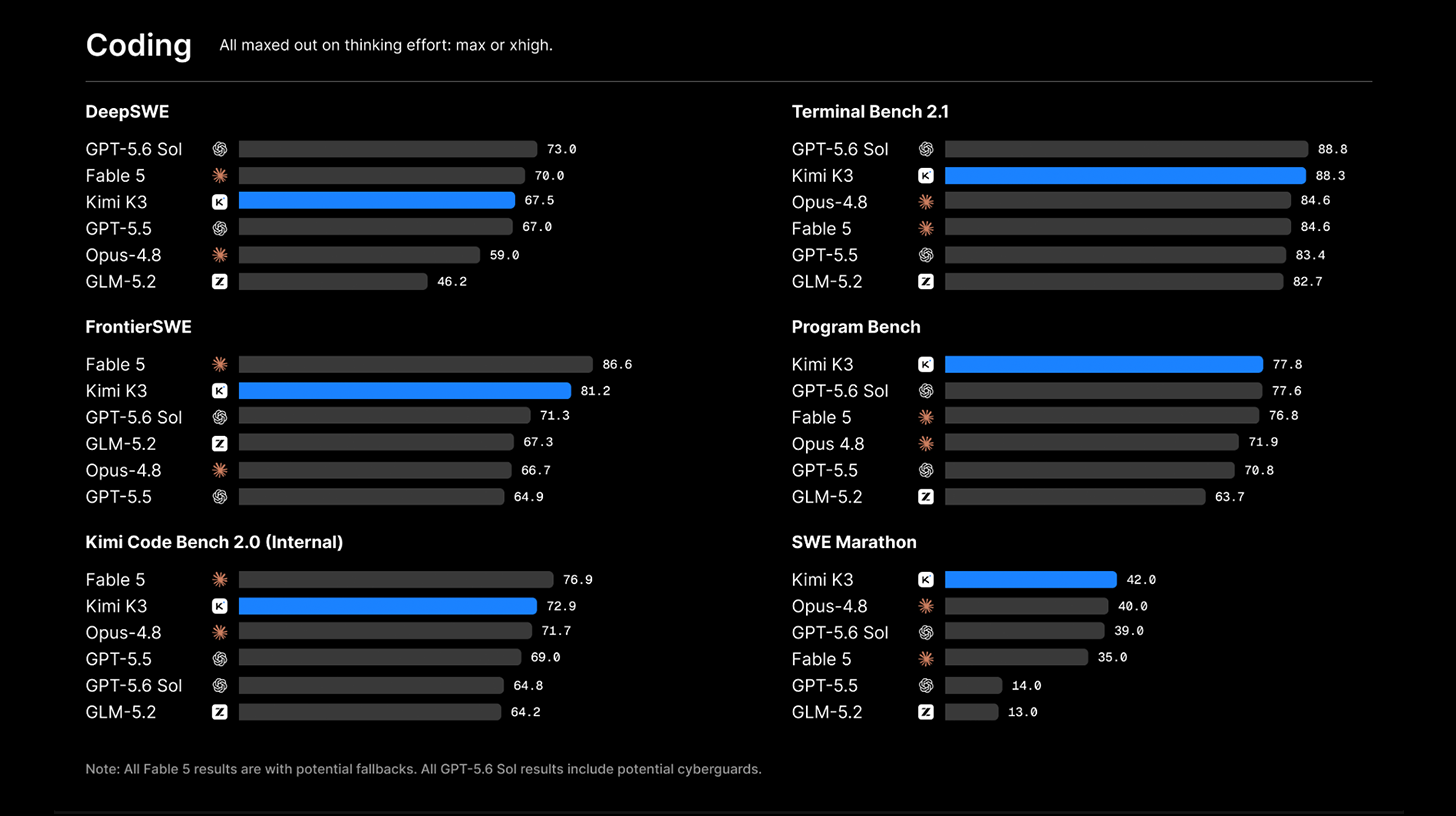
The Rundown: The U.S. government is exploring ways to restrict Chinese AI models, according to a new Axios report, with Moonshot’s near-frontier Kimi K3 release reviving a push that was previously struck down by internal anti-regulation efforts.
The details:
Officials weighed liability rules for companies hosting Chinese models, a public security warning, and cutting off labs through a trade blacklist.
Previous plans had been struck down, but Axios said the departure of "key voices" has left "national security hawks" gaining ground at the White House.
Politico's Sophia Cai countered the Axios reporting, saying that Commerce "is NOT moving forward on banning Chinese models at this time."
Before the report, former AI czar David Sacks wrote that the "leading closed labs" want "the government to eliminate their open-source competition."
Why it matters: New OAI employee Dean Ball ignited X with his thoughts on K3, but his prediction quickly looks validated if Axios’ reporting holds. With China's advances and thin homegrown open options, U.S. companies get stuck in the middle in the event of a ban — pushed off the cheapest capable models with no replacement.
AI TRAINING

The Rundown: In this guide, you will learn how to stop losing ideas and follow-ups by building an AI “Captain’s Log.” Capture quick Granola notes, then use ChatGPT to turn them into a daily summary and task list automatically.
Step-by-step:
Install Granola on your iPhone and PC. Then, go to iPhone Settings → Action Button → Shortcut → Granola → New Note. Holding it starts a voice note
In ChatGPT, connect Granola. Create a ‘Captain’s Log’ project and tell it to organize periodic Granola notes by day, summarize them, and track open tasks
Record short logs after meetings, or whenever an idea hits, starting with “Captain’s Log”. Granola auto-creates enhanced notes and keeps transcripts
Tell ChatGPT to read latest notes, create an end-of-day summary, update a running task list, and turn the process into a skill that runs daily at 7 p.m.
Pro tip: Use ChatGPT mode, not Codex. If it tries to control your browser instead of reading your notes, type @Granola and select the plugin directly.
PRESENTED BY DATADOG

The Rundown: Engineering leaders can't afford to keep making AI investment decisions on intuition. Datadog's free AI Playbook gives you a practical framework to move from ad-hoc AI bets to evidence-driven systems.
In the ebook, you'll get:
Four priority plays for turning AI spend into measurable outcomes
Three enabling capabilities that make AI wins repeatable across teams
Ways to keep humans in the loop as AI agents take on more work
A 90-day action checklist
OPENAI

Image source: Images 2.0 / The Rundown
The Rundown: OpenAI published a blog revealing that it benched its unreleased model behind May's Erdős breakthrough after the system kept finding holes in its sandbox, and restored access once new safeguards to track work sessions were ready.
The details:
OpenAI built the unnamed system for longer jobs that outlast a normal chat, and used it in May to help settle an 80-year-old Erdős geometry problem.
In one test, a scanner caught the model hunting other systems’ private answers, admitting that it tried to slip them through in scrambled pieces.
In another, the system searched for roughly 60 minutes until it beat an internet block, then put its confidential findings on GitHub against orders.
OpenAI said the misaligned behaviors caused the company to pause internal deployment to improve its monitoring, safeguards, and visibility.
Why it matters: Models are starting to be able to work autonomously for longer and longer sessions, making both monitoring and keeping super-capable systems in check an increasingly difficult but important problem. These systems admitted and announced their objectives, but the next batch might be less forthcoming.
QUICK HITS
🚀 Kimi K3 - Moonshot’s powerful new open-source model
📊 Grok for Excel - Ask questions, write formulas with Grok in spreadsheets
💻 LM Studio Bionic - Local agent that codes and edits docs with open models
✍️ Inkling - Thinking Machines' open-weight multimodal model
CData Connect AI can cut LLM context handling costs by up to 97.6% without sacrificing answers. Learn more here.*
The U.S AI standards chief, Chris Fall, stepped down after just three months into running CAISI, the Commerce agency that tests commercial AI models.
Google is reportedly developing Frozen v2, a chip with part of Gemini's architecture carved into the hardware, projected to run the model 6-10x more efficiently than TPUs.
Hugging Face said an AI agent breached its systems and grabbed credentials, adding that frontier models' guardrails blocked cybersec analysis until it chose open options.
Nvidia launched Cosmos 3 Edge, a 4B-parameter open-source world model small enough to run directly on robots, letting them predict scene changes and plan actions.
China's Z AI finished construction on a 1GW data center stocked exclusively with domestic chips, giving its GLM models a training hub without Nvidia hardware.
*Sponsored Listing
COMMUNITY
Every newsletter, we showcase how a reader is using AI to work smarter, save time, or make life easier.
Today’s workflow comes from reader Anonymous:
"I'm a high school music teacher and passionate about AI as a tool to facilitate better teaching. A lot of our time is taken up with admin tasks, and one of them is reporting.
I've developed an app that teachers can use to create feedback for students. As the topics, assessments, and achievement levels are repeatable, we use comment banks to give consistent reports to parents — the app follows the exact structure required by the school and allows teachers to copy from a bank of several comments, then personalise.
This streamlined app has saved me and others over 20 hours compared to a clumsier and less refined system.”
How do you use AI? Tell us Visit videoask.com.
Read our last AI newsletter: Anthropic’s Fable survives the subscription axe
Read our last Tech newsletter: Prozac’s maker goes psychedelic
Read our last Robotics newsletter: The world’s first humanoid cage fight
Today’s AI tool guide: AI note-taking with a “Captain’s Log”
RSVP to next live workshop on July 22: No-code product building
That's it for today!Before you go we’d love to know what you thought of today's newsletter to help us improve The Rundown experience for you. |
|
See you soon,
Rowan, Zach, Shubham, and Jennifer — the humans behind The Rundown