TypeSafe launches Jev for AI decisions inside software
ChatGPT contributor Diogo Almeida's TypeSafe launches Jev, betting that cheap, fast and reliable AI judgments can become a standard part of software.
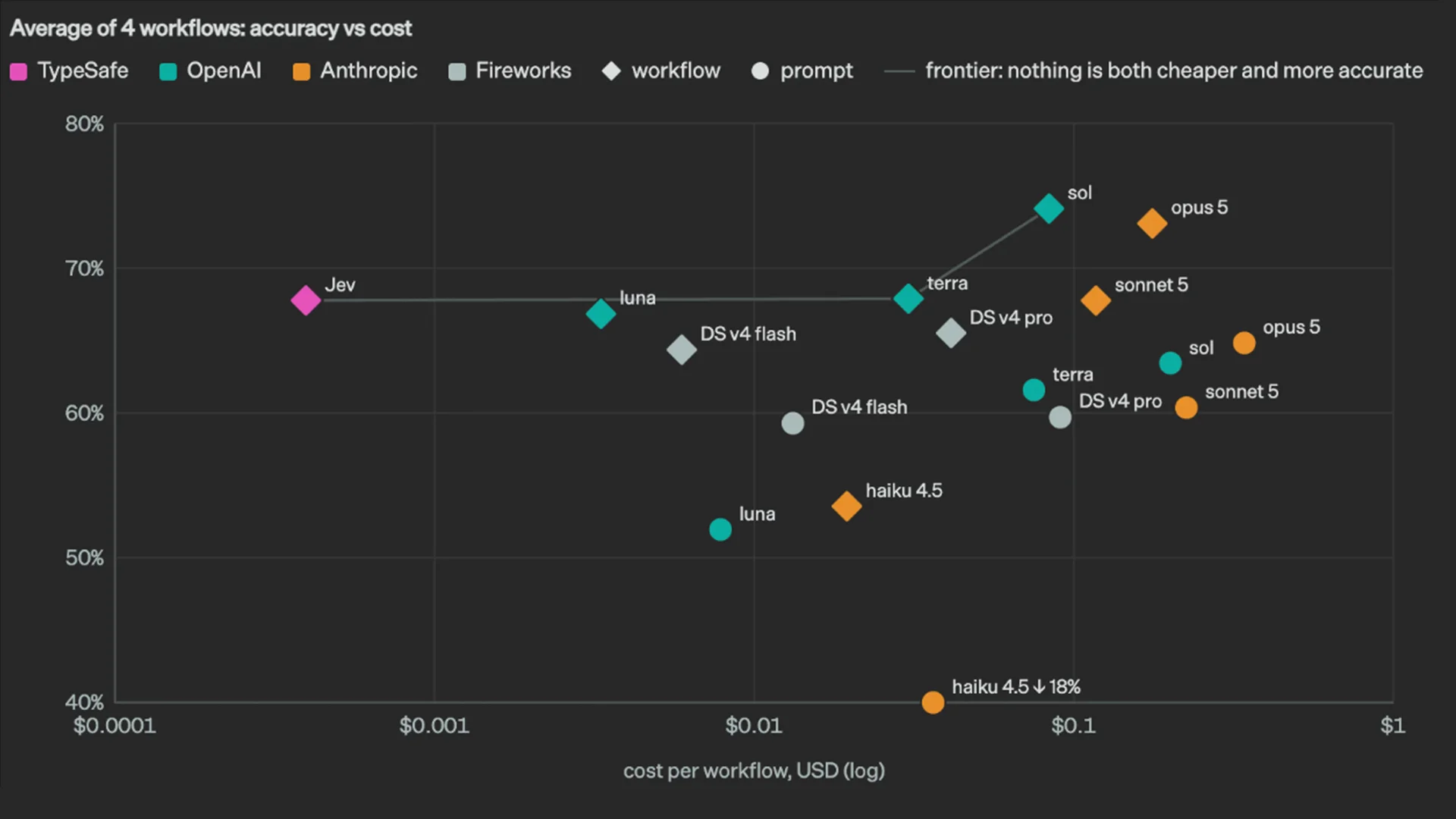
TypeSafe, the startup from former OpenAI researcher and ChatGPT contributor Diogo Almeida, announced early access to Jev on September 15. The AI model answers preset questions inside software.
As The Rundown reported, TypeSafe is pitching Jev for quick judgments such as sorting requests, scoring records and screening AI outputs for jailbreak attempts. Its bet is that fast, cheap answers can make these decisions a routine part of apps.
What Jev does
Jev handles three kinds of questions, according to TypeSafe's workflow evaluations. It can answer yes/no questions with probabilities, choose among defined options or score an input against a scale. For the choice and scoring formats, it also returns a confidence measure alongside the probabilities, according to its documentation.
TypeSafe says Jev “can’t hallucinate” because it only selects from allowed answers. That guarantee concerns the answer's format. A model can select an allowed option and still make the wrong judgment.
The reference answers in TypeSafe's evaluations average judgments from GPT-6 Astra and Claude Fable 5.1. Agreement with those models gives only a partial view of whether Jev makes correct decisions.
TypeSafe's price and speed claims
TypeSafe advertises a price of $0.042 per million input tokens, or $42 per billion, with free output.
The company compares that with Claude Fable 5.1, whose listed base input price is $10 per million tokens, about 238 times Jev's rate. Anthropic also offers cache and batch discounts. Total application costs depend on the workload and surrounding infrastructure.
TypeSafe also reports responses in 70 to 500 milliseconds and speedups of 40 to 200 times for structured decision queries. Its latency tests generally ran near its West Coast service. The company acknowledges that its method of getting probabilities from competing models adds time and cost to the comparison.
Why it matters
Jev's opportunity is to handle routine decisions inside apps. Almeida told Forbes, “Most intelligence should eventually live inside software, running quietly in the background.” If its speed and price hold while its judgments stay reliable, Jev is likely to become a standard component of software.
A support app, for example, could ask Jev to classify a request, then apply its own rules for routing and permissions. Another model could draft the reply. TypeSafe's example workflows include customer service, invoice handling, security alerts and reviews of completed AI agent runs.
The name is a nod to Jevons paradox, the idea that making a resource cheaper can lead people to consume more of it. At Jev's advertised rate, an app making one million calls with an average of 1,000 billable input tokens per call would spend $42, before infrastructure and review costs.
At that price, a developer could check each request as it arrives and review an AI agent's work before accepting the result. Those repeated decisions are where Jev's proposed economics could change how an app is built.
Confidence scores could give developers a way to control how much they automate. TypeSafe recommends automatic action for clear cases, confirmation or more information when confidence drops, and escalation for uncertain cases. The scores come from the returned probability distribution. Developers still need to test how often confident answers are correct and set conservative thresholds on their own data.
Response times under load and sustained pricing remain open questions. A developer weighing Jev will need to measure the whole workflow, including the people who review uncertain cases and the consequences of a wrong decision.
Sources & further reading
This story builds on reporting from The Rundown newsletter on September 16, 2026.