Salesforce introduces Koa while expanding its Claude partnership
Salesforce’s Koa brings CRM reasoning under its control, while Claudeforce connects its customers and workflows with Anthropic’s frontier AI models.
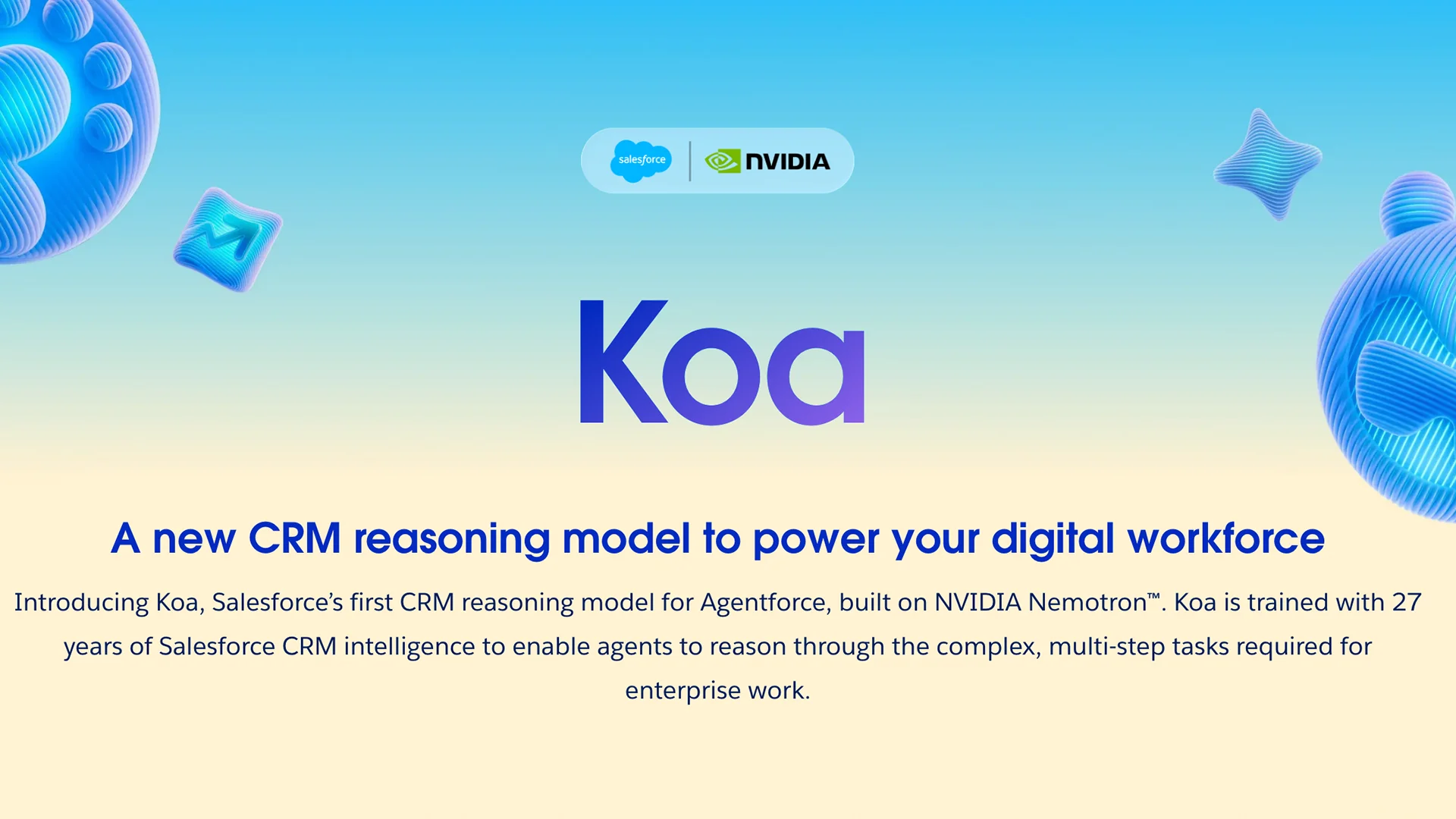
Salesforce introduced Koa on September 15, a reasoning model for its sales and support agents built on Nvidia’s open Nemotron 3 Super model. The company already runs Koa internally and is bringing it to selected customer pilots. It expects U.S. general availability in winter 2026.
As The Rundown reported, Koa arrives as Salesforce expands the ways customers can work through Claude. The company now acts as a customer, distribution partner, and competitor to frontier AI labs.
Trained for sales and support
Salesforce says it adapted Nemotron with synthetic business scenarios across more than 14 industries, without customer training data. Its technical report describes turning Agent Script workflow rules into simulated tasks and rewarding successful actions through software tools. The training targets work such as updating deals and routing support tickets.
During a live request, Koa can draw on the records and instructions customers make available, according to Salesforce’s documentation. Salesforce controls its version of the model and runs requests on its own systems.
Salesforce’s technical report gives Koa an average score of 0.86 on CRM Bench, its test of customer relationship management tasks. Claude Opus 4.8 scored 0.87 and GPT-5.5 scored 0.90 in that company evaluation.
More Salesforce work inside Claude
Salesforce also announced AIforce on September 15, opening its data, business logic, permissions, and actions to outside AI tools. The company says requests respect existing permissions and actions run through Salesforce.
The first Claudeforce experience, Salesforce in Claude, includes 37 prebuilt sales skills and was available to all customers in beta, according to the announcement.
Why it matters
By running Koa itself, Salesforce gains a way to keep recurring sales and support reasoning on a model it controls. If Koa completes those tasks reliably at a lower total cost, Salesforce could spend less on outside model capacity and gain a stronger position in negotiations with AI labs. It would also carry the cost of serving that work itself. The pilot rollout leaves open how much agent reasoning the company will ultimately bring onto Koa.
Salesforce is also a customer of the labs it now competes with. Its August 26 partnership announcement with Anthropic described the companies as strategic customers of each other. Claude powers Agentforce Coworker and Slackbot by default, giving Anthropic a direct role in Salesforce’s own products.
AIforce extends the distribution role. A salesperson can work through Claude while Salesforce governs access and carries out changes to CRM records. That could keep Salesforce central to daily work even when employees spend more time in another company’s interface. Anthropic gains business workflows, and Salesforce gains another way for customers to reach its software.
For sales and support teams, the practical test is whether Koa completes their workflows correctly. Salesforce’s documentation describes model selection by organization or agent, which could support trials on selected workflows as access expands. Teams can check deal updates, ticket routing, and handoffs for accuracy. They can also compare response time, total serving cost, and permission failures before assigning Koa more work.
Sources & further reading
- 01therundown.ai ↗
- 02Salesforce and NVIDIA Announce Koa - Salesforce ↗
- 03Salesforce Koa: An Enterprise Language Model for Agentic Tool Use ↗
- 04Salesforce Koa, built on Nvidia Nemotron | Salesforce ↗
- 05Salesforce Unveils the Future of Enterprise Software: AIforce - Salesforce ↗
- 06Salesforce and Anthropic Announce Claudeforce - Salesforce ↗
This story builds on reporting from The Rundown newsletter on September 16, 2026.