Reflection introduces Beam as a U.S. challenger to Chinese open models
Reflection’s Beam targets coding and agents, with open weights due in October. Its own tests show a gap to newer Chinese models despite efficiency claims.
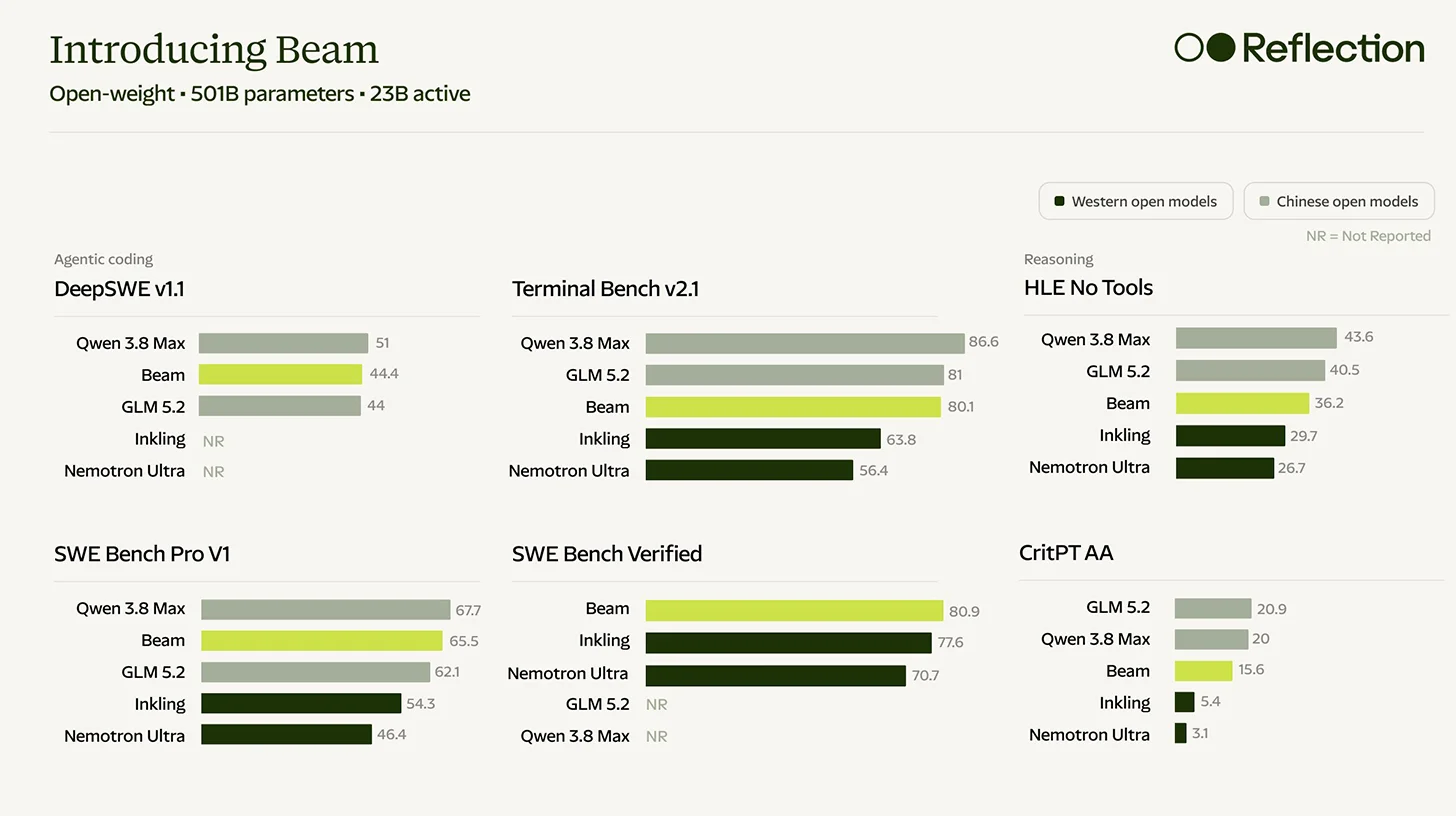
Reflection AI introduced Beam on October 5, a model for coding and AI agents with public weights planned for later this month. The launch, covered in The Rundown, gives the U.S. startup its first model to challenge Chinese rivals in open AI.
Reflection says Beam needs far less compute than Z.ai’s GLM-5.2 while delivering similar results on some tasks. Its published tests also show a gap to newer Chinese models, including GLM-5.3 and Moonshot’s Kimi K3.
What Beam offers
The New York company was founded in 2024 by former DeepMind researchers. It confirmed a funding round in June at a $25 billion valuation before the new investment, Semafor reported.
Beam has 501 billion parameters, with 23 billion active at a time, according to Reflection. The company offers restricted early access and promises public weights, documentation and an Apache 2.0 license later in October. That would let companies customize Beam and run it themselves.
On Terminal Bench v2.1, Reflection reports scores of 80.1 for Beam and 81.0 for GLM-5.2. Its table puts GLM-5.3 at 88.2 and Kimi K3 at 88.3. On HLE without tools, Beam scores 36.2, compared with 42.3 for GLM-5.3 and 46.9 for Kimi K3 in the same table.
The company claims a threefold to fourfold reduction in estimated compute to generate answers compared with GLM-5.2. That estimate excludes initial prompt processing, attention costs tied to context length and the overhead of serving the model.
The longer plan is AI factories where companies or governments run Reflection models on their own infrastructure and private data. Reflection and Shinsegae announced a memorandum of understanding in March for a planned 250MW facility in South Korea with Nvidia GPUs. The facility’s operating status and any Beam deployment remain unclear.
Why it matters
Investors have called Reflection the “DeepSeek of the West,” according to The Wall Street Journal. Beam adds to a limited field of U.S. open models. Reflection’s own tests still put newer Chinese rivals ahead, leaving a clear gap between the expectations around the company and its first model’s reported performance.
GLM-5.2’s role in the pitch is the clearest reason for caution. Z.ai had already followed it with GLM-5.3, which it says improves coding and longer tasks through further training of the same base model. Reflection includes GLM-5.3 in its table, while its efficiency pitch centers on the older GLM-5.2. The successor’s higher scores show that approaching GLM-5.2 on some tasks still leaves Beam behind the newer generation.
For customers seeking a U.S. supplier, another option can matter even if it trails the leading models. Semafor reports that Reflection is targeting buyers unwilling or unable to run Chinese systems. Public weights and the promised license could let those buyers adapt Beam and run it with private data on infrastructure they control. Running it themselves would also bring responsibility for the hardware and systems around the model. Reflection’s factory strategy could help address that need if the company delivers working infrastructure.
The efficiency claim could make that tradeoff more attractive. Buyers still need to compare cost per successfully completed task, response times and retry rates under the same conditions. Extra attempts to finish a coding job could raise the total cost, while the costs excluded from Reflection’s estimate would also affect the bill. Independent testing on real workloads would show whether the claimed compute savings translate into lower operating costs.
Sources & further reading
- 01therundown.ai ↗
- 02Introducing Beam: Reflection’s 501B open-weight model — Reflection ↗
- 03Reflection AI unveils its first model, Beam, an open-source answer to Chinese labs | Semafor ↗
- 04Reflection and Shinsegae Group to Build Korean Sovereign AI Factory ↗
- 05www.wsj.com ↗
- 06zai-org/GLM-5.3 · Hugging Face ↗
This story builds on reporting from The Rundown newsletter on October 6, 2026.