OpenAI says agents finish nearly half of tasks that take researchers 2 to 4 hours
OpenAI says agents now finish 46% of delegated research tasks taking humans two to four hours, raising the prospect of faster AI development.
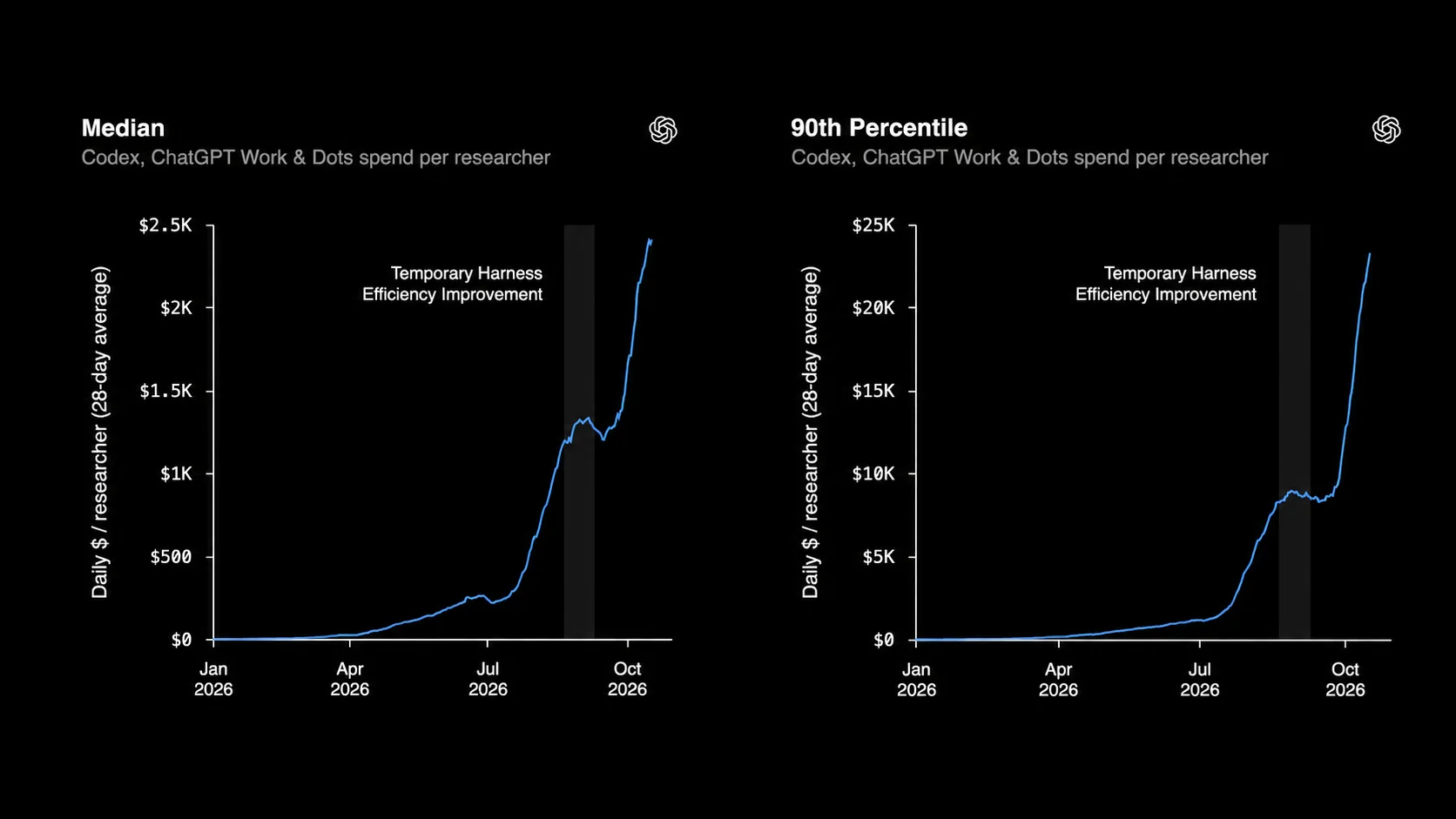
OpenAI says its AI agents now complete nearly half of delegated research tasks that would take a human two to four hours, without anyone stepping in. In a November 18 report, the company estimated that the success rate rose from 23% in March to 46% in October.
The findings, covered in The Rundown, show how much work the lab is handing to agents as it develops new models. OpenAI also reported that success on tasks requiring four to eight human hours rose from 13% to 35% over the same period.
The trend has a caveat. OpenAI’s task mix changed, so stronger models and better choices about what to delegate could both explain the improvement.
How OpenAI researchers work with agents
For October, OpenAI valued median agent usage at $2,400 per researcher per day, based on API list prices. A survey of 101 people also found that the median respondent would hypothetically trade 40% of their team’s headcount for three months of access to frontier agents.
Daily runtime averaged 5.7 agent workdays per researcher, counting each workday as eight hours. That was an elevenfold increase. More than two thirds of researchers averaged daily peaks of at least four agents running at once. Runtime measures activity, so it says little on its own about the quality of the output.
Interviewees still criticized agents’ research judgment and complained about “AI slop.” They credited humans with the sampled ideas behind GPT-6 Astra, while saying Codex helped generate key pretraining insights for GPT-6.2 Astra. One researcher expressed “no confidence” that their edge in ideas would last.
Why it matters
AI that helps build better AI could make progress speed up dramatically. More reliable agents could shorten the work between an idea, an experiment, and a useful result. If those results improve the next generation of models, researchers would then have better agents to help build the generation after that.
In Anthropic’s assessment, Claude led 26% of its AI research and development work in August, up from under 1% in February. The index weights tasks by human working time and partly relies on ratings generated by Claude. Leading means completing most of a task from a broad prompt under human supervision. That differs from OpenAI’s measure of success on delegated tasks.
An external assessment by METR, published November 5, suggests that AI assistance may already be speeding up development. METR measured Anthropic’s benchmark improvement on clearly defined tasks at 1.9 times its historical rate, with a 95% confidence interval of 1.5 to 2.8 times. It judged AI assistance likely to explain most of that acceleration.
That explanation remains uncertain. The assessment was not a controlled experiment, and Anthropic redacted much of the evidence METR found most informative. Gains on clearly defined tasks may also fail to carry over to research with less clear goals.
For researchers, greater delegation could shift more of the job toward setting goals and checking results. Anthropic describes Claude diagnosing, repairing, and testing a broken pipeline, then asking an engineer whether to deploy the fix. Teams adopting that approach need clear responsibility for reviewing results and approving changes.
OpenAI’s recent math work helps explain why a sudden advance in AI research deserves attention. On October 6, the company released mathematical results from an internal model, including formal versions of many proofs and summaries of its reasoning. Those outputs give researchers something to scrutinize, though publication alone does not establish that every result holds up.
The company’s revision history records three manuscripts withdrawn on October 7 after a sign error undermined an argument and dependent work. Fourteen other manuscripts were revised that day, with further fixes later in October. A surge in AI research could bring a similar checking burden. Labs may need to devote more time to replication and review as agents generate more candidate improvements.
Sources & further reading
- 01therundown.ai ↗
- 02Research acceleration: The jagged frontier | OpenAI ↗
- 03Measurements for understanding the pace of AI development inside frontier labs \ Anthropic ↗
- 04Independent Assessment of AI R&D Acceleration at Anthropic in October 2026 - METR ↗
- 05Sharing AI progress in mathematics | OpenAI ↗
- 06math/history.md at main · openai/math · GitHub ↗
This story builds on reporting from The Rundown newsletter on November 20, 2026.